
I played the game “Cube Escape: Paradox” made by a Dutch studio Rusty Lake. The founders of the studio are Robin Raas and Maarten Loise. The game is meant to be played by people who are 16+ with an audience focusing on those who enjoy puzzles/logic games, mystery, and indie styles. It is a single-player game (1 player maximum and minimum), so I played this game by myself (1 player) on Steam. Overall, “Cube Escape: Paradox” engages players through a controlled architecture and multimodal clues, but issues with repetitions and accessibility can make the game frustrating.
This game engaged me by interconnected clues that constantly revealed new information about the environment. Specifically, I remember thinking how Fig 1 is “Such a unique and helpful clue!” This game is an enacting narrative as players use mechanics like solving puzzles, clicking through objects to find clues, and using tools to discover the key moments. Along with discovery, there are a variety of dynamics including pattern recognition and problem solving causing people to revisit rooms and uncover key connections. This shows an embedded narrative as people make guesses about how clues found in the environment relate and progress the narrative.
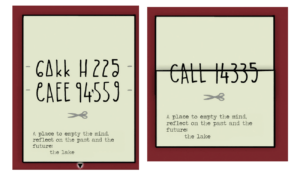
Fig 1: It was engaging how cutting and folding this paper reveals the number to call.
The formal elements guide the primary architecture which controls when and how the story unfolds. Specifically, the game is in a tightly defined space, has strict rules, and has limited player agency with one goal (to escape). These elements act as a constraint which limits where players can go, forcing controlled progression. This is reflected in reactions like “clues are scattered everywhere, especially in places I least expected 5 minutes ago” (Fig 2). By concealing clues in drawers and paintings and having puzzles as obstacles, the game leads to exploration through a controlled sequence of actions. This influences discovery and challenge as players uncover the narrative in a controlled environment.
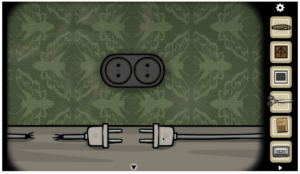
Fig 2: This plug at the bottom of the room seemed meaningless, but clicking it revealed how it is broken and could be significant.
Secondary architecture also shapes the aesthetic experience and emotions/interpretations of the story. The room seems like a familiar detective setting but is disrupted by surrealism through unfamiliar audio and moving objects. This leads to reactions like “I didn’t expect the painting to have new objects appearing. Maybe it’s important” (Fig 3). This along with a dark atmosphere leads to sensations of unease/tension and fantasy as reality is distorted. Thus, the secondary architecture controls how the narrative is delivered/understood.

Fig 3: I thought the woman appearing in the image meant that she had an important role
“Cube Escape: Paradox” stands out from similar games like “Escape Simulator” and “Can You Escape” by using multimodal clues, including visual (movies), tangible (drawing), and audio (tapes). Because of this, I had reactions like “I feel like I understand who this character is now after listening and watching him.” By engaging all the senses, a better narrative and more sensation/immersion is created.
This multimodality leads to a key issue in “Cube Escape: Paradox” as it is difficult to connect clues through distance and time. This happened to me when looking at a painting as I thought “I really don’t know where these roman numerals could lead me” (Fig 4). This confusion can cause players to struggle or give up. To achieve better pattern recognition and cross modality connection, there can be directional clues or hints through key words/images. This leads to clearer discovery and a stronger narrative as connections are more straightforward instead of confusing/lacking direction.
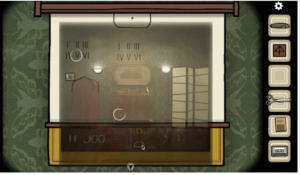
Fig 4: First, it was hard to identify which Roman Numerals were being circled. I then didn’t know where to go from here as I forgot which object had these symbols.
Another issue is that the game feels repetitive because of the fact that players revisit the same room without indication of progress. I certainly felt this, thinking “being in the same room over and over game feels aimless and suffocating” (Fig 5). Overall, revisiting spaces without visible changes can make interaction feel like meaningless trial-and-error instead of advancement. To fix this, related puzzles should be grouped better and feedback should be provided by fading out completed puzzles or showing the day’s progression through lighting. As a result, exploration will feel more meaningful and the players will feel challenged without being frustrated.
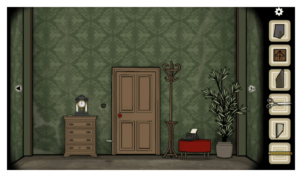
Fig 5: I clicked on various parts of the room, but most were either locked or led nowhere. I was not sure how to proceed.
There are minimal accessibility features in “Cube Escape: Paradox”. Specifically, all auditory hints also have text subtitles. Additionally, by analyzing forums, many players appreciate the simple point and click interface and lack of time limits lower the barrier to entry as interaction is straightforward. Lastly, none of the puzzles rely on colors providing accessibility for those with color blindness. This leads to self-paced and accessible exploration which leads to challenge without stress/pressure.
Despite this, there are several accessibility barriers. The game relies on connecting clues from many different types of puzzles which is difficult for older players with memory impairments. The game’s dark color palette also makes it hard for players with low vision to see objects. Additionally, text clues are not translated to audio, making the game hard for hard-of-hearing players. Since there is no way to adjust accessibility settings, the only way to learn more about the game is through watching a walkthrough tutorial which hinders the exploration and discovery of the game. Relying on tutorials pulls these players outside of the game’s magic circle, weakening immersion and the game’s experience.