What Remains of Edith Finch (What Remains) is a first-person narrative game developed by Giant Sparrow and published by Annapurna Interactive. First released in 2017 for various consoles such as the Playstation and Xbox, I played it on my Windows Laptop, downloaded from Steam. It’s a single-player game meant for new players and general gamers interested in narrative experiences.
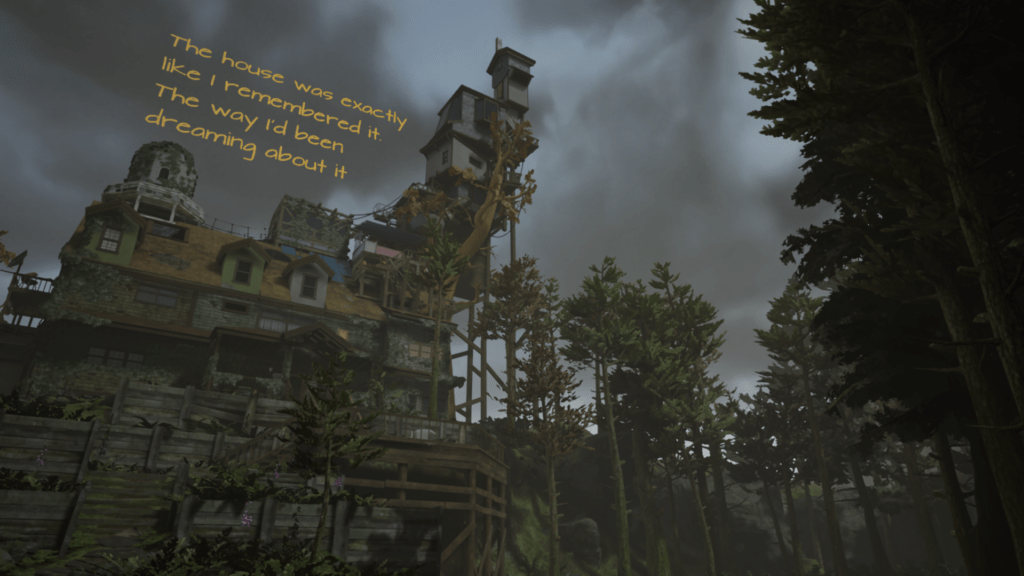
What Remains is about Edith Finch returning to her freaky family’s house after many years and discovering the stories of how the rest of her family passed away. As a first person game, you (Edith) explore the house, walking around recounting memories to yourself before discovering various “shrine-like” areas, each dedicated to a member of the family, and jumping into their point of view in their moments before death. The game has a melancholy, bittersweet feeling, made more prominent by the music, Edith’s slightly-sad voice, and her thoughts laid out in text that often blows into the wind in its fragility (see fig. 1).
While the game is a “walking sim” primarily focused on the types of fun of discovery and narrative, there’s a surprising third factor that ties into the telling of the story: fun as engaging the senses. I felt that What Remains was a highly experiential narrative, supported by two main factors: movement mechanics and POV shifts.
Firstly, the movement mechanics. They seem extremely simple; WASD to move, left click to interact. What Remains never tells you what buttons to press, only sometimes prompting you what object to interact with, resulting in an especially “immersive” feeling that isn’t broken by floating text giving you instructions. One example of this is turning the handle of a music box. After being prompted by a small glowing bubble, I clicked on it and at first was confused when the handle wouldn’t move after further clicking. Then, I hit the arrow keys and realized that the handle moved in the corresponding direction of the keys, giving a “realistic” sensation to turning the handle on the music box! Not only does it serve to immerse you in the game, I actually think this system is great for beginner gamers, as from my observations, gamers not too familiar with traditional controls tend to translate real life actions into games, which doesn’t always work.
The traditional mechanics of video games are usually “shortcuts”, or altered representations of what it means to do something in real life. In Valorant for example, you click to shoot the gun, click control (or shift, I forgor) to crouch, shift (or control) to sprint, etc. These are quick representations of actions that may not necessarily be intuitive for someone playing a game for the first time. However, due to limitations of a keyboard and the speed of the game, these shortcuts are needed for the game to be fun (you wouldn’t want a deep, experiential process for reloading the gun in Valorant). However, since What Remains is a simple game with simple mechanics and no time limit, they can afford to slow it down and have that element boost that experiential narrative feeling. What’s funny is that this actually tripped me up initially as someone who plays more “advanced” games!
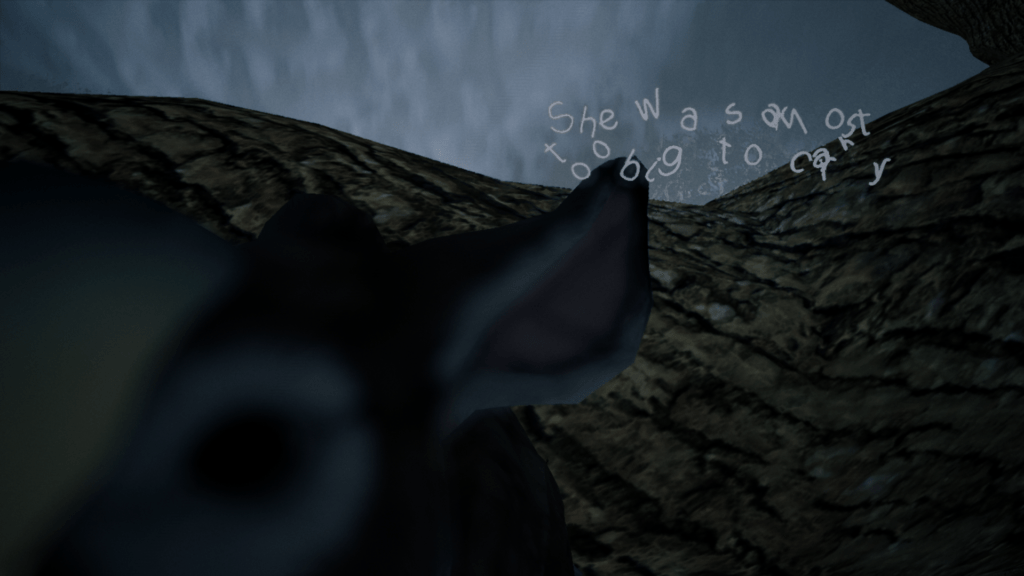
Another example of this experiential storytelling is through the POV shifts. I felt that the game was following the classic quote “show, don’t tell”, but in game form. Many other games with a similar tone have many textboxes, and you as a player must go around reading them to get to the truth (like the game We Know the Devil). What Remains cuts straight to the heart of the matter and just brings you fully into each narrative by just making you the effected character. The first POV you get brought into is Molly’s, who died several decades earlier. During her sequence, she transforms into several animals: a cat, an owl, a shark, and a snake. This relates back to the simple yet impactful movement mechanics as in each sequence, the controls change slightly to better reflect the animal she transforms into. As an owl you can swoop down, vicariously feeling the speed in your feathers (see fig. 2), and as a cat you’re nimble and can jump around. These choices make you feel like you’re experiencing those things in the game and gives the overall narrative more weight by transforming the absurd into something that could have physically happened.
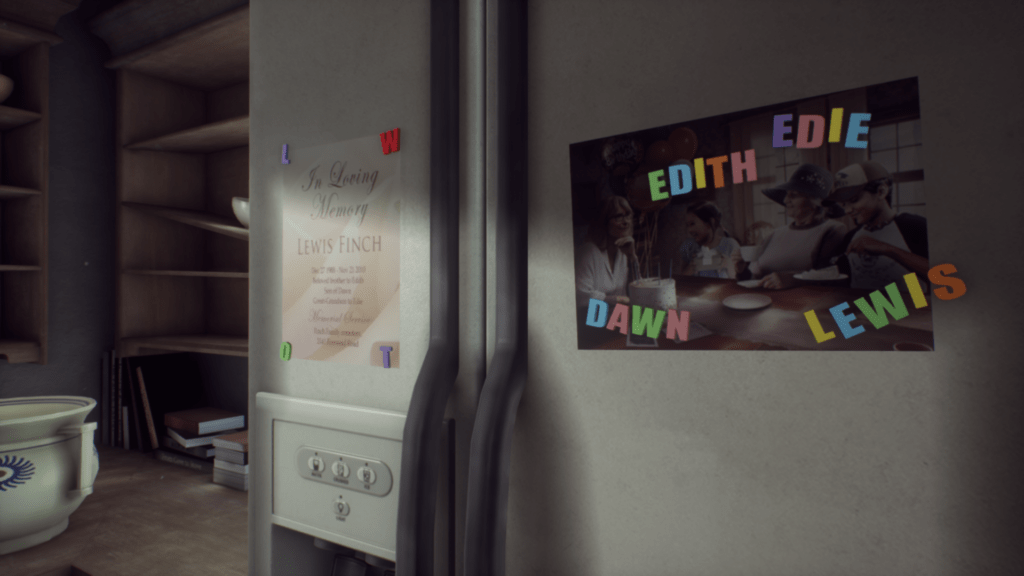
What Remains is an embedded story because you’re able to piece together what you think happened from various pieces of information given to you throughout the gameplay; not just from the story sequences but also from the environmental artifacts that hint you toward an assumption of reality (see fig. 3). You could also argue What Remains is an enacting story because as the last remaining member of the family, you are inherently extending the storyline of the Finches, though I believe that rhetorically Edith is mostly just a viewpoint for the player’s puzzling together the story.
Violence is a crucial part of What Remains’ story as it’s about how all of Edith’s family died, and yet it doesn’t feel gratuitous. The violence that is shown on screen has a clear narrative purpose. In Molly’s story, she’s violent toward animals and later humans, but any violence shown isn’t especially graphic, but just enough to get the message across. The violence may have been there to showcase her own sudden death, or imply an abusive relationship with her parents. The violence supports the narrative and is treated respectfully. Alternatively, other violent games I’ve played like Valorant often have killing as the main objective. For those games, the goal is to give you a feeling of achievement, and violence is simultaneously the main point and the method for those feelings, leading you to be more apathetic about such acts.