Developer: The Chinese Room (Dan Pinchbeck, Jessica Curry)
Publisher: Sony Computer Entertainment
Platform: PlayStation 4, Windows, Linux, Mac
Release: 2015
SPOILERS FOR THE LAST OF US PART II IN THE ETHICS SECTION (YOU HAVE BEEN WARNED)
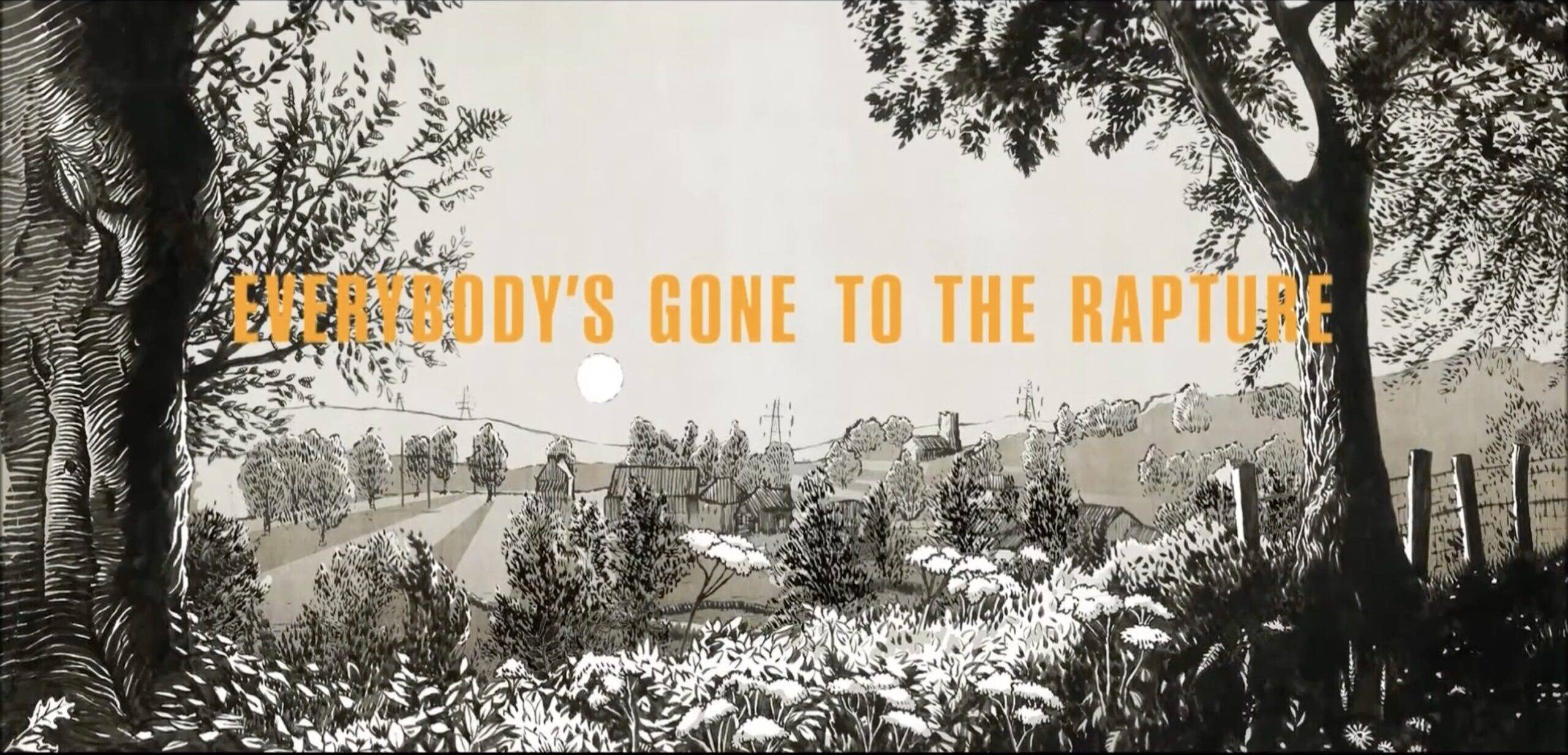
The opening sequence starts you on a scenic viewpoint overlooking the English village of Yaughton. The camera lingers on rolling hills, maybe a small chapel or inn surrounded by clustered cottages in the distance. Then the score begins—an angelic, almost otherworldly swell of strings and vocals—purposeful storytelling it evoked in me almost a melancholy hope, a memory-like feeling I had chills. The game hadn’t asked me to do anything yet. I hadn’t moved, hadn’t pressed a button. It was already telling me something: this story will not be about what you do. It will be about what you feel.

As the opening score resolves, the strings fade and natural sounds fade in. You hear birds, wind, the distant hum of a radio broadcast drifting from somewhere. I followed the sound. The closer I walked, the clearer the broadcast became: a looping message about something having gone wrong at the local observatory, residents advised to stay indoors. My immediate question, as I stood listening to a message meant for people who weren’t there, was simple: why am I the only person? So I had two mysteries immediately to solve.
The title had already set my expectations. “Everybody’s Gone to the Rapture” evokes two things simultaneously: a religious end-times (the rapture) and a joyful escape (a rapture of delight). I didn’t know which one the game meant. But that opening sequence—the angelic score, the empty viewpoint, the haunting radio broadcast—suggested both. Something beautiful had happened here…or something terrible had happened here…and walking was the only way to find out which.
This is how walking tells the story in Rapture. Not through cutscenes or dialogue trees, but through pacing and atmosphere and the slow accumulation of detail. Henry Jenkins argues that game designers are not storytellers but narrative architects who design worlds ripe with narrative possibility. Rapture is a good example of what Jenkins calls embedded narrative—the story is not told to you; it is waiting for you in the environment, embedded in the objects, spaces, and sounds of Yaughton. The radio broadcast is not exposition. It is a piece of debris from a shattered world, and walking toward it is your first act of archaeological recovery. This game designed multimodal narrative styles—examples of emergent narrative naturally pop up from scenes abruptly left behind, frozen stories that never get explained with the golden orbs of light you do interact with.

The game could have started with a cutscene explaining the observatory incident. It could have given me a journal to read. Instead, it gave me a hill, a view, and a distant radio signal. I had to choose to walk toward it. That choice—small as it seems—made the discovery mine. Nicole Clark, in her defense of walking simulators, notes that critics see these games as subtractive, missing combat, missing puzzles, missing fail states. But Rapture is additive. It adds something that violent games often leave out: time to sit with mystery, to wonder without acting, to feel the weight of absence before you understand what caused it.
Compared to other walking sims, Rapture is unusually spacious, the developers drop you into an entire village and trusts you to explore. This is both a strength and a weakness. The freedom is exhilarating—I can see myself spending hours just looking at all the unexplained visuals—but the game’s slow walking speed can feel “punishing” when you realize you’ve gone the wrong way. I understand why players complained in the reviews (before “running” patch) but I liked walking! The slow walk forced me to notice details: a child’s toy on a doorstep, a half-drunk cup of tea, the way light falls through a church window. If I had chosen to run, would I have seen them?
Walking tells the story in Everybody’s Gone to the Rapture by giving you time to notice, space to wonder, and the freedom to discover fragments in any order. The opening sequence taught me that I was not a hero arriving to solve a mystery. I was a witness arriving too late. And all I could do was walk.
(FINAL WARNING FOR THE LAST OF US PART II SPOILERS)
In The Last of Us Part II, there’s an unskippable cutscene where Ellie beats a Nora’s face in with a pipe. She hates this woman (maybe you do to), blames her for taking part in Joel’s untimely death, brutal murder. You don’t just watch—you press the button again and again. The game forces you to perform the violence. It’s brutal, uncomfortable, and narratively essential. Violence in that game serves a purpose: to make you feel the weight of revenge, not just understand it intellectually.
Everybody’s Gone to the Rapture chooses differently. No violence. No button-mashing. Just walking. That doesn’t make it better or worse—just different. Violence can serve narrative when used intentionally. But it doesn’t need to be in every game. Walking sims prove that sometimes, the most powerful story is the one you discover by doing nothing at all.