

I played a game called Stop Disasters! and was created by the United Nations Office for Disaster Risk Reduction. This game is about creating a risk map and creating countermeasures when dealing with natural disasters (Like tsunamis).
I would say that the primary type of play this game uses is Challenge. This game has a variety of different difficulty levels, and on the higher levels the constraints are much more defined (Less money, more people, less time to prepare, etc). A lot of the play aspect is coming from the budget given to help protect/reorganize the towns in the game. To me personally, I didn’t really see the other kinds of play present here. I suppose there is some degree of Fantasy as well though, as NPCs refer to the player as a risk assessor/planner, but it felt more like the premise than it did a main part of the player experience.

If we look at this game through the MDAO framework, we can start with the outcome. Luckily, the United Nations gave us their intended outcome of this game, which is to help educate children on the risks of these kinds of disasters. I think this came across in the design of the game, it was full of bright colors, and simple art and mechanics, but more on that later. Aesthetically I think the player is meant to feel somewhat “sobered” by the amount of destruction that will occur in these disasters. As the wave hit the town, the game displays icons indicating all of the people killed in the disaster.
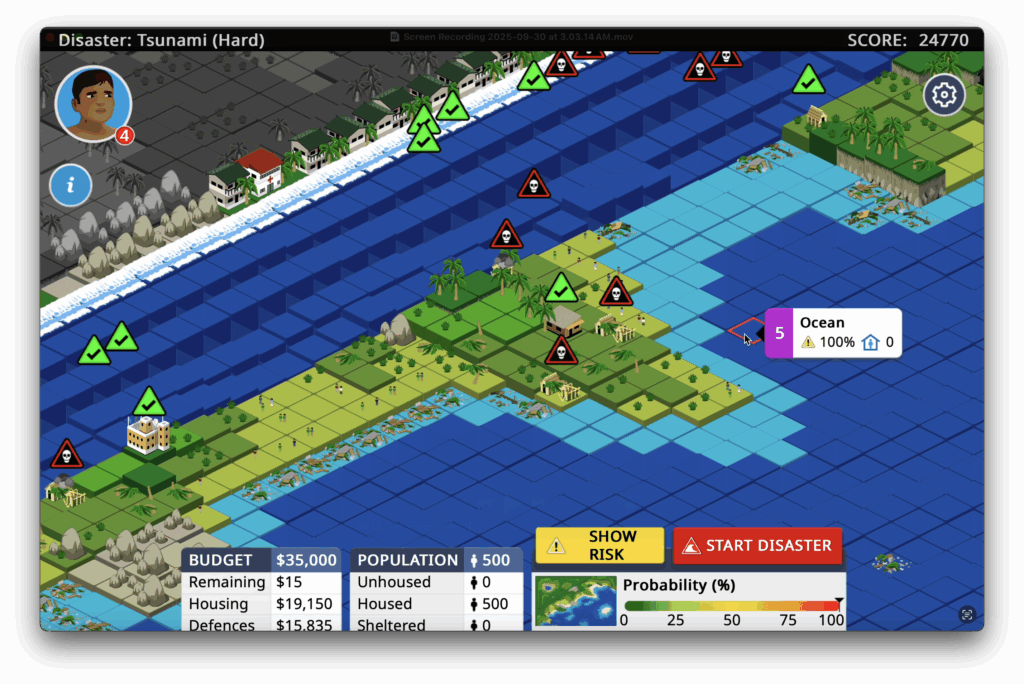
Even on the easiest difficulty and after spending all the money possessed, people will die, which I think really helps to emphasize the learning. Specifically, this reinforces the fact that these disasters can’t be dealt with pre-emptively, and are dangerous no matter what. I do think that the mechanics of this game are kind of easy to manipulate, leading to dynamics that are probably a bit at odds with the desired outcome. When I was playing, I quickly realized that I should just put every single structure as far from the coast as possible very high up on the land. This was easy to do in the game, but obviously wouldn’t be very practical in reality. (Note the hotels and hospitals towards the edge of the colored area of the map)
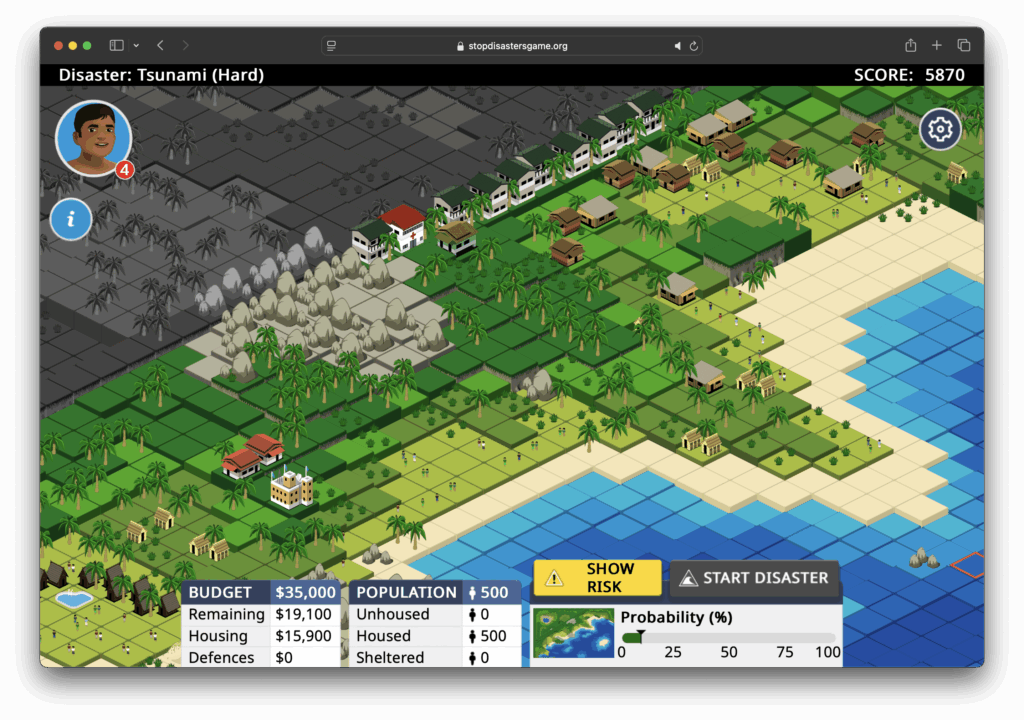
Overall, I’d say that the game would be very at home (and welcome!) in a classroom environment, especially with younger students (like middle school aged). The clean art style and tile based approach are intuitive, and features like the risk map take some of the guess work out of the game. I never found myself having to guess what counted as safe since the game helps to show you. I think this would also be great in a school environment, since there would probably be more time limitations on play. I really appreciate the different levels and environments in this game too. Mechanics like difficulty selection allow for players to revisit the game and play more of it, challenging themselves further. This game in particular I could definitely see as being one of those games people play during class because it’s not blocked on the school wifi. It’s quick, easy to understand, and gets the point across.


