Question #1
Game: Uno, the cards game
Actions: Dealing cards, drawing cards, putting down valid cards by matching color/number/symbol, putting down action cards (Skip, Reverse, +2, Wild, Wild +4), calling “Uno” when down to one card.
Goals: Be the first player to get rid of all cards in your hand
Rules:
- The first player places a card face up in the middle to start the discard pile
- Each turn, players must play a card face up matching the top card’s color or number, or use a special card (Reverse, Skip, +2, +4, Wild)
- Reverse: Switches play direction
- Skip: The next player loses their turn
- +2: The next player draws two cards and skips turns (cannot be stacked)
- +4 Wild: The next player draws four cards and skips turns (cannot be stacked)
- If there is no valid card, the player must draw from the pile
- A player with one card must say “UNO,” or draw a penalty card if caught
- The round ends when a player plays all their cards
Objects: The Uno deck (108 cards including number cards, action cards, wild cards), a discard pile, and a draw pile.
Playspace: Anywhere with a surface to put down cards such as a table or floor. The cards space involves the discard pile (active cards), players’ hands, and draw pile.
Players: 2-10 players (Uno Party supports 6-14 players)
Question #2
I would swap one rule in Uno “Players must put down a card face up in the discard pile” with the rule in the card game Bullshit (BS) “Players must put down a card face down in the discard pile. If a player suspects a player is lying about their playing card, they have to call “BS” to call the player out.”
The play experience in Uno would change since now, players never know if other players are putting down valid (matching) cards with the correct color or number. This implies several additional changes. For one, players will have to learn how to lie and detect others lying; however, the likelihood of calling out a player with “BS” is significantly less likely than in the actual game BS since each Uno player will have a slightly greater than ¼ chance of putting down a valid card. Second, since players put cards face down, they may not get much of an advantage when putting down special cards such as +2 or +4. The only advantage would be if another player calls out BS on the current player, only to reveal a special card that would apply to the player who called out BS. In short, this would make the game significantly less engaging due to less frequent application of special cards.
The play experience in BS would also change. If players put down cards face up, this defeats the whole purpose of the game—the winner of the game would be based purely on luck of the initial cards each player was dealt as well as the cards they draw from the draw pile. This would also make for a significantly less engaging game.
Question #3
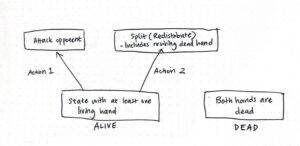
Chopsticks is a simple hand game where players use their fingers to represent numbers and attack their opponent’s hands by adding fingers to them. The ultimate goal is to reach the opponent’s hands’ all five fingers to make them lose.
The space of possibility is pretty limited due to the number of fingers we have on each hand (5), the strict rules of positive addition, and only two main actions possible from any state. See the states diagram below.
Question #4
Real time game: Bakery Story (mobile app game)
Initial state:
- Empty bakery with starter counters, oven, and one recipe unlocked
- Player has limited coins and gems
Game log:
- Player selects an oven and selects a recipe (brownies)
- 5 minute timer starts -> brownies are baking
- Player decorates the bakery (adds a new table in exchange for coins)
- Brownies finish -> player clicks on them to serve them to counter for customers to eat
- Customers arrive, eat food, and leave coins
- Player collects coins, reinvests in new decor/recipes
- Player visits neighbor’s bakery, tips them
- Day ends with bakery earning coins
Space of possibility:
Compared to turn-based games like Halli Galli, Bakery Story has a broad space of possibility since players can select a wide range of actions at any given time. For example, key elements include the timer, design choices (interior design of bakery, complexity of recipes chosen), and resource management (managing bakery inventory, coins, gems, baked goods). At any moment, the player can decorate, collect coins, cook, expand, or socialize. Of course, there are still rules with realistic limitations—players can’t cook another item in the same oven while in use, players can’t purchase furniture if they don’t have enough coins etc. Note that the space evolves continuously with real-time timers—recipes finish whether the player is active or not, simulating a realistic bakery environment.
How basic elements interact:
The following elements intertwine over time as rules (recipe timer, timer expiration, exchange of coins etc) create real-time pressure and pacing. In particular, the rules are realistic limitations such as baked goods expiring on an oven if not taken out for too long, not being able to purchase goods that are beyond current coins/gems budget, not being able to cook a new item on an oven if it’s currently in use. The goal is also realistic of a real-life bakery: the player should grow the bakery, unlock new recipes, and maximize profits to reinvest or save.
- Players: single player with optional social neighbors
- Actions: bake, serve, decorate (buy furniture/decorations), collect coins, tip other players’ bakeries
- Goals: grow and decorate bakery, unlock new recipes, maximize profits
- Rules: recipes have timers and expire if left in the oven for too long, recipes require a certain amount of coins, customer satisfaction
- Objects: ovens, counters, cashier, tables, chairs, interior decor, coins, gems, food
- Playspace: the bakery grid and social network of neighbors’ bakeries
Turn-based game: Halli Galli (card game)
Game log:
- Player A flips top card -> 2 bananas
- Player B flips -> 3 bananas
- Player C flips -> 2 strawberries
- Player D flips -> 2 bananas -> now 5 bananas total
- All players rush to hit the bell -> Player C hits first
- Player C collects all face-up cards
- Play continues with next flips
- Eventually, as the game continues, one player loses all cards and is eliminated
- The last player with cards wins
Space of possibility:
Compared to real-time games such as Bakery Story, Halli Galli has a more focused or limited space of possibility since a player can only play on their turn and can only choose two key actions (flip a card from top of your deck and the possibility of hitting the bell).
How basic elements interact:
In Halli Galli, turn order structures the game with each player flipping a card during their turn. The goal of the game is collect all cards and outlast others, eliminating all other players. The rules are based on addition—if matching fruits appear that add up to 5 of the same fruit, all players must try to hit the bell first in order to collect all cards on the table. While the actions, goals, and rules of the game are pretty limited, the bell creates a sense of high pressure in key moments, making the game engaging.
- Players: 2-6, each with a stack of face-down cardsActions: flip card, hit bell when 5 matching fruits appear
- Goals: collect all cards and outlast others
- Rules: must flip in order, bell only valid on exactly 5
- Objects: fruit cards, bell
- Playspace: central flat surface (e.g. table) with bell and face-up piles