

This week, I played Monument Valley, a visually stunning and narrative-rich puzzle game developed by ustwo games for iOS and Android. The game is designed for all ages but is especially popular among puzzle enthusiasts, story-driven players, and mobile-first users seeking casual, low-pressure gameplay on-the-go.
The core puzzle mechanic is perspective manipulation. Players guide Princess Ida through impossible geometry by rotating platforms, sliding pathways, and reframing the perspective of structures to create new routes where none existed previously. Built in an isometric space, there is just one rule: if two paths look like they’re connected, they are connected, even if the path defies real-world physics.

This mechanic evokes a gentler kind of fun rooted in discovery, sensation, and narrative. The methods of manipulating the environment are quite subtle, and it encourages players to reinterpret the space using visual logic and spatial reasoning rather than time pressure or brute-force problem solving. The lack of failure states also reinforces the game’s calm, meditative quality. Each level introduces a new mechanic and gives space to explore it, resulting in the kind of “aha” moments essential to good puzzle design. Its puzzles are also seamlessly integrated in the world’s design, adhering to the idea that puzzles should feel “natural to the environment”, as described in this week’s readings.

Monument Valley also weaves a compelling narrative through its architecture and mechanics, making it so players aren’t just solving puzzles but participating in Ida’s emotional journey. Some mechanics include interactions with ghostly figures that pass on cryptic dialogue, crow people that block roads, and fragmented ruins that hint at a world that’s been damaged. These narrative elements are not explained outright but are embedded in the spaces you move through.
One notable moment in the game is when Ida is guided to a room filled with coffins. Ida bows and places a flower in front of one coffin, but there’s no text telling the player exactly what just happened. There is, however, a sense of apology that is conveyed, subtly hinting that Ida’s journey may be one of atonement for disrupting the world.

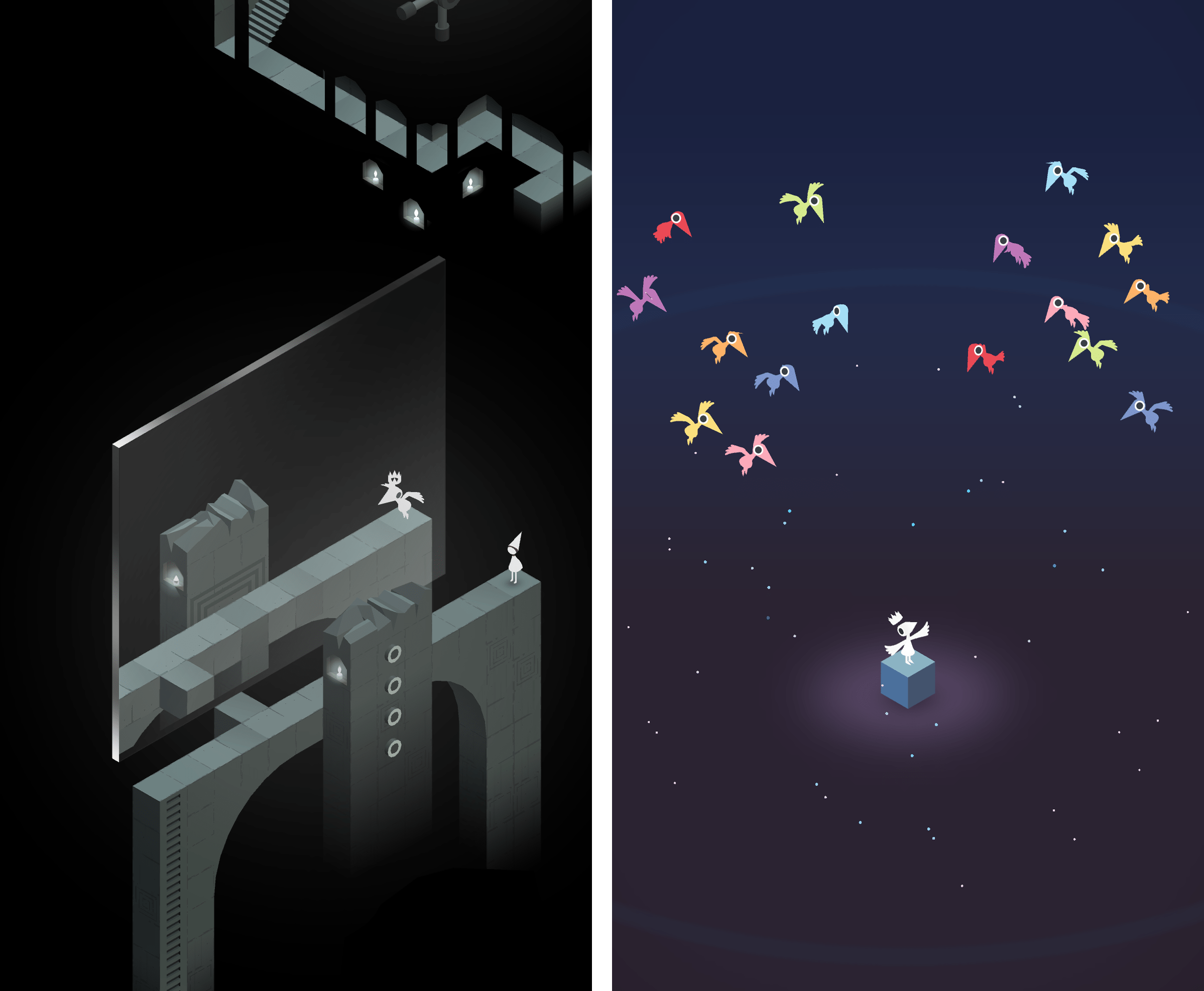
Another interesting mechanic appears in Level 9, where Ida’s movements are mirrored by a white crow as she navigates the environment. This subtle duplication is both a mechanical twist and a narrative hint that the white crow is connected to her. At the end of the entire game, Ida transforms into this white crow, revealing that the figure from earlier was her all along. This moment of symbolic liberation is thus thoughtfully built into the gameplay itself, making the narrative reveal feel more cohesive.
Monument Valley, however, does make several implicit assumptions about what players know. As discussed in class, puzzle games must decide what knowledge is considered “inside the box.” In this game, that “box” is a certain level of visual literacy that includes understanding perspective and depth cues. For example, many puzzles in the game rely on players recognizing and interpreting optical illusions. While these may be intuitive to players familiar with Western art or visual puzzles, they could pose unexpected barriers for players from different cultural backgrounds or with less formal exposure to visual arts.
Additionally, the game’s absence of instruction assumes that players will figure things out through exploration alone. While this supports a sense of discovery, it can be less inclusive of players who benefit from direct guidance, such as neurodivergent players or those with cognitive disabilities. In this sense, there could be friction for those who need more explicit scaffolding. Because there are also no hint systems, they would need to resort to out-of-game resources like guides online in order to get assistance.
Overall, however, Monument Valley effectively shows how puzzle design can be as much about emotional and visual exploration as it is about problem-solving.


