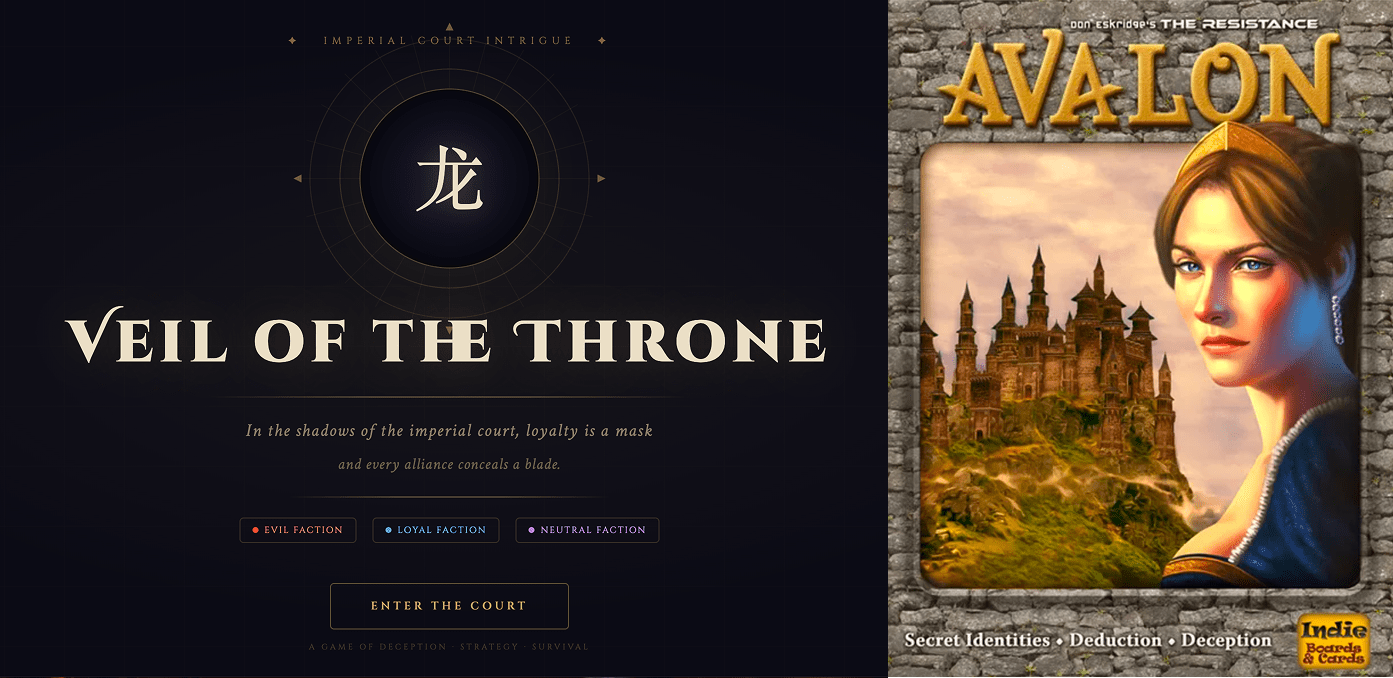
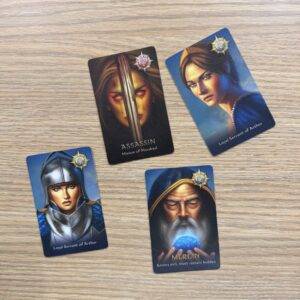
 The game I’ve played is Avalon, created by Don Eskridge. It is a tabletop social deduction game for 5-10 players, targeting those who enjoy strategic discussion and bluffing. Similar to our game, Veil of the Throne, players use skills to hide their identities while communicating with others to achieve their objectives. The key difference between them, after playing as the assassin, is not simply their mechanics but how they encourage players to communicate. Avalon treats every conversation as a form of deception, putting players completely in the magic circle. Veil of the Throne, on the other hand, incurs moments where players get to reveal parts of their real personalities, blurring players’ perceptions of the boundary between the magic circle and real life. Thus, the communication mechanics of these two games encourage completely different player behaviors: Avalon rewards continuous deception, whereas Veil of the Throne balances deception with genuine self-disclosure.
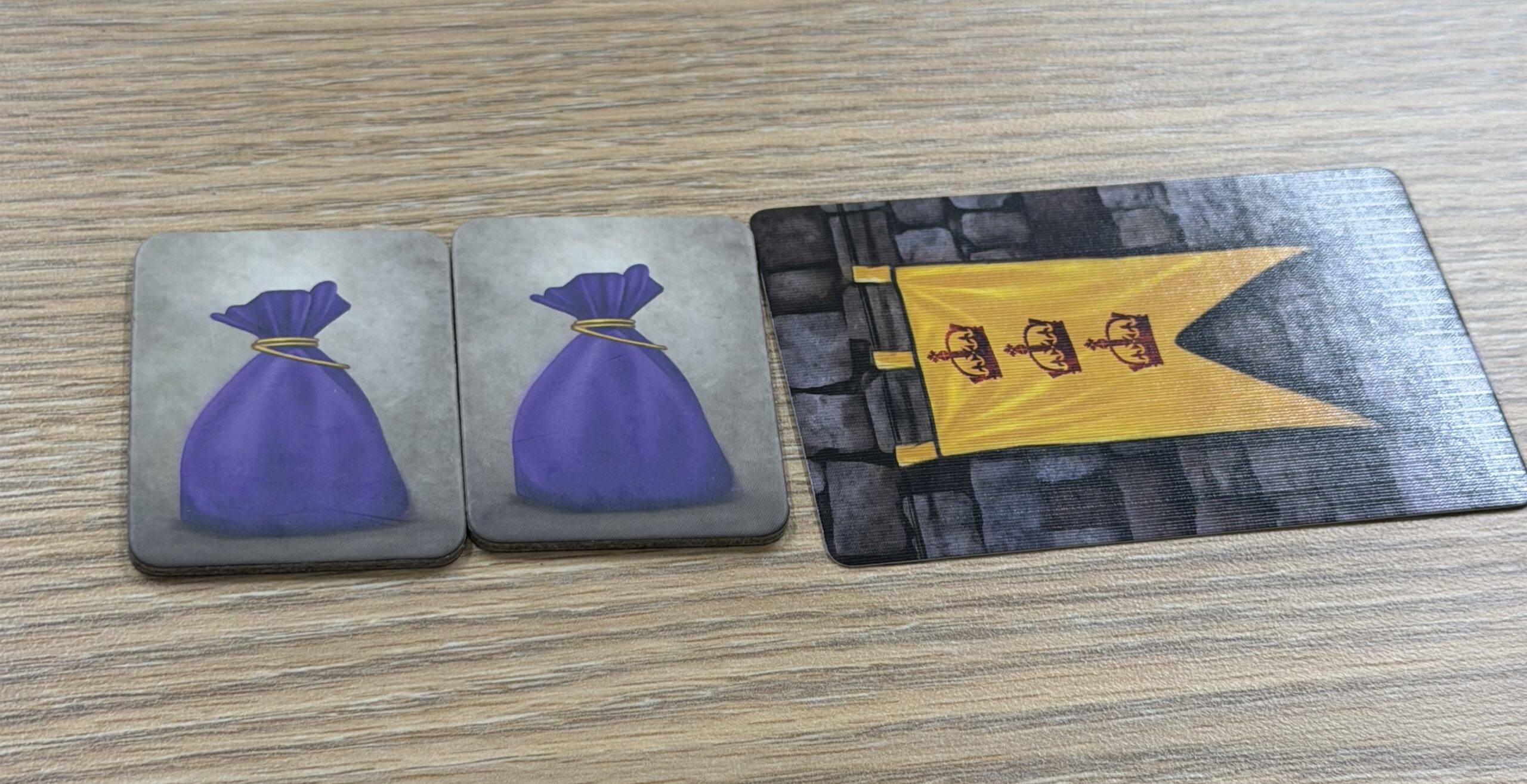
One of the most standout design decisions Avalon uses to create this form of deception is that players rarely receivedirect information. The only information players may get is the result of the quest and voting. They are unable to know others’ identities through specific strategies, which differentiates Avalon from other social deduction games such as Werewolf and Blood on the Clocktower. Players are then encouraged to bluff and lie during the discussion, automatically embracing the magic circle, since every piece of evidence comes from observing communications and previous decisions. Considering this point, at the beginning of playing when my teammate selected me to join the first quest, I realized that failing it would immediately make me suspicious. Maintaining my credibility became more valuable than completing my objective in the short term. However, after I make a quest fail, several players start to point fingers at me because I had been involved in both the successful and failed quests. In addition to the revelation of my rejection to several quests, they have sufficient reasons to explain that I likely made the first quest succeed in order to hide my minion identity.
This shows exactly how the MDA framework in Avalon worked: the hidden-role mechanic constantly creates a dynamic where players constantly refresh their interpretation towards each player’s identity through observing players’ new comments and their decision-making during the communication, which produces an aesthetic of uncertainty and tension since no conclusion ever feels completely certain. This also explains why Avalon remains engaging throughout the game. Because every new conversation changes players’ interpretations, it encourages discussion instead of letting players rely on the results from earlier rounds.
The hidden-role mechanic of Avalon made me wonder about what dynamics and aesthetics our game mechanics brought through the communication. Although both games depend on discussion, I realized that the conversation context feels different. For Avalon, I was always thinking about how to hide my identity while trying to find others’. Almost every sentence I brought up had a strategic purpose, either to try to move the target away from me or blame others in order to fail the quest. However, for Veil of the Throne, besides the goal related to identity, players were asked to reveal some of their personalities in order to revive another player. So, besides being encouraged to follow the norms of bluffing and misleading others in the magic circle, the mechanic of revealing personalities also encourages players to balance strategic deception with genuine self-disclosure.
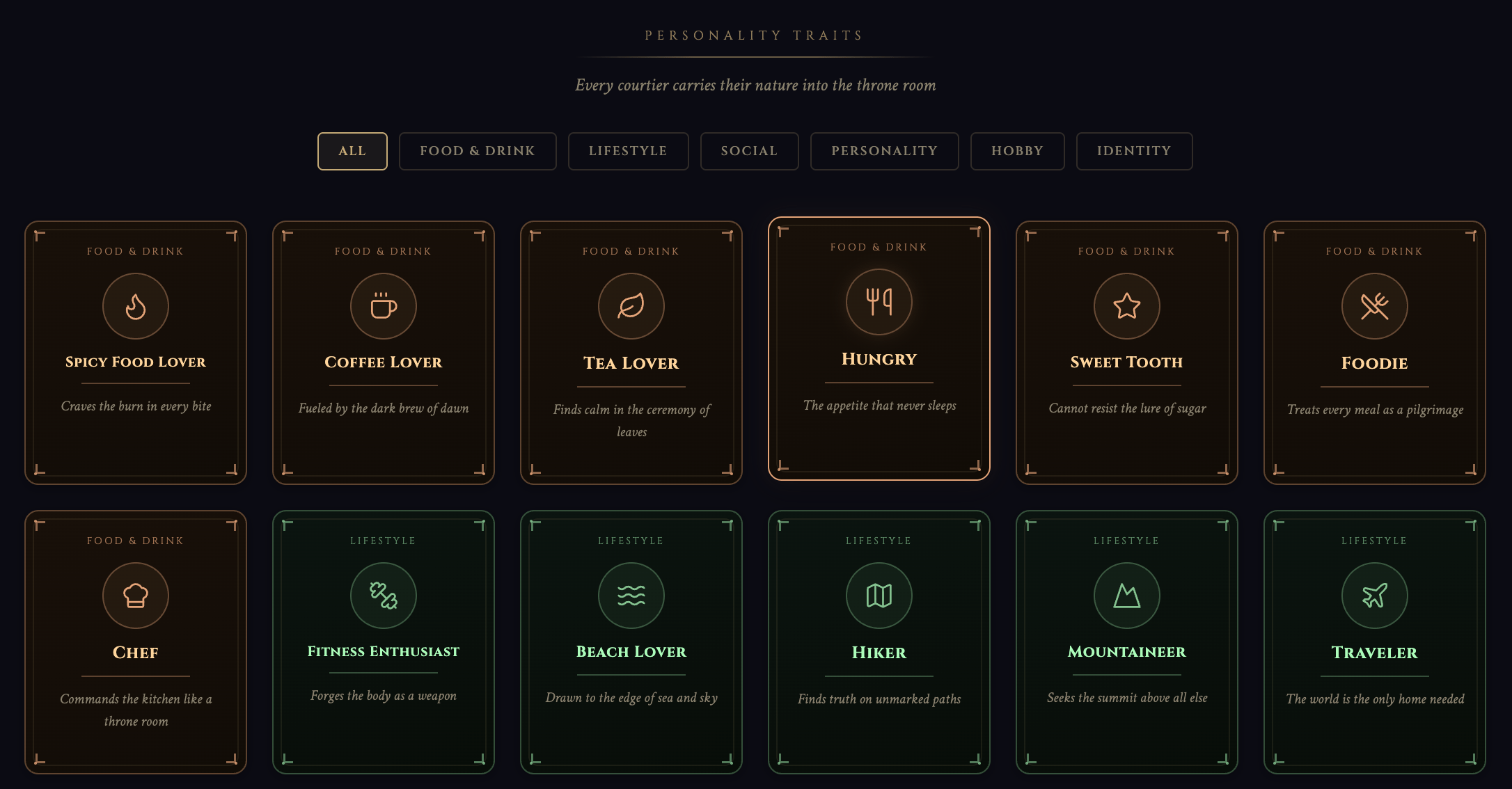
The addition of revealing personalities leads to a different social experience from Avalon. While almost every conversation in Avalon aims to deceive or detect deception, Veil of the Throne’s combination of strategic and personal interactions involves building the aesthetic of social connection. It encourages players to build trust using real-world information, creating moments where players shift from acting purely as game characters to interacting as themselves.
However, though Avalon made great progress in designing the hidding-role mechanics, one design choice I questioned was Avalon’s public voting system. Although it gives players additional behavioral evidence and keeps discussions active, it also gradually reduces uncertainty because every vote becomes permanent information. Since Merlin already possesses significant knowledge at the beginning of the game, I wondered whether hidden voting could better preserve the sense of uncertainty created by the hidding-role mechanics and shift the focus back toward interpreting conversations instead of analyzing voting history.
Playing Avalon helped me confirm what kind of social experience our team wants to create. If we want psychological deduction, Avalon serves as a great sample since it’s just a simple, conversation-driven structure. But if we want to combine the deduction with relationship building, Veil of the Throne’s combination of strategic and personal conversation offers a more suitable structure.
In the end, one thing I learn is that communication itself is a game mechanic. Small changes to what players are allowed to say or what truths they are encouraged to reveal can completely turn the social experience, even when two games belong to the same genre.