Who’s Lila? is a point-and-click horror game created by Garage Heathen. It can be played on a Windows PC. Its intended audience are adults and late-teens, particularly gamers who enjoy slow and subtle horror experiences. The reason for the older age of the recommended audience is because the game engages both mature and complex topics into its core narrative. 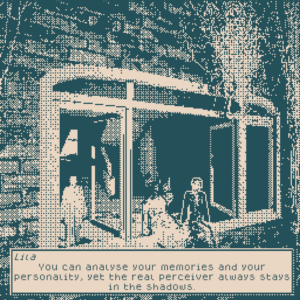 The game centers around the implied murder of a teenage girl, and in some of the routes depict an onscreen murder of another character. In addition to the explicit and implicit violence, the game also features detailed discussions of sex, child abuse, racism, and cult activity that an older audience would be more able to pick up on. In addition, the game bases a lot of its narrative and themes around mimetic theory and Jungian psychology, which can be difficult to pick apart for younger, more unfamiliar audiences.
Who’s Lila? plays out its embedded mystery narrative through the game’s branching possibility space, blurring the line between diegetic and non-diegetic pathways. On the surface, the game’s central mystery seems to be about the fate of the missing girl, Tanya Kennedy, and the identity of her killer, but the true circumstances surrounding Tanya and the main player character, William, turn out to be much more complicated. Rather than straightforwardly trying to solve Tanya’s disappearance, William’s goals and mannerisms imply that he is strangely knowledgeable about Tanya’s circumstances, and yet very reticent to share even with the player. 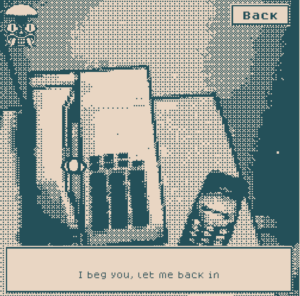
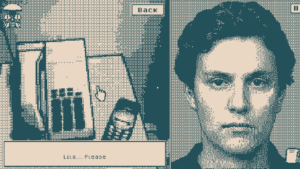 The story soon spans out into other related mysteries, such as “what is going on with William?” and the one introduced in the title of the game: “who’s Lila?”. Piecing together a full understanding of the game’s narrative involves exploring the game space thoroughly and repeatedly to unlock different scenes and areas of the map. The story itself is embedded into the environment, and plays out in a non-linear fashion—individual elements of the sequential and vertical narrative appear to the player whenever they are first encountered in the world, and they come in the form of flashbacks triggered by entering a new area, completing an ending path, conversation with NPCs, examined items, and puzzles the player solves.
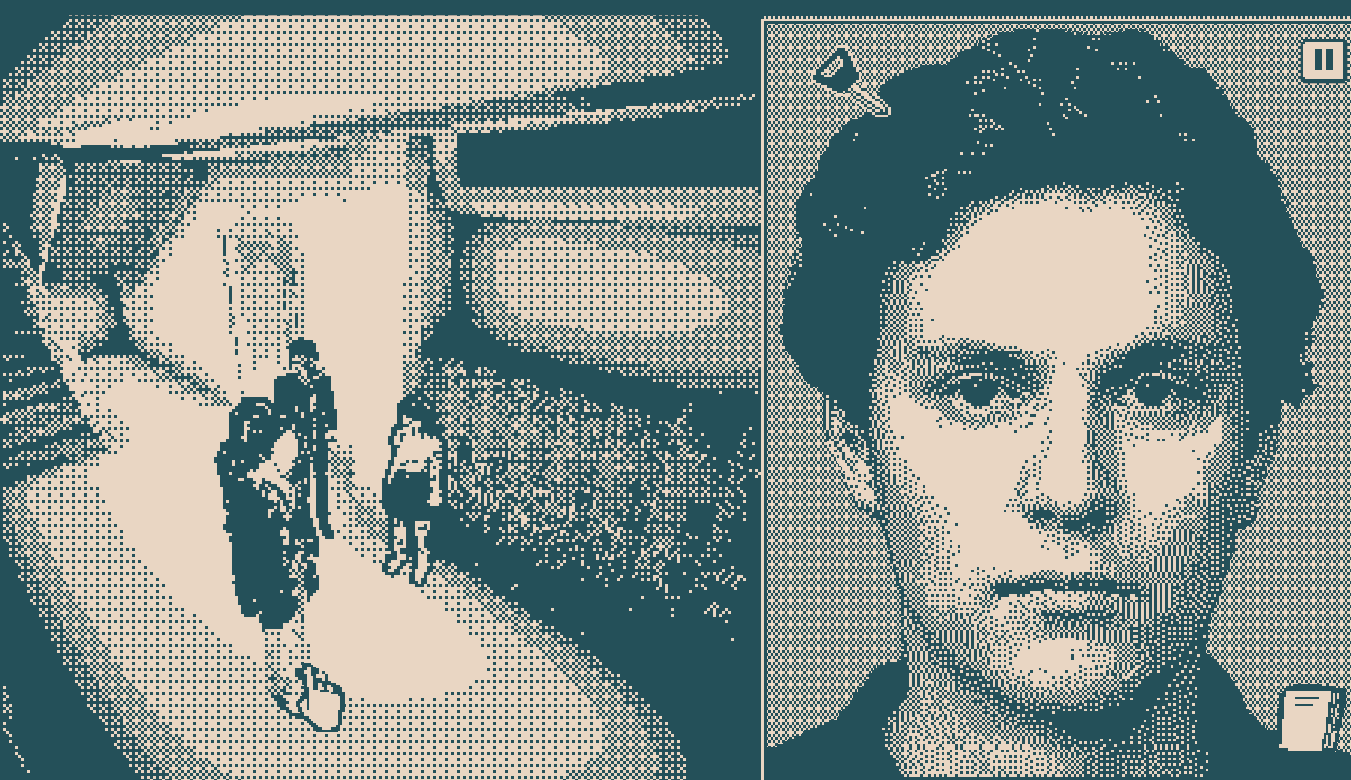
As a point and click game, Who’s Lila?’s gameplay mechanics include walking around a space and clicking on items, characters, and routes that will reveal more information about the world. In an additional twist, Who’s Lila? also involves manipulating William’s facial expressions during conversations with other characters to achieve one specific outcome or another.
Choosing to explore different areas of the world, behaving differently in a key social interaction, and solving certain puzzles ahead of others are all things that can cause a single playthrough of Who’s Lila? to differentiate itself from the others. A single playthrough, from clicking the “Wake Up” button in the main menu all the way to the credits scroll, is very short, probably around 10-30 minutes depending on the ending. As a result, the amount of exploration that the player can do, and the information they gain about the narrative, is extremely limited. The only way to know more is to replay the game, continuously, to get different endings. The number of unique endings are, of course, extremely robust. The ones that are indicated by the game include cards corresponding to most of a Rider-Waite tarot deck’s Major Arcana, and then a few secret endings—measuring up to around 18 or so unique endings in total. 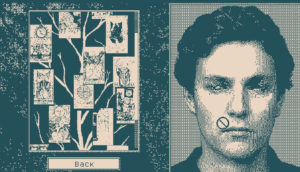 To achieve each ending, the player is pushed to explore different areas of the map, further developing their understanding of the shape of the game’s space as well. For example, when I played, an address that contained several crucial clues was only available after I had first found a different ending that involved engaging in a chase scene through underground tunnels. These ending mechanics are the tool which Who’s Lila? uses to carry out the development of its embedded narrative, as the player’s testing of different actions allows them to fully explore the game’s possibility space over the course of many playthroughs.
The use of many endings to form the game’s mystery narrative is also acknowledged diegetically—within the fiction of the game’s story—as well, blurring the lines between the game and the story it contains and further immersing the player within the conceit of its branching endings. 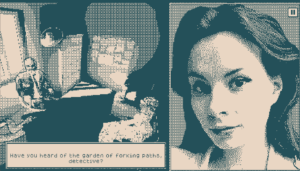 In a hidden section of the game wherein the characters discuss the significance of each of the endings the player has unlocked, the characters address the simultaneous existence of each ending, despite the fact that some of them contradict each other, and assert that they are all true. The ways in which the game plays with metatextual self-commentary and diegesis are also played out in the architecture of the game’s world. Areas of the game extend beyond the “magic circle”-like containment box of the game window, creating an experience of a pervasive entity encroaching upon the real world through the purposeful violation of conventional video game boundaries. The game includes ARG elements, requiring the player to open up their browser to view websites, Twitter pages, and documents. The extension of Who’s Lila?’s area of play adds to the immersive experience of the fantasy narrative that’s playing out, as the player must contend with the existence of items connected to the game not only in the game window, but also in spaces that the player occupies in their regular life. Scrolling through an extant website for clues made the scattered scientific(?) ramblings seem much more real, like it was something that someone had posted earnestly about.
  The horror of Lila’s inescapable existence is also manifested in the way she is able to move about the game by interacting with it as if it were a game. In my game, for example, I quickly discovered an series of extra scenes featuring Lila and another character that was accessible through my save files. It inspired the same sense of horror that watching Sadako from The Ring crawl out of the television has, the feeling that the boundary between fiction and reality is no longer tangible enough to protect from the monsters within.
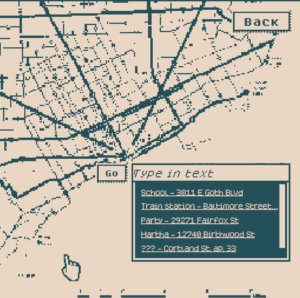 In game space—the architecture of the part of Who’s Lila? that plays out within the game window, I mean—is strictly regulated. The player has freedom to explore within the context of a specific floor or building, but the hallways and rooms available to them are often narrow and small in number. Travel between each location requires knowledge of the destination’s exact address, and can only be done by accessing bus stations in front of each location. These addresses often become challenges to discover, and may require the player to complete puzzles and pass social interactions to gain. The primary function of Who’s Lila?’s architecture is mainly to constrain the player and encourage them to explore, developing a better understanding of a handful of familiar buildings and the way they’re interlinked over the course of multiple playthroughs.
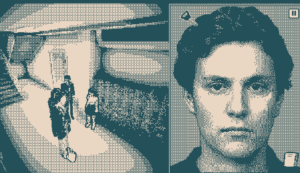 The cramped character of Who’s Lila?’s game spaces also contributes to an atmosphere of fear and a feeling of a loss of autonomy, reflecting William’s narrative about being hijacked by a malevolent entity and unable to free himself. The strange camera angles and point-and-click movement that makes up most of the game creates an awkward distance between player and onscreen character. The framing of the architecture—though the aesthetic qualities of the structures may be familiar—makes the moving around unintuitive and at times confusing. When the game enters a space inside William’s head, however, where he is free of malevolent influence, the perspective shifts into first person and the controls change to moving using WASD.
 In these sections, the player and William are brought closer together, and movement comes more naturally than the segmented commands of clicking areas of the room. This perspective shift is accompanied by an open area in the game that is much larger than any other space, where William is free to explore to its fullest extent. The differences between these two gameplay modes creates two contrasting playing experiences that invoke a more horrific and eerie atmosphere, as well as helping the player better embody the role of William.
Ethics Question:
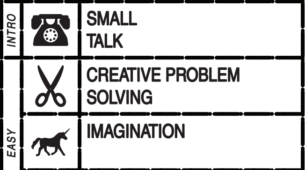
The first and most notable accessibility barrier in Who’s Lila? is that it’s not safe for epileptic people to play, since there are scenes with rapid flashing effects. This is the first barrier I noticed, because they include a warning about these flashing scenes whenever the game boots up. However, despite their acknowledgement of the unsafety of flashing scenes, the game is not more accessible to people with epilepsy, since there’s no way to turn off these flashing effects—a change that would not significantly affect the flow of the game, since the flash effects appear only in cutscenes, and don’t alter the gameplay mechanics in any way.  What Who’s Lila? does have, however, is an “Easy” mode, which allows the player a longer time limit to arrange Williams face. It also prevents the face from moving on its own, an element that adds an extra layer of difficulty to the timed challenges. I couldn’t find any sources from disabled gamers describing their experiences with this mode specifically, but it does lower the difficulty of these timed challenges, which requires a certain amount of hand-eye coordination and speed to pull off. There’s more time to drag the mouse to the desired location on the face, and more time to position it, and also the extra time is a helpful stopgap against panicking whenever one of these challenges pops up.
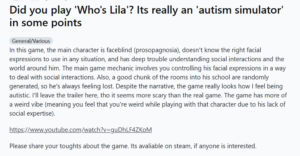 Something that has been written about Who’s Lila?, though, is its resonance with neurodivergent gamers. This post on r/autism calls parts of the game an “autism simulator”, citing William’s face blindness, sense of being lost, and his struggles with facial expression and social interactions as the reasons. The now deleted user notes that the game “really looks how [they] feel being autistic.” I couldn’t find any posts explicitly addressing whether this aspect of the game impacted neurodivergent playing experiences in terms of accessibility, but I will note that the game heavily relies on the player understanding what the appropriate emotional responses are to different situations, and being able to connect the correct appearance of a facial expression to the emotion. However, the difficulty of discerning and displaying the correct emotional reaction is something that the game does engage with on purpose, as its most unique and compelling gameplay mechanic.