Note, this article does contain some spoilers that aspiring Portal players should avoid.
While most folks think of Portal 2 when prompted to envision Valve’s Portal franchise, the original Portal still sits as an incredible puzzle game worth playing. (In fact, Valve’s Portal is still ranked as not only just one of the greatest puzzle games ever made, but one of the greatest video games ever made). For this reason (and because I have played some parts of Portal 2…), I felt Portal would be a great candidate to examine the role of puzzle features in a modern video game. The complexity and themes of Portal make this puzzle game fit well for teens and young adults – which funnily enough perhaps explains why Portal was much quicker and more fun for me at this older age than Portal 2 was when I was younger…
Portal so masterfully propelled the franchise forward due to its ability to incorporate lore so deeply into its very puzzle mechanics. Because of this ability to incorporate narrative into the puzzle mechanics, rather than having to supplement puzzles with addition lore, the narrative the player discovers for themselves resonates more deeply and personally. I argue that in Portal, the puzzle mechanics and the overarching narrative are one wonderful blur– combining together to make one strong, cohesive gameplay experience.
In Portal, the player plays as a test subject named Chell – our unspeaking protagonist who is forced to solve puzzle chambers in a state-of-the-art science facility. The player does so via a handheld device that, as the namesake of the game suggests, creates portals that our protagonist can travel through. Puzzles are solved by reaching the end of the test chamber while simultaneously completing the chamber’s tasks to do so (i.e., help a pellet reach where it needs to go, placing a weighted cube onto a button, etc.) – all which require using the portal gun and traveling through portals in creative ways (i.e., jumping through a portal with lots of momentum to shoot out the other side, making a portal for a weighted cube to fall through, etc.).
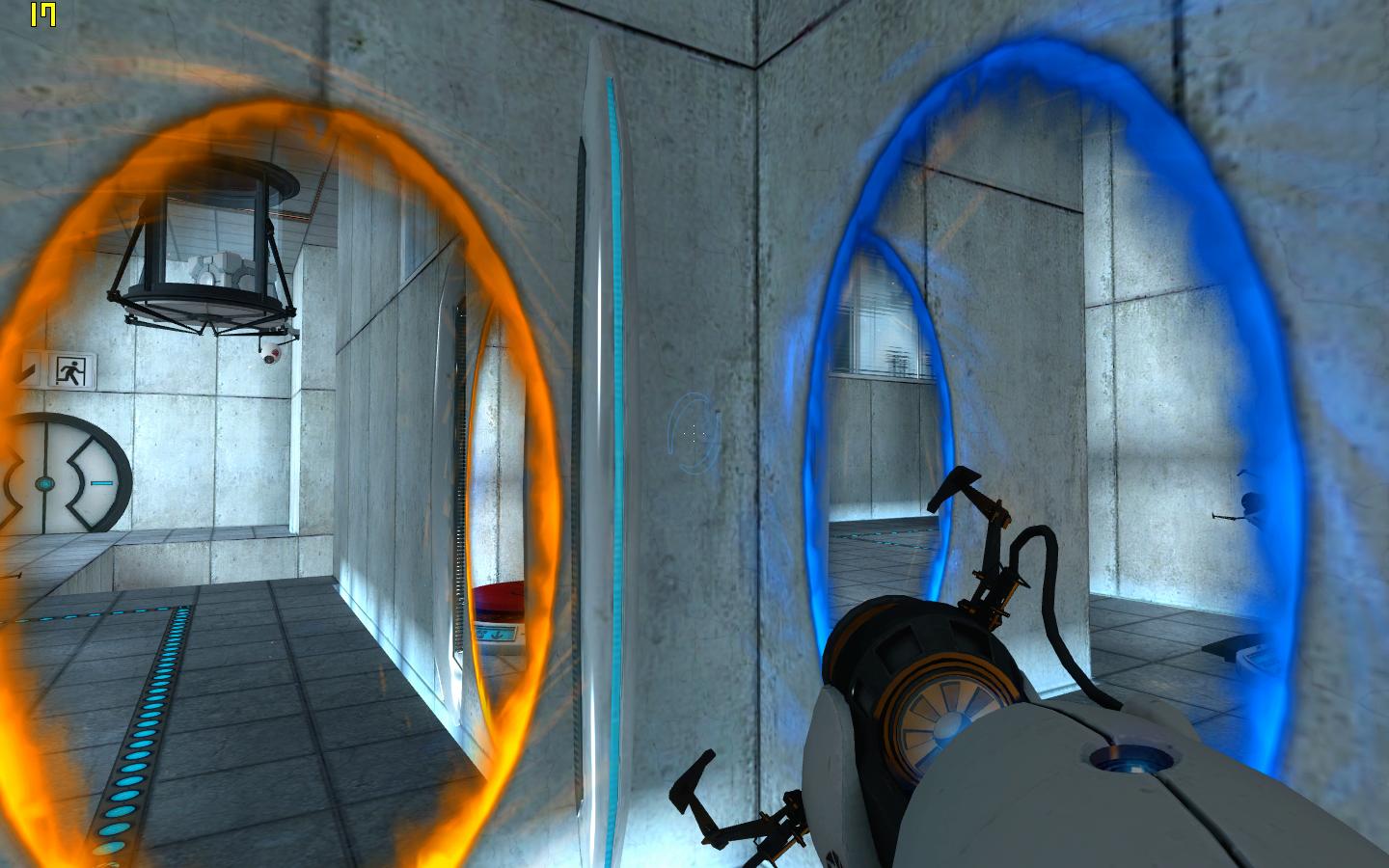 However, it is this very gameplay item and mechanic that first ties us deeply into the narrative. The player’s “job” is to test the portal gun. We are solving these puzzles via portals not to test our intelligence, but to gauge the usefulness and efficacy of this device. The very mechanics we master (how we can travel through portals, what surfaces they can adhere to, etc.) are data points for Aperture Science – and we learn our narrative place as a lab rat through this. In fact, we are nearly murdered after our final successful test – as our usefulness as a test subject reaches its completion. We learn everything there is to know about the portal gun, we master its mechanics – and thus, we are no longer a useful test subject. We are tied to the narrative via the portals themselves.
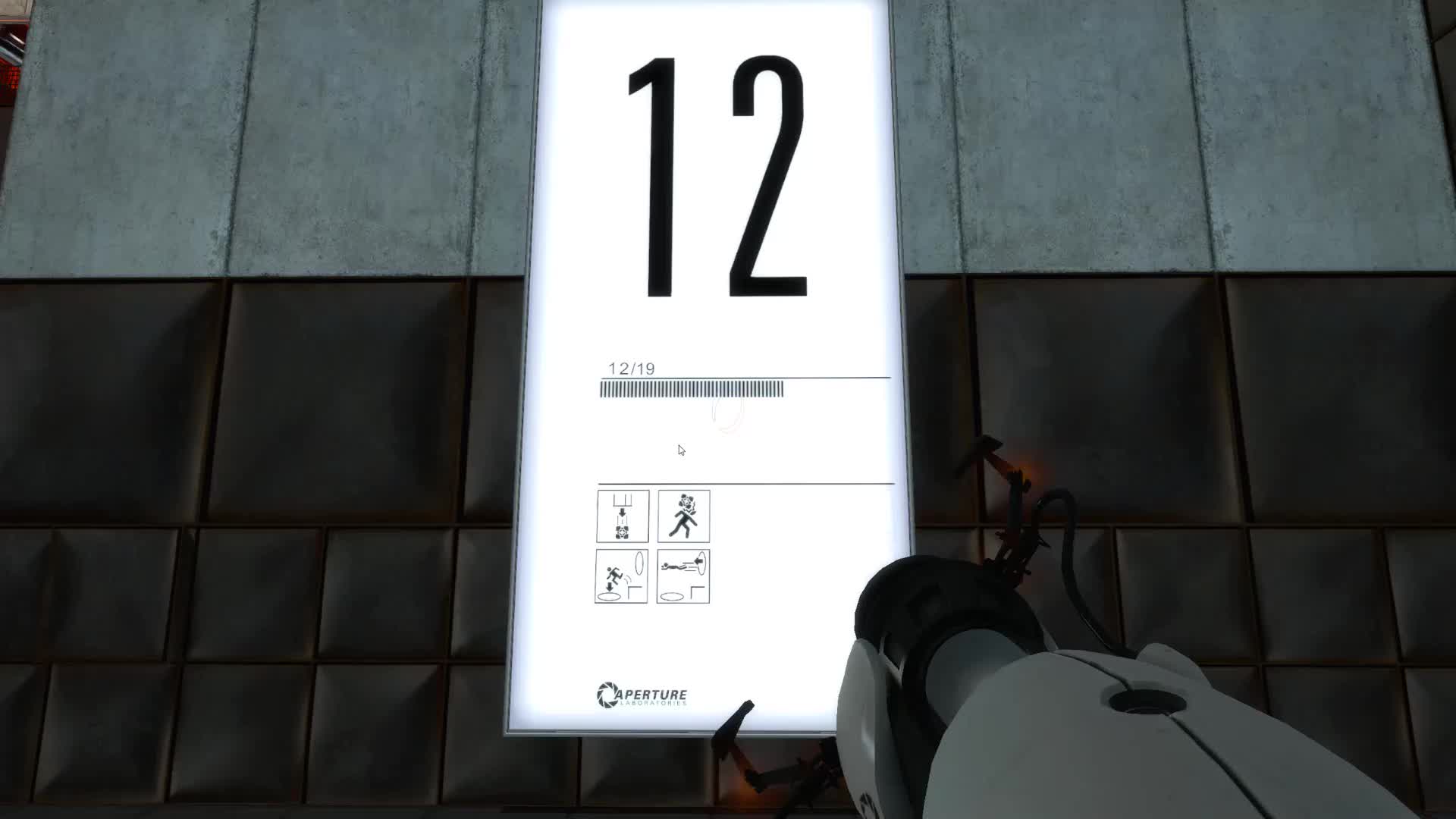
As we navigate through the facility, the testing chambers we solve follow a rigid and orderly scheme. Each test has an exact solution (a cube must rest on a button, a pellet device must be activated, a height must be reached), and we proceed through them very linearly. We are even given an infographic at the beginning of each test chamber to denote the challenges we are expected to solve.
In Scott Kim’s “What is a Puzzle?”, once published on the now defunct The Games Café, he provides the popular puzzle definition of an item that is: 1. fun, and 2. has a right answer. While the challenges we face in our testing chambers can seem like simple, ordinary puzzles by this definition, our rigid puzzle ruleset ties us to the theme of our science facility setting. The rigidity of each puzzle is an essential lore element, as it aims to show how we are indeed in a science facility aiming to test their device in a controlled setting, against controlled obstacles. The mechanics that dictate a puzzle also dictate methods that help to personify the world we play in.
But while Portal guides us linearly through a lot of its gameplay with rigid and linear themes, it does expect us to assume some basic information. We are expected to feel in a “science-y” setting based on all the sterility and cleanliness of the (at least first few) chambers. We are expected to feel surrounded by advanced technology, because the world and items around us fit a very first-world tech esthetic. We are assumed to be intimately familiar with this world, with a world of touch screens and white walls, to feel like this space is one of advanced intellect. These assumptions exclude many cultures who have come to preserving intellect in other forms, and with other themes. The ordered and infinite tiling in many places of study during the Islamic golden age would present an air of intellect through these patternings instead.
Overall, Portal is able to provide such a deep and strong narrative connection with its players due to its intricate weaving of puzzle mechanics and narrative elements. The very portals themselves, the very test chambers we navigate, not only serve as essential puzzle elements to solve, but also as personifications of the world we play in. Because of this, Portalcontinues to sit as a top puzzle game of all time.