

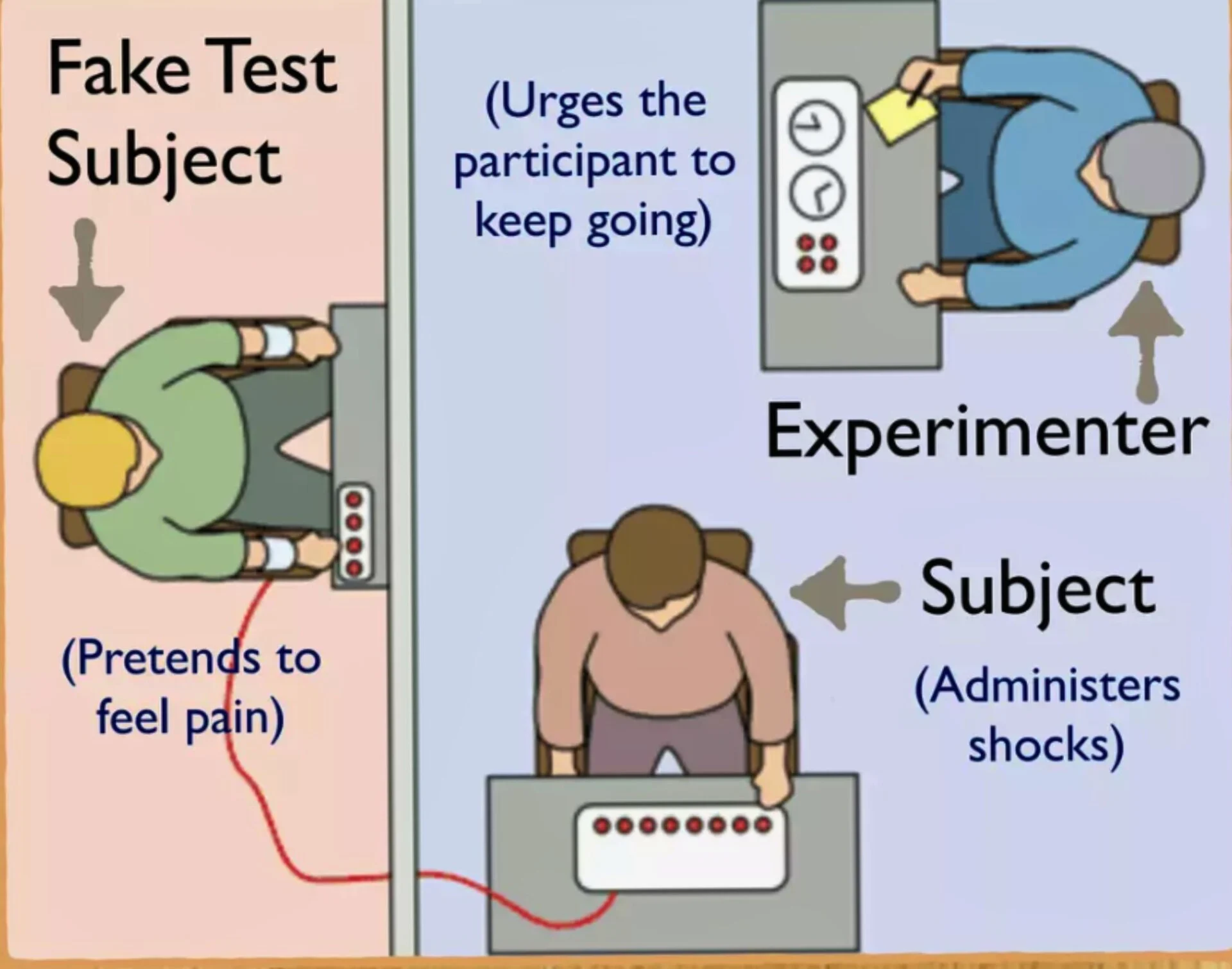
The experimenter wears a white lab coat. He is not unkind. When you turn to him—because the man in the next room has stopped answering and you are holding a dial that says DANGER: SEVERE SHOCK—he says, gently, that the experiment requires that you continue. And so you do. Later, when you try to explain what happened, you will find that the sentence has done something strange to your memory of the afternoon. You did not shock him, exactly. You were asked to, and you did not refuse, and someone in a lab coat with some sense of authority seemed to think it was fine. How did he get this authority, and why did you listen to him? Three games—Bastion, Slay the Princess, and Papers, Please—have each discovered a version of this mechanism. All three place a voice, or its procedural equivalent, in the position of Milgram’s experimenter: present at the moment of action, claiming the meaning of what the player just did. What they reveal, by different routes and methods of portrayal, is that the player always performs the action but rarely owns its meaning and that the most interesting thing a game can do is vary how visible it makes that gap.
Rucks has a voice that is deliberately and disarmingly warm. Kid just rages for a while, he says, after you have spent thirty seconds beating a wooden box to splinters in Bastion’s opening minutes, and the line lands like a hand on your shoulder, in a tone that is affectionate, knowing, already forgiving. Were you raging? No, you were just figuring out the controls. But Rucks has named it now, and the name is generous, and you find that you would like to be the kind of person Rucks thinks you are. By the time you reach the Bastion itself, he has narrated you into a character: tired, decent, carrying the weight of the world. You did not write that character. You just pressed W and the spacebar. But someone in the next room has agreed to be the author of what you did, and you did not refuse. Could you even refuse? Bastion’s answer is that warmth is the lowest-friction form of authorship-transfer, but it is also incredibly hard to notice it in the first place.
But what happens when the voice is not warm? Slay the Princess takes the trick Rucks runs on you and turns up the volume until you can hear it being run. Where Bastion hides the authorship-transfer inside affection, Slay the Princess stages it as the central horror by making the player’s awareness of the mechanism the game’s primary subject. You are on a path in the woods, and at the end of that path is a cabin. In the basement of that cabin is a princess. You are here to slay her. He tells you who you are and what you want before you have done anything at all, and when you deviate, he just sharpens, corrects, and insists. The game’s central horror is not the princess. It is that you can hear, in real time, someone trying to author you, and you can feel how much of you wants to let him.
Both games, however, depend on a recognizable speaking presence the player can locate, attend to, and push back against. Papers, Please removes that presence entirely. What happens when the experimenter is not a person but a procedure? The Ministry of Admission in Papers, Please does not have a voice, exactly. It has a rulebook, which grows by a page each morning, and a stamp, which makes a satisfying sound, and a paycheck, which is never quite enough. It does not tell you who you are. It tells you what counts as a valid entry, and trusts that you will become whoever processes valid entries. And for a while you do. You deny the woman whose passport expired yesterday. You separate the husband from the wife. You turn down the sex worker with the inconsistent story. The Ministry never asks you to do any of this; it only describes the conditions under which your work is correct. The horror of Papers, Please is the moment you notice that someone is still authoring you, and that you have been letting them, and that the lab coat this time is just a booth.
When we bring the conversation around to Stanley Milgram’s experiments, we see that Milgram’s subjects were not cruel. Sixty-five percent of them went to the highest voltage of 450 volts because someone in the room had already agreed to be responsible for what they did. The other thirty-five percent refused because they recognized, eventually, that he was only a man saying a sentence. The shock was theirs. The authorship was theirs too, if they were willing to claim it. What Bastion, Slay the Princess, and Papers, Please have each discovered is a single mechanism: place a voice in the next room, and see whether the player hands it the lab coat.
Most authority works at a distance. Laws are passed and then enforced; orders come from the top of an org chart and trickle down through chains of intermediaries; the people who set the rules are not, usually, the people standing in the room when you decide whether to follow them. Milgram’s experimenter does something different. He stands next to you. He speaks in the same moment that you act. The subject’s hand moves toward the dial. The sentence is already in the air: the experiment requires that you continue. It is not describing what is about to happen. It is what is happening. The subject does not push the button and then receives the explanation. The explanation arrives with the button-press, attached to it, inseparable from it. By the time the subject has finished moving their hand, the meaning of what they just did has already been written by someone else.
This is what these games discovered, in their different ways. Novels narrate events that have already happened to characters who are not the reader. Films show actions performed by actors who are not the viewer. Even a memoir, which addresses the reader’s experience as directly as anything in print can, is reaching across time, as the writer composes the meaning of an event hours or years after it occurred, the reader meeting that meaning at a further remove still. The narrators of Bastion, Slay the Princess, and Papers, Please collapse this distance. They reach the player in the present tense, in the player’s own hands, in the moment of action itself. These games do not describe what the player did. They actually tell the player what the player did.
This is the inversion Barthes did not see coming. In “The Death of the Author,” Barthes argued that meaning is made by the reader, not the writer; the author’s intention does not fix what a text means, and that to free the reader, we have to dispense with the figure of the author as the source of textual meaning. The reader is alive and the author is dead. Games, when they put a voice in the next room, run this in reverse. The player performs the action, as they are the one whose body, whose hands, whose decisions produce the event. But the meaning of the event is claimed, in the moment of its production, by a voice that is not theirs. The reader is alive; the player’s authorship is what dies. What dies, specifically, is the player’s right to say what their own action meant. So we have to ask the question, the one Milgram was asking without quite naming: who gets to decide what the player did?
Consider what Rucks is not doing. He is not, primarily, telling the story of the world of Bastion, though he does eventually get around to all of that. What he is doing, from the first second of the game, is narrating the player. We see this through his constant and pestering narration of the Kid’s every action. The Kid wakes up. The Kid takes a step. The Kid just rages for a while. You hit a scarecrow with a hammer. You hit it again. The narration arrives half a beat behind your action, but it is not retrospective; it is interpretive. It is telling you what you did, with feeling, just slightly after you did it.
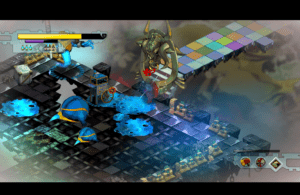
The trick is that the interpretation flatters. “Kid just rages for a while” is generous. You were not raging; you were figuring out which button swings the hammer. But Rucks has named it now, in his weary, affectionate, Western-narrator voice, and you find yourself wanting to be the kind of person the narration suggests you are. The flattery is so light it barely registers as flattery. Rucks does not tell you that you are heroic. He tells you that you are tired, and stubborn, and pressing on anyway. He attributes a character to you in negative space: not the things you do but the things you must be feeling to do them. You did not write that character. You just pressed W and the spacebar. But by the time you reach the Bastion itself, you have been quietly characterized as stoic, loyal, and world-weary.
The character is a gift; however, it is also a contract. Rucks gives you the gift, and you are expected, in exchange, to play the kind of person Rucks has described. The compliance is so small as to be invisible: you keep pressing W. You keep swinging the hammer. The narration keeps building. By the second act of the game, when the moral weight starts to arrive, such as through the destruction of the Ura, the question of what happened during the Calamity, and the slow revelation that the world ended for reasons you might have to take some responsibility for, the player has already been pre-positioned to receive these revelations as the kind of person Rucks said they were.
And then the ending makes the trick explicit. Bastion offers you the famous choice between Restoration (use the Bastion to undo the Calamity and start the world over) and Evacuation (use it to escape, carrying the survivors forward into an unknown future). The game presents this as your choice, but the choice is not really being asked of the player. It is being asked of the character Rucks has spent the entire game building. The “choice” is a test of whether you will be the person the narration has already said you are. Many players choose Evacuation, because Evacuation is what the tired, decent, world-weary person Rucks described would choose. The choice has been authored in advance. You are only being asked to ratify it. This is the easiest kind of authorship-transfer, because the voice is warm. Warmth is the lowest-friction interface between a narrator and a player. The narrator is not commanding; he is befriending. To refuse a friend’s interpretation of you is harder than refusing a stranger’s command. Rucks is your friend and you have been spending hours with him. He has never lied to you. Why should you refuse? Why would you refuse?
But what happens when the voice is not warm? Slay the Princess takes the trick Rucks runs on you and turns up the volume until you can hear it being run. The opening voiceover is the Milgram experimenter’s sentence with all the softness removed: You are on a path in the woods, and at the end of that path is a cabin. In the basement of that cabin is a princess. You are here to slay her. If you do not, it will be the end of the world. In the space of four sentences, the Narrator has assigned you a location, a destination, a goal, an identity, and a moral framework. You have not done anything yet. You have not even moved. The authoring has already happened.
The game’s central horror is not the princess herself. The central horror is that you can hear, in real time, someone trying to tell you what you want. And the continuing horror, the one the game keeps making you confront, is that some part of you wants to let him. To deviate from the Narrator’s script is not just to disobey him; it is to reject the premise of the entire game you are playing. Are you sure she is a princess? Are you sure you are a hero? Are you sure she needs to die? Each of these questions, the moment you ask it, is a small refusal. Each refusal forces the Narrator to do more work, to recover, to insist harder.
This is the second thing the game discovers, and it is more philosophically interesting than the first. When the player resists the authoring, the Narrator does not get more powerful. He gets less. The more clearly you can see him trying to tell you who you are, the less authority he has to tell you. He begins to argue with you. He revises his earlier statements. He pleads, then commands, then sulks. By the midgame, in some routes, he has been reduced from a frame around the experience to a character within it, where it is one voice among several and no longer the voice that decides what is real. The game is staging, mechanically, the discovery Milgram’s refusing subjects made: when you stop granting the experimenter the lab coat, the experimenter is revealed to be a man just saying a sentence.
What Slay the Princess understands, that Rucks’ warmer game does not, is that the authoring is most visible at the moment of refusal. The game makes refusal the center of its play. The princess changes, the dungeon changes, the world changes, but the Narrator changes too, and changes in the way that the experimenter would change if Milgram had given his subjects long enough and the right kind of attention. He becomes someone you can see. And once you can see him, the question shifts: not “what is he telling me?” but “why am I listening?”
This is the second mode of authorship-transfer. Where Bastion hides the transfer in effect, Slay the Princess stages it as the moral problem to be solved. Both, however, depend on a recognizable speaking presence that the player can locate, attend to, and either accept or push back against. What happens in a game where there is no such voice? What happens when the experimenter is not a person but a procedure? The Ministry of Admission in Papers, Please does not have a voice. It has a rulebook, which sits on your desk and grows by a page each morning. It has a stamp, which makes a satisfying mechanical sound when it hits the paper. It has a bulletin board, on which the day’s new restrictions are posted in identical typography. It has a paycheck, which is itemized, and which is never quite enough to cover heat plus rent plus food plus your son’s medicine. None of these objects tells you who you are. None of them gives you a moral frame. They describe the conditions under which your work is correct, and they trust that you, an inspector at the border crossing, will become whoever processes correct work.
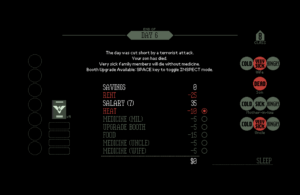
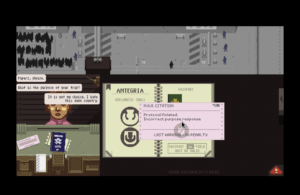
For a while, you do. You deny the woman whose passport expired yesterday. You separate the husband from the wife when only one set of papers is in order. You refuse the sex worker who, alongside their sister, is being pursued by their boss and is simply trying to escape their rough life. The game watches you do this. It does not narrate it. It does not tell you what kind of person you are for doing it. It simply records that you did it, charges your accounts at the end of the day, and opens the booth again tomorrow morning.
This is the most Milgram-like of the three games, and it is so for an unexpected reason. Milgram’s experimenter, despite the cultural memory of the experiment, almost never commanded. He had a fixed list of four prods, and the first three were softer than people remember: please continue; the experiment requires that you continue; it is absolutely essential that you continue. Only the fourth sentence of, “you have no other choice, you must go on”, was an unambiguous command, and Milgram found that subjects who heard the fourth prod almost always refused. Authority that issues direct orders gets disobeyed. Authority that describes conditions of correctness gets followed. The experimenter was effective because he was bureaucratic. He stated procedures and he let the subject be the one to enact them.
The Ministry of Admission works the same way. It does not tell you to deny anyone. It tells you what counts as a valid entry. The denial is your action; the rules are merely the conditions under which it is correct. And bureaucratic authority of this kind has a specific moral effect: it makes refusal feel like a procedural error rather than a moral act. To wave a person through whose papers are out of date is not, in the booth, an act of compassion. It is a mistake that generates a citation, and the citation reduces your paycheck. The reduction means your son does not get medicine or your family goes without heat for longer. The architecture of the game converts moral choices into administrative ones, and the conversion is the authoring.
And yet Papers, Please is the most morally legible of the three games because it leaves the architecture of authoring visible. It is in this game that the player, in the end, can most clearly see what they are doing. The rulebook is on the desk that you can read at any time. The paycheck is itemized so you can see what each citation costs. The bulletins are dated so you can see how the rules are changing, and which directions they are tightening. The game makes the booth visible as a booth. It does what Bastion will not and what Slay the Princess only does at the moment of confrontation: it shows you the conditions of your own compliance, in full, from the first morning, and then it asks you, every day, whether you want to remain compliant.
These three games therefore form a spectrum: warmth through Bastion, insistence through Slay the Princess, and bureaucracy through Papers, Please. We are presented with three different versions of the experimenter and three different ways of making the player into a subject. All three correspond to something Milgram saw in his subjects, and all three depend on a single question: whether the player grants the authority being claimed.
However, there is an obvious objection here: this is not, really, a story about games, but rather that it is a story about narrative. Every novel tells the reader how to feel about its characters; every film frames its action with music and editing that direct our judgment; every memoir reaches into the reader’s experience and tells them what to make of what they are reading. If Rucks is authoring the player, so is every third-person narrator in every novel ever written. However, when a novelist tells you what to feel about a character, the character is not you, and the action is not yours. The description is arriving across time, where the words were written by someone else. Rucks is doing something different because the action is yours. Your hands are on the keyboard. The hammer-swing is a physical motion you just performed. And the narration arrives in the moment of the motion, attached to it, claiming it. Rucks shapes how you feel about yourself. The two are not the same operation, even if they share a vocabulary.
A sharper version of the same objection comes from inside game studies: this is just procedural rhetoric. Ian Bogost argued that games make arguments through their systems, through what the player is allowed to do and the consequences that follow; Papers, Please is a famous example. So why frame this as a story about voice and authorship, when the real action is in the system? Why not just say: games structure player agency, and these three games structure it in ways the player should examine?
Because the framing through voice catches something the procedural framing misses. The philosopher C. Thi Nguyen has argued that games are an art form that designs agencies; what games offer, uniquely, is a temporary form of agency that the player inhabits as part of the aesthetic experience (Chapter 1). While this is broadly true, Nguyen’s account presumes that the player can see the agency they are being offered. The interesting thing about Bastion, Slay the Princess, and Papers, Please is that they vary, dramatically, in how visible the designed agency is. Rucks hides it inside affection, the Narrator stages it as horror, and the Ministry buries it in procedure. To understand what each game is doing and what each game is asking of the player, you have to attend not just to what agency is being designed, but to how that design is being made invisible. And the answer, again and again, is voice, or its bureaucratic equivalent. It is a presence that arrives at the moment of action and tells the player whose action it really was.
There is one further objection worth naming, because it is the most honest: the Milgram parallel is melodramatic. Players are not subjects of psychological experiments. They are not under duress. They paid for the game; they can quit; they are in their own living rooms. To compare Rucks to a Yale researcher in a lab coat is to overstate the manipulation by several orders of magnitude. This is true; but it is also, in a sense, what makes the games interesting. As we have discussed in class during multiple discussions, games like these reproduce a low-stakes mechanism that in its high-stakes form was historically catastrophic. They let the player feel, safely, what it is to be authored by another voice. They make the lab coat visible, in fragments, as a fictional device. The question they leave the player with is smaller, stranger, but packing a mighty punch: now that you have noticed the voice, what will you do with it?
Return, then, to the experimenter’s sentence: “The experiment requires that you continue.” Sixty-five percent of Milgram’s subjects continued, and thirty-five percent did not. The difference between the two groups was not cruelty or kindness, intelligence or stupidity, courage or cowardice, as Milgram’s data is fairly clear that none of the standard moral variables predict it well. The difference, as best anyone can reconstruct it, is that the thirty-five percent eventually noticed the sentence. They noticed it as a sentence, said by a man, that they could refuse. The sixty-five percent never quite got to that noticing. The lab coat held its authority for them all the way to 450 volts.
This is what these three games are teaching, by three different methods. They are not teaching the player to refuse because that would be too strong, and probably not even desirable; refusing every voice in every game would make most games unplayable and most stories unreadable. They are teaching the player to notice. Rucks in Bastion, with his warmth, makes the noticing harder. The Narrator of Slay the Princess, with his insistence, makes it almost too easy; the horror of the game is partly that you cannot un-notice him. The Ministry in Papers Please, with its rulebook and its stamp and its itemized paycheck, makes the noticing into a moral act of its own: to see the booth as a booth is already to begin to refuse it. Each game stages a different version of the same lesson, and the lesson is older than games: that the player, the subject, the reader is always being authored, and the only question worth asking is whether the authoring is visible enough to be recognized for what it is.
Barthes wanted to kill the author so that the reader could be born; the meaning, which had been hoarded by the figure of the writer, needed to be redistributed to the people who actually produced it in the act of reading. Games, when they are honest, run this in the opposite direction. The author is everywhere in games, either in a voiced, procedural, bureaucratic, layered, or inescapable manner. The player cannot kill him because he is built into the medium. What the player can do, and what Bastion, Slay the Princess, and Papers, Please are each trying in their own way to make possible, is to recognize him and to notice, in the moment of action, that someone is trying to tell them what they just did and who they are for having done it. And then, with that noticing in hand, to decide, either freely or unfreely, generously or stubbornly, in warmth or in insistence, or against the entire bureaucratic apparatus of a fictional state, what to do with the dial.
Sources:
Featured image also from SimplyPsychology
All other screenshots are my own.
https://philarchive.org/archive/NGUGAAv3 – C. Thi Nguyen reading
https://direct.mit.edu/books/monograph/4392/chapter-abstract/187827/Procedural-Rhetoric?redirectedFrom=fulltext – Ian Bogost’s “Procedural Rhetoric”
“Death of the Author” – Roland Barthes
Class Discussions
AI usage: After developing my own thesis and game selections (approved by Seamus in earlier stages of the essay writing process), I used AI for overall language clarity and grammar, alongside drafting and structural feedback throughout the essay. Mainly, I used to clean up my language. I prefer to initially write in a long-winded stream of words, then sometimes have AI go back and help my language fit the level of the academic piece I am writing. I revised the AI-generated suggestions substantially and verified all scholarly references independently. The thesis/ideas, game selections, and argumentative direction are my own.
