I. INTRODUCTION
Depression Quest (2013), is a free browser game associated with Twine and created by Zoe Quinn, Patrick Lindsey, and Isaac Schankler. It’s a narrative storytelling non-fiction game with a focus on depression. The main goal of the game is to inform about depression to those who do not suffer from depression. And for those who are currently experiencing, the goal is to provide a sense of hope and letting them know that they are not alone. As a guy, what it means to play Depression Quest as a feminist is to see it through a perspective of a nonviolent, emotion, and compassionate lens, not letting the assumed “masculine” lens of an emotionless gaming experience be the focal point.
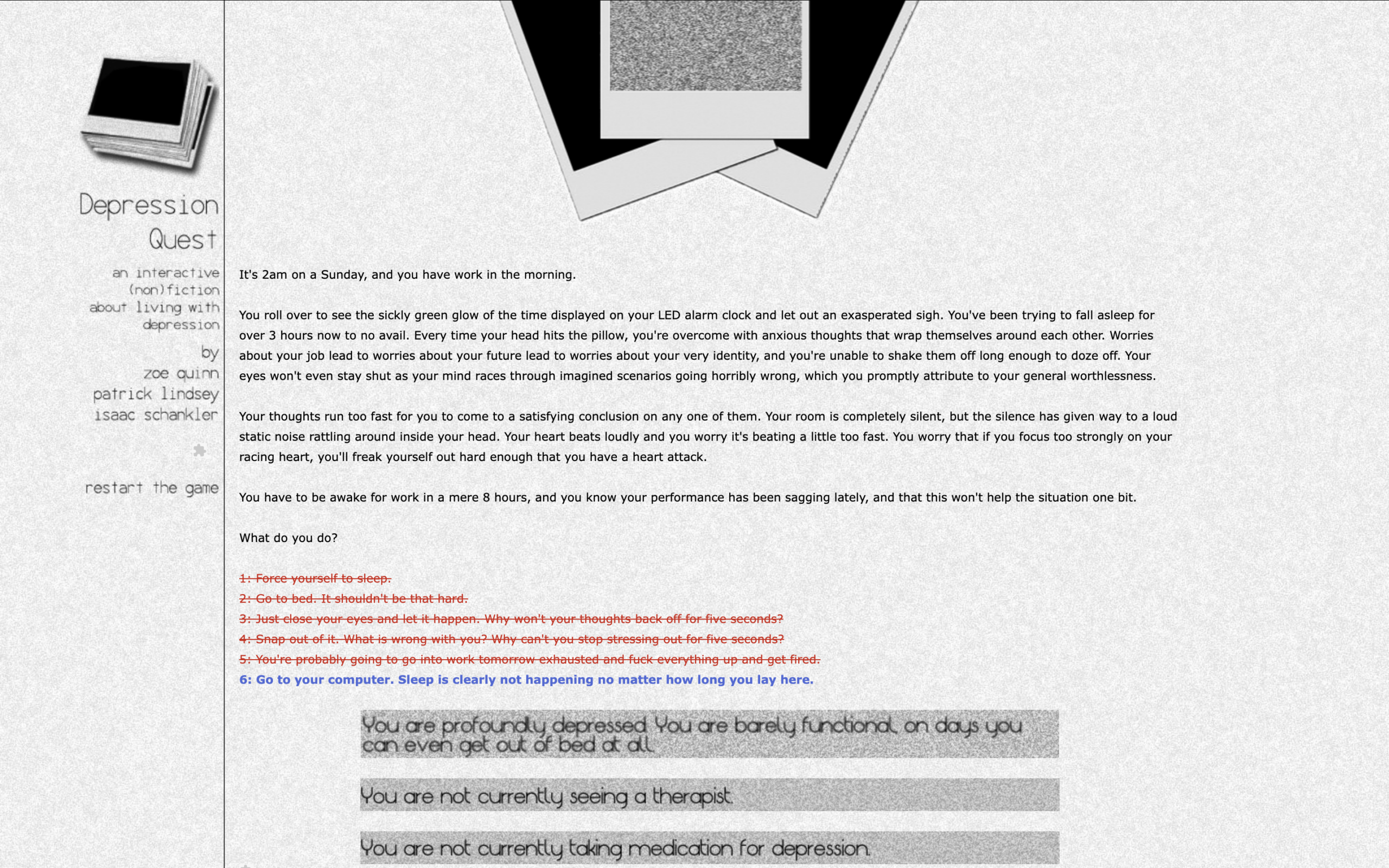
From Chess’s reading, I believe the concept of agency is the most important when it comes to the storytelling. As the screenshot shows, the game mechanics display “methods invoked by agents for interacting in a game world,” where one can define their story through actions that lead to different outcomes. And though, some actions are crossed out in red, the agency remains, as this is exactly what a person with depression may be dealing with when it comes to facing these scenarios. The assumed limitations to those without depression is actually agency for those with depression, connecting to the feminist idea of agency as the will to act and gain voice within the systems that govern power. The systems are designed by the narrative, the thoughts of “you are profoundly depressed…,” and our own internal struggles with interacting with the world around us, which still provide us power of moving forward even in its most limited form of simple actions. To further this point, at every decision point you see a list of options, but the ones that reflect rational, healthy thinking are struck through in red and simply can’t be selected, again speaking to the character who is suffering with depression and conquering these systems of power, all culminating to teaching us why telling someone with depression to “just work harder” is useless and actually detrimental, which invokes a feeling of emotion in the player (another agent interacting with the game), making the storytelling through a feminist lens more compelling.
The Ending
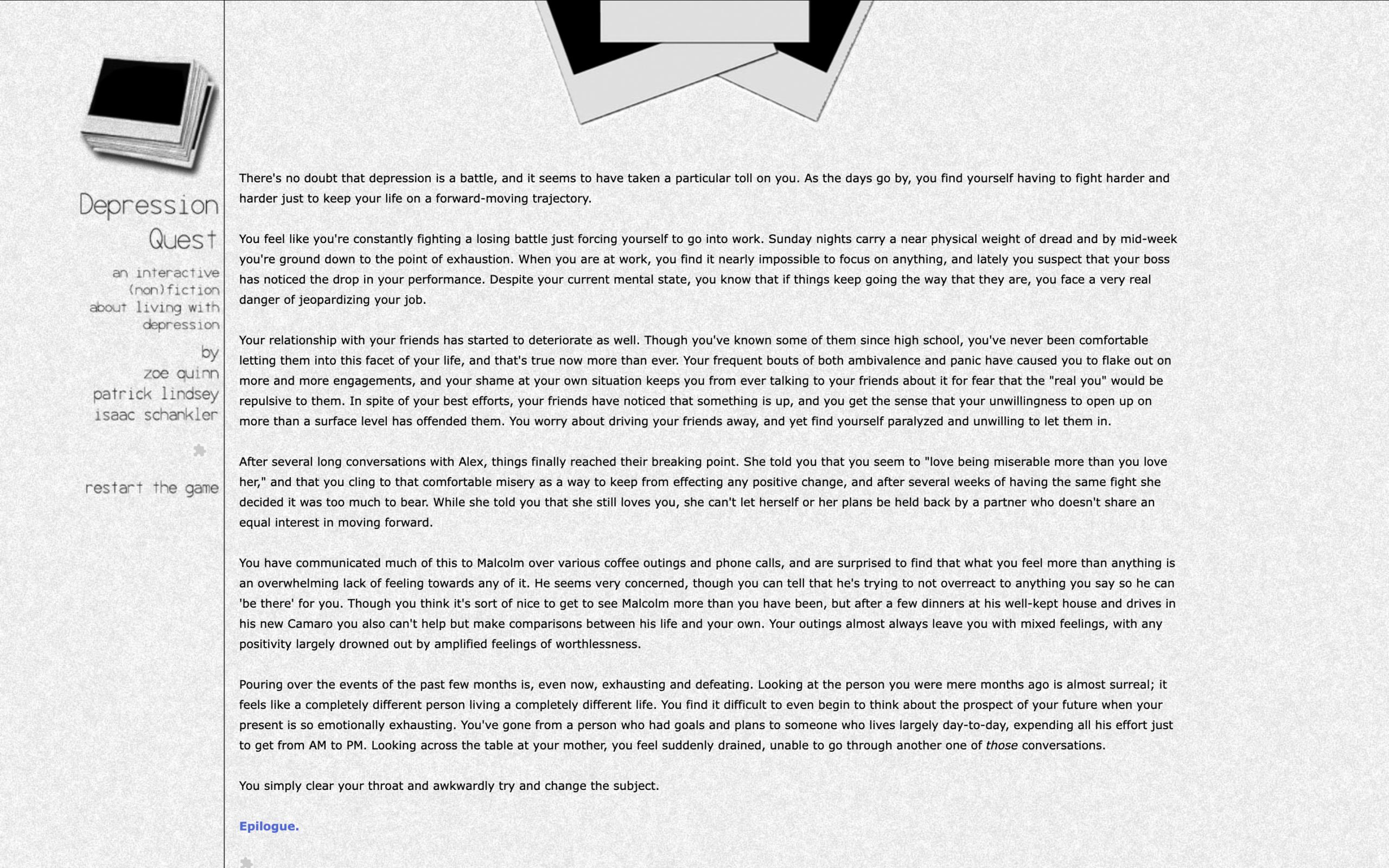
Chess also draws on theorists like Roof, de Lauretis, and Scholes to describe how mainstream narratives are built around a single peak in the design which she calls “inherent maleness of all narrative movement.” However, this game contrasts the belief of the “maleness” by focusing on the feminist storytelling of “never-ending narrative middle,” where there is no win or what I would like to call a happily-ever-after ending. Depression Quest closes with an Epilogue, where the player is still struggling with depression, stuck in the loop of battle the systems of power, including their mind. There is not boss fight, fancy effects, or climax of a happy ending, this is the ending as it is part of dealing with this circumstance. I did enjoy the design of actions leading to this Epilogue, providing an illusion that things can change, and certainly they did with each action. However, the narration leads us to understand that the struggles with the oppressive systems found in depression are not a discrete linear end result.
II. CRITIQUES
That said, the game falls short in some meaningful ways. Chess draws on Kishonna Gray’s concept, where the idea that race, gender, and class all shape how people experience systems of power. Depression Quest does lack this concept, as there isn’t varying storytelling told through different people. Sometimes wealth, stigma, and personal circumstances can lead to different conclusion. In this case, there could be a wealthy depressed character who sought therapy and worked on their relationship, another could be a religious/spiritual character who reconnected with their religion, helping them deal with depression. From a feminist standpoint, designs must consider the possible diverse perspectives that help battle these systems/situations, demonstrating an interconnectedness in the way we battle such structures (e.g. inaccessibility to medical resources).
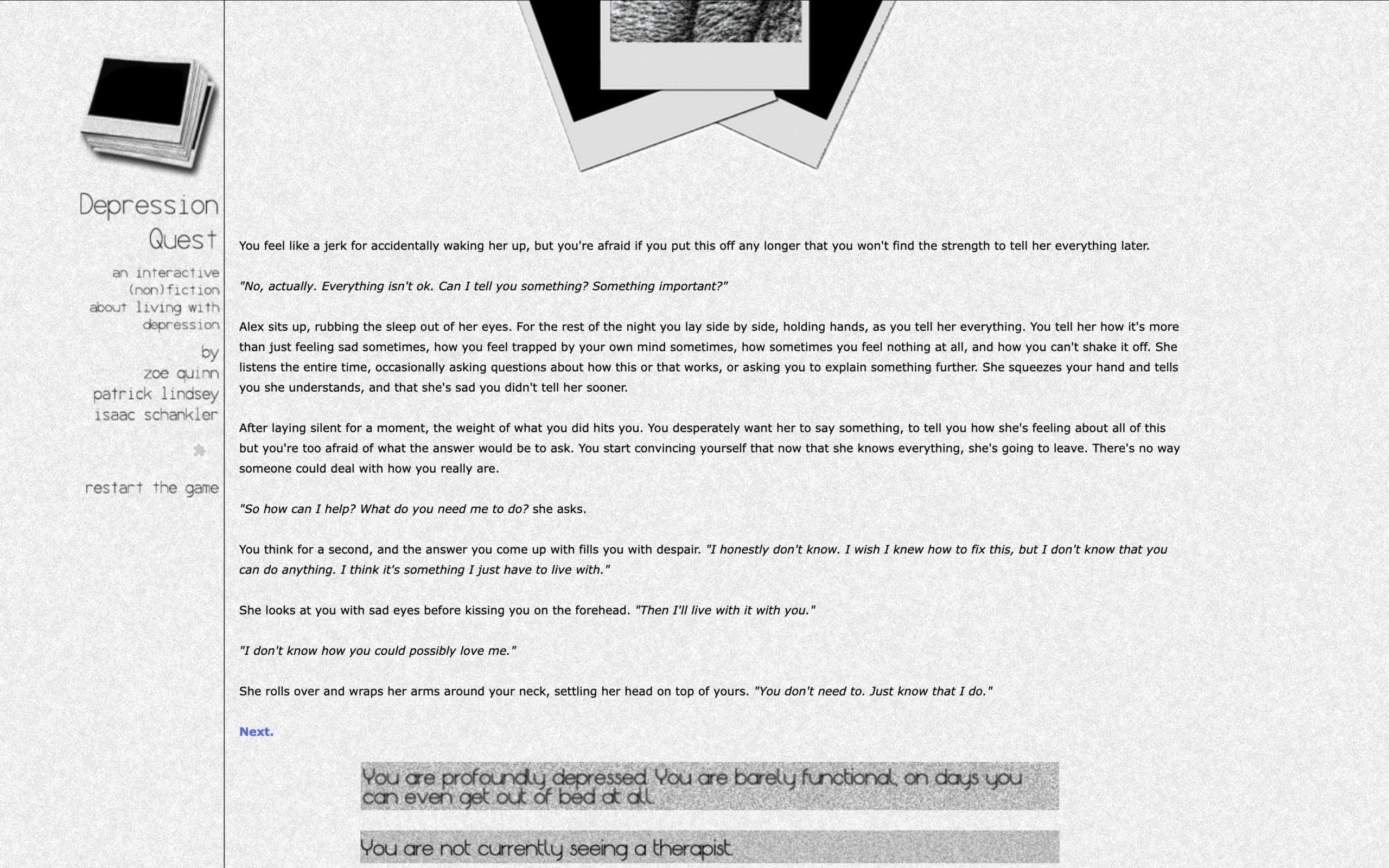
When it comes to Alex (your girlfriend) there is another missed opportunity. She absorbs all of the protagonist’s emotional weight, and the most wholesome moment is when she says “Then I’ll live with it with you.” As cute as this is, there is much character development for her, and in life, the people around us are also affected by our actions especially those we love most. Chess writes that feminist narratives should be “conversational, personal,” and should push past what patriarchal storytelling expects. With regard to other characters like Alex, Depression Quest, does not build on this personal character development.
Compared to Life is Strange, which uses a rewind mechanic to turn the act of reflection into something you physically do as a player, Depression Quest does not allow for exploring the psychological, emotional effects of your actions onto others. It does well in explaining your internal struggle, and I do appreciate that through a feminist perspective, this means that power can be found in oneself, and though the game does not fully explore it, it also means finding power from others’s love.