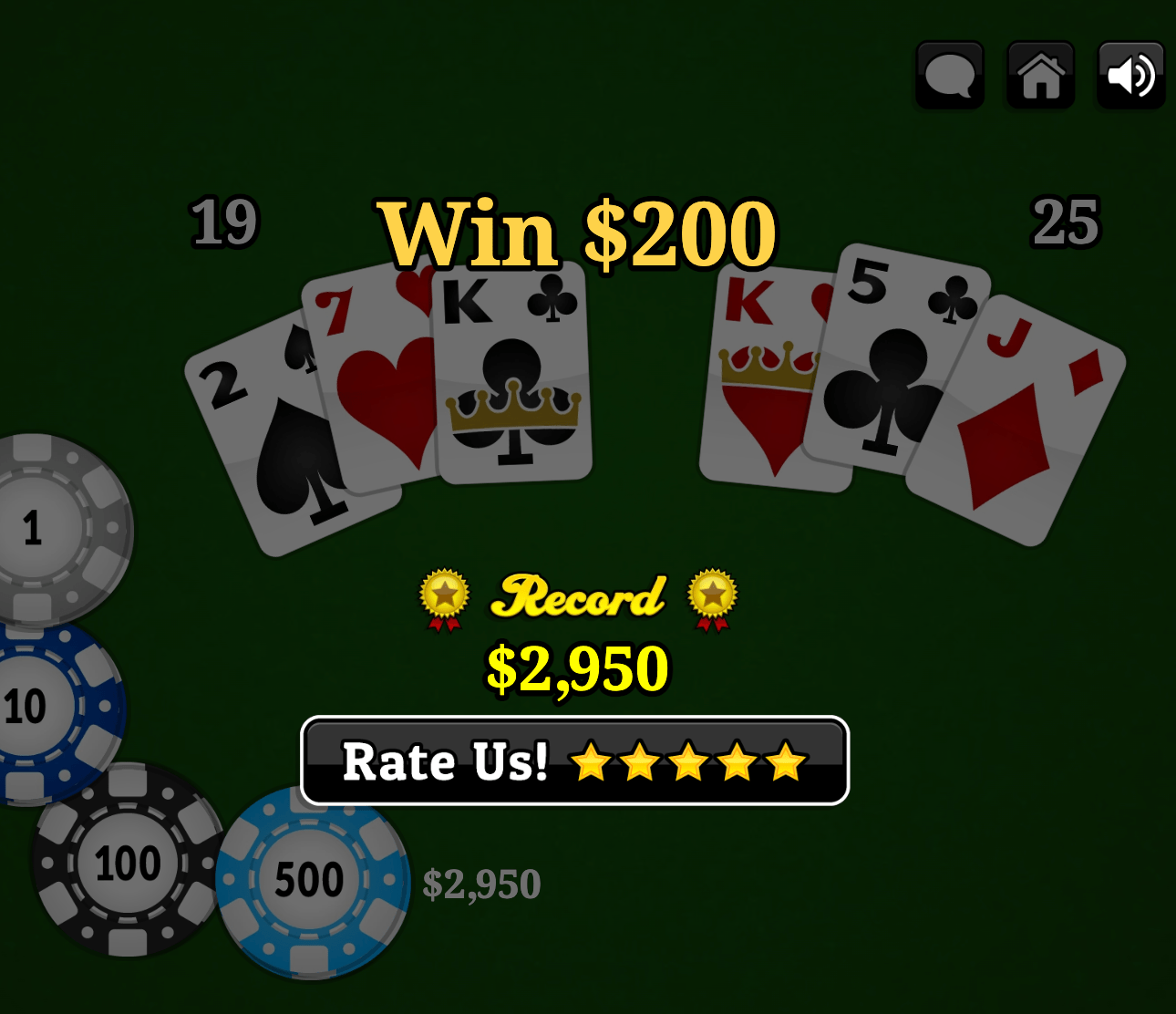
This week, I played Blackjack online on 24/7 Blackjack (referred to as Blackjack) developed by 24/7 Games. It is a single-player version of Blackjack available from any device that can access the web. The target audience for this online version of Blackjack is players of all ages because it does not involve gambling with real money.
Blackjack’s simple procedures and short interaction loops grant the player high agency and make the game feel easy to master, encouraging gambling fallacies. Furthermore, its gamification of gambling tactics may put the player in danger of developing a gambling addiction.
Blackjack is unique from other games of chance because its mechanics fully reduce the uncertainty to exclusively the randomness of the cards. Unlike multiplayer card games (eg. poker), in Blackjack, one always plays against the dealer whose strategy is deterministic. Furthermore, rather than the strategy lying completely in the betting (eg. in Craps), the player bets on their own ability to win. This creates a sense of player agency by adding input randomness with player choice, rather than solely output randomness (such as in roulette). Finally, the interaction loop is very short with most games only lasting a few seconds to a minute.
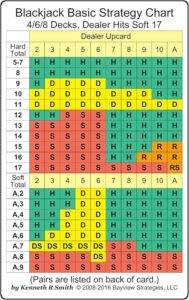
Together, these three components make Blackjack feel easy to master. The short interaction loop means players can quickly experiment and discover effective strategies that make them feel as though they know how to “win” the game. Because the uncertainty is restricted to the randomness of the cards, the game can even be fully solved and tables exist online of the optimal strategy to play Blackjack. Because the game is so simple, playing Blackjack appeals to a player’s sense of competence of Self-Determination Theory and the psychological need for achievement. It is not hard to figure out how to win, and when one does it feels good. Blackjack emphasizes this in game via color, sound, and a high score mechanic in its UX. Winning is accompanied by both a colorful golden score indicator, a positive sound, and a high score if that has been reached, providing the player with extra sensory pleasure upon winning.
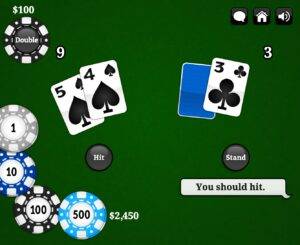
All of this is designed to lull the player into a false sense of security. At first glance, the game feels balanced and almost winnable: both the player and dealer are playing by the same rules, but the dealer is restricted to a set strategy. The game even provides in-game suggestions to help you learn the correct strategy for the current hand, as well as a written description below describing general “optimal” strategies. These mechanics reinforce the idea that there is a way to become “good” at blackjack. However, what they never reveal to the player is that even with perfect play, the house edge is about 0.5% according to Riverwind. While this may seem like a small number, it means that over long periods of play, no matter how good the player is, the player will always be expected to lose.
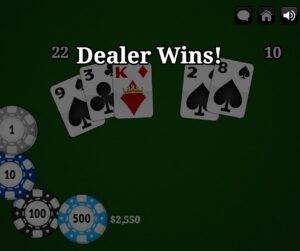
Even knowing these odds, it’s easy to not fully understand them. As Daniel Cook explains, players readily misinterpret odds. A house edge of 0.5% is so close to zero, it feels winnable because almost half the time, the player is winning. Even worse, the randomness naturally creates addictive patterns such as near misses. When playing, the player will often bust or lose to a dealer by just a point, creating a sense that if they just got a little bit luckier the next time, they would have won. It keeps the player in a constant loop because the odds dictate that even if a player starts losing, there will be times when they quickly win it back, creating the dynamic of wanting to play just one more round to make up for their losses.
This is exacerbated by the betting mechanic, where players must bet every hand. Thus, losses and wins have lasting effects into the next round playing into the gambler’s fallacy: after a series of losses, the player may feel “due” for a big win.Combined with the high score mechanic, players are also given a constant reminder of how much that had won at some point in time, creating a player-driven objective of winning the most money possible and not stopping until they do.
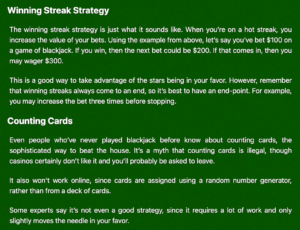
While online blackjack could be addicting on its own, it also dangerously gamifies gambling which could encourage harmful real-world tendencies. It uses UX to make these bets from $1-500 seem similar, while in reality, the difference is drastic. There is also no consequence for losing: the player can always restart, creating a free $2500, allowing players to build up a tolerance for losing large sums of money. Furthermore, the game explicitly suggests real-world overlap and encourages betting strategies that play on the winning streak fallacy while discouraging logic-based strategies such at counting cards. Combined with UX elements that emphasize luck, such as a special audio cue on Blackjack, they encourage the player to set aside logic for the feeling of luck, exactly what creates addiction in slot machines. The fun from Blackjack does come from random chance. However, especially for games people may later spend real money on, game designers should be more aware of common fallacies that arise from other components of their game. Chance can still be used, but with apt warnings.
Blackjack succeeds in creating addiction because it creates a tantalizing sense of player agency and balance, making winning seem within reach. However, the odds of the game are never in the player’s favor, making them want to bet, just one more time, to hopefully win it big.