I played A Dark Room for this week’s critical play, a stark, text-based resource management game where the player gathers materials to sustain life in a small community in the woods, beginning with a small dark room (at least this was my interpretation… but I will get into that later). A Dark Room is a game by Canadian indie studio Doublespeak Games, and it was initially released in 2013. The intended audience is someone smarter and more patient than I am, and I want to be a preschool teacher, so the bar for patience is already high. I would say ideal players have experience with resource-management games, good short-term memory, and solid deductive reasoning (probably placing the game in a 13+ age range). I played the iOS app version of A Dark Room. In this critical play recap, I will argue that while the text-based nature of A Dark Room supported player imagination and resisted common ethical shortcomings of character-based games, the absence of formal and narrative elements limited investment in the game and made the gameplay much more confusing.
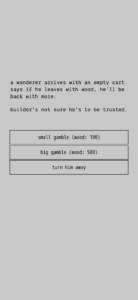
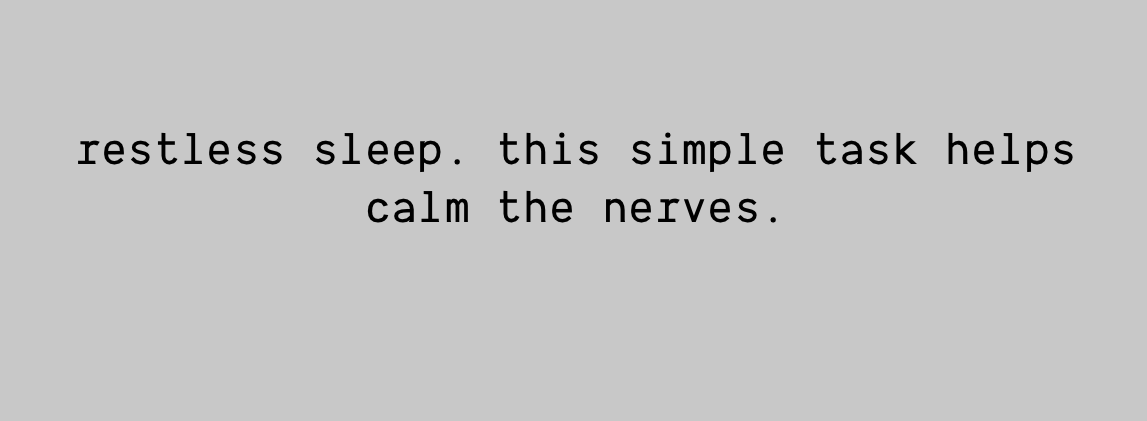
I will begin with a short delve into some of the elements I liked about the game. A Dark Room builds empathy and narrative through short phrases of text that give the player context for the setting.
The narrative of the game is both embedded and emerging, supporting the player’s sense of place throughout the gameplay. In the example of the wanderer, for example, the player receives the embedded narrative of the wanderer, but they are given choices to select which emerging narrative to pursue. I appreciated this narrative choice because it gave me a sense of personality as a player, and I found self-expression fun in my ability to care for wanderers and beggars.
Aside from the empathy built through these random encounters, I also think the game invited a sense of investment through its progression through more and more available challenges. The introduction of new resources and buildings creates a surprising pull to continue playing because the player desires access to more newness, and the hope is that these cumulative successes build toward a broader goal.
This very question of a broader goal leads me swiftly into my critiques of the game. I left the gameplay experience feeling stupid and tired. I began playing with zero context, and it took me the better part of 20 minutes just to figure out what was going on. The lack of separation between the home screen and play screen is one of many design choices that left me disoriented. I desired a connection to an overarching mission that never came, so I assumed that in the meantime, I should just build as much as I could. To this day (one day later), I still don’t know if that was an optimal strategy. I cannot clearly state what the game is about. I think this is a central issue, despite the allure of the mystery, and I would suggest a more coherent set of objectives indicated explicitly throughout the gameplay to support usability.
The simplicity of the game is its strength and its curse. I found the layout aesthetically pleasing, but I encountered screens that felt absolutely indecipherable in terms of information hierarchy, proximity, and action steps. For example, what on earth is going on here:

The placement of the settings button in the middle of the main game screen breaks the magic circle and invites the player to push a button that will disrupt the gameplay. The user interface does almost nothing to support novice players gaining a sense of self-efficacy and agency in the game. I encountered the mechanisms for building and gathering by chance, mostly because the text felt small and obscured, so I did not realize it was telling me how to play. In fact, most of the time, I felt like the game was playing me. I suppose the game is aiming for players to gain a sense of joy from the acquisition of materials (materialism) and the exploration of the world (knowledge-seeking/information), however, I felt that the lack of self-determination in the game undermined the mechanics building this experience of fun. I felt no autonomy, competence, or relatedness, and as a result, I could not understand what my specific contribution was.

Even then, the lack of a central goal continued to confuse me. I thought perhaps my goodwill toward others would eventually help me out in the game, but these isolated moments of fellowship did not reappear. If anything, I felt that the game got increasingly more cryptic, and my lack of understanding made me frustrated. I could continue the grindy experience of gathering wood and checking my traps, but without any goal or understanding of the narrative, these mechanics felt obsolete.
I can’t say that I loved the experience of ending a game feeling unintelligent. I would have appreciated more handholding. A Monument-Valley-Style introductory story would have transformed the experience and situated the mechanics within broader goal frameworks to motivate play.
I didn’t think that the formal and narrative elements entirely failed at worldbuilding, however. I want to end on a more optimistic note related to the game’s ethics. I loved the concept of telling a visual story entirely through words, and as a creative writer, the use of these small moments of interaction stood out to me as the strongest element in the game. A Dark Room’s avoidance of portraying characters creates a beautiful opportunity for players to envision their own personas, imagine what other characters look like, and experience the creativity of building their own visual world. Reflecting on the ethics question about portrayals of the body, I think the intentional abstinence from doing so in A Dark Room creates a space that centers the narrative elements of the game without alienating any player or perpetuating stereotypes.