

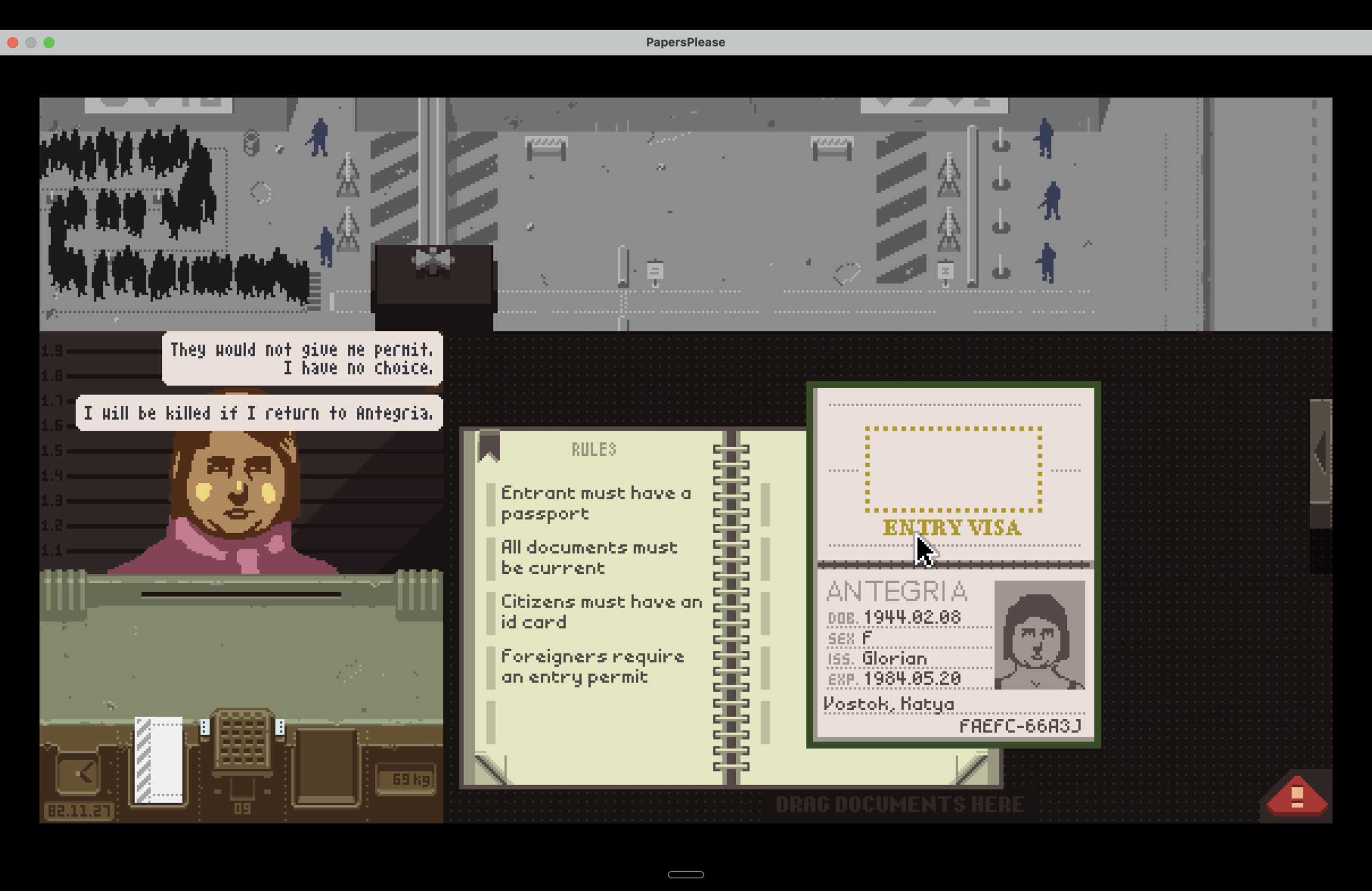
Papers, Please argues that even if personal responsibility remains within bureaucratic systems, repetitive processes can train regular people to suppress natural empathetic tendencies by rewarding procedural efficiency over moral judgment. The game requires us players to go through repetitive document-checking mechanics, deal with financial punishments, hear narrations from people that we must judge, and understand the consequences of our judgments, all while escalating rule complexity. Thus, through this, the game transforms the player from someone interacting with individuals to a “judge” into someone primarily focused on avoiding citations and optimizing survival.
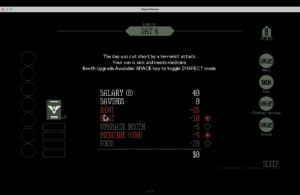
Bogost suggests that games are able to persuade users through systems and processes rather than just a narrative story. In this specific game, the system of the game becomes the argument. At the beginning of the game, the tasks feel simple, and there is emotional space between the user and their decisions. Giving someone the green stamp or the red stamp doesn’t really hold weight. I found myself following the instructions mechanically, not really listening to the stories of the people who crossed the border. I collected a lot of the pink citations, not really knowing how this would affect me later on. As the game progressed, though, I was introduced to more personal incentive. I was told my son was sick, had to deal with budgeting and prices, which gave me a sense of determination to not pick up citations on the next day.
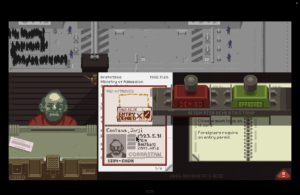
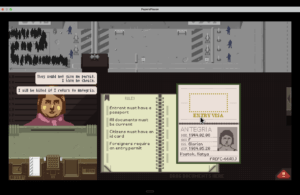
As the rules became more complex, I had to look out for more discrepancies and process more forms of ID. I started embodying the role of the inspector more deeply. I was hyper-focused on every possible mistake, comparing the DOBs across documents, checking whether every photo matched (even when it obviously did), verifying how long one wanted to stay vs how long they were allowed to stay, whether they had valid entry dates on their passport, and much more. One entrant (the bald man wearing red) kept trying to come back across multiple days with different forms of identification, and I realized I was scrutinizing his visits more, knowing that maybe there was nefarious intent.
Over time, the checkpoint interface made these people become collections of fields and data to validate. Getting into the routine of checking all these boxes, I found myself flying through people, quickly going through their data, and deciding whether to pass them or not. Every time I didn’t receive a citation, I felt proud.
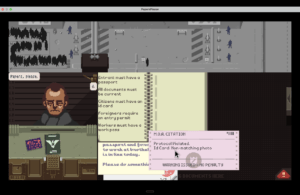
I was being rewarded not for understanding people, but for being able to identify inconsistencies quickly and accurately. This shows the role of incentives, where the procedure made it such that I was able to dehumanize those in front of me, and ensure that I was protecting my self-interest and needed to do a good job. Bogost’s idea of procedural rhetoric is applicable here, as the game isn’t telling us that bureaucratic processes can become dehumanizing, but training users into bureaucratic thinking through these incentives and intense repetitions.
The game also shows the emotional discomfort in the balance between personal morality and the responsibility of being an immigration officer. This connects to what Nagel mentioned, where public systems can pressure individuals to separate their personal moral instincts from their obligations as professionals. In the game, there were a couple of moments where this really stood out to me, where I felt bad for just doing my job. Specifically, when denying the woman in pink, and when she said, “curse you”. The discrepancy in her paperwork was so small, but I knew I’d get a citation if I let her through, and thus I had to deny. Since my “family” depended on my correctness, I was fighting this internal conflict, where even though helping people out may be morally right, this action could directly harm my own family. This conflict showed that inherently, procedures don’t need people to become cruel, but they cause moral distancing and compartmentalization by attaching survival and success to following the rules and doing one’s job.
The game felt especially effective because this transformation was gradual, through the introduction of more rules and game complexity. While at first, I noticed the stories and emotional stakes of each applicant, I realized that as the days went on and more and more rules were being introduced, I simply had to distance myself from the empathetic tendencies. I felt like I was treating these applicants as “if-else” statements, going through a system of checks before arriving at my decision. The game’s repetition and structure helped make this routine. As a player, however, I don’t think I was totally able to detach emotionally, as characters continued to tell personal stories/plead for help. In all of the people I considered, I found some stories to slip through the cracks, and really make me think a bit more (e.g the girl who said another man had mistreated her and her sister). This shows that even when acting within a system, one can still feel morally implicated in the consequences of their actions, even if these feelings deplete over time, and we become desensitized to them.
To conclude, playing Papers, Please, showed that through repetitive mechanics and incentive structures that tie one’s actions and consequences to survival, the game is able to train players to suppress empathy and prioritize efficiency. I wonder if I continued to play the game for the full game time, if the remnants of guilt and hesitation would persist, or if the game would be successful in completely suppressing them.


