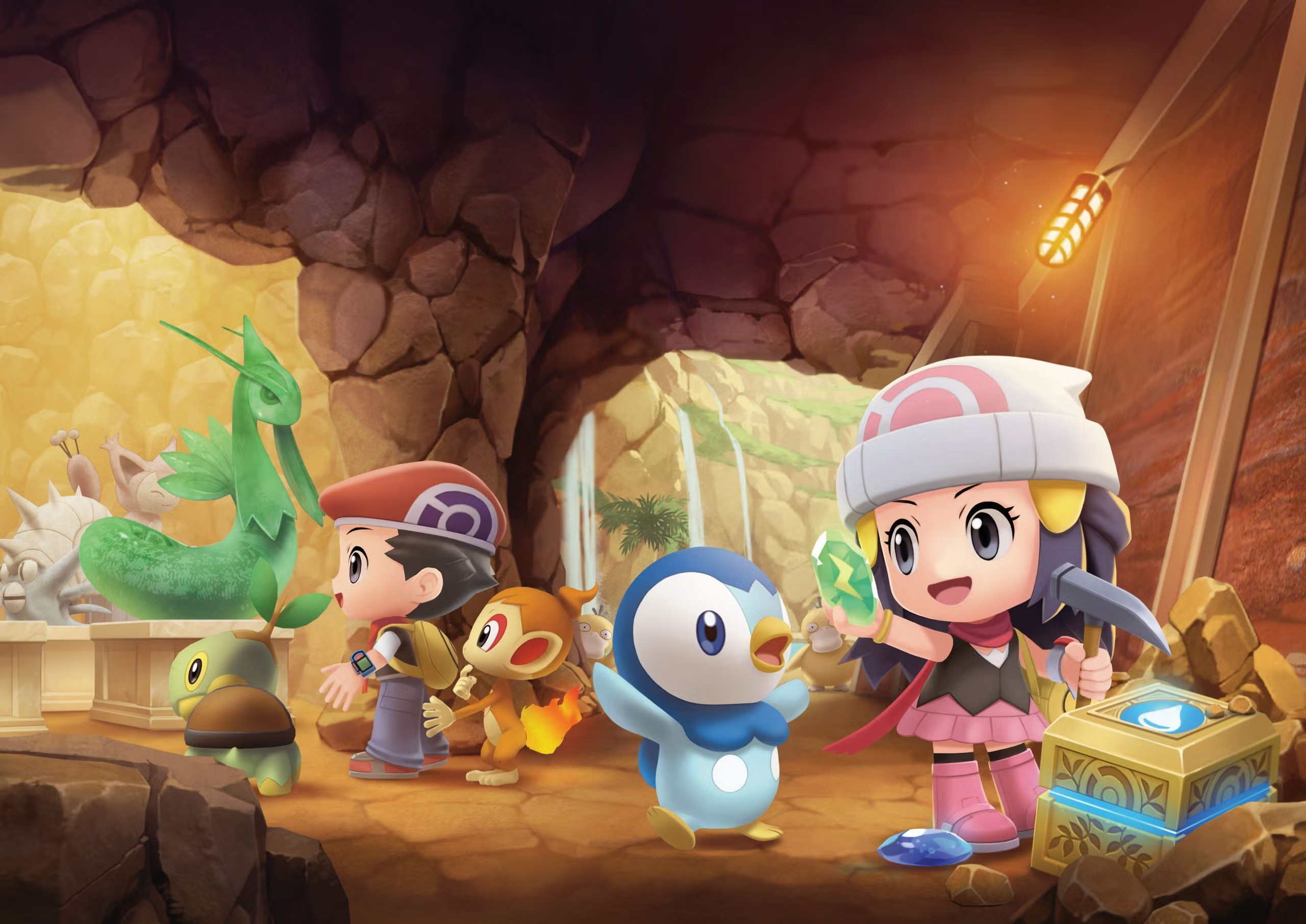
For this week’s critical play I played Pokemon Brilliant Diamond, a 2021 remaster of Pokemon Diamond originally released in 2007. The game was developed by ILCA and Game Freak for the Nintendo Switch, which is what I played it on. The game is targeted toward children, RPG fans, longtime Pokemon players, and players who enjoy collection-focused progression systems. This is actually my first time ever playing Pokemon!
Pokemon Brilliant Diamond invites players to care about its world through repeated interaction loops of exploration, battling, and collecting which gradually transforms unfamiliar creatures and environments into emotionally meaningful parts of the player’s experience. The game’s mechanics, architecture, and progression systems all work toward this aesthetic goal of making the world feel alive, expansive, and worth investing in.
One of the earliest things the game does to accomplish this is the starter Pokemon. At the start of the game the player must choose between Turtwig, Chimchar, and Piplup. Mechanically, this is just selecting a starter combat unit, but this Pokemon becomes inseparable from the player’s journey. Pokemon’s core interaction loop involves walking through tall grass, encountering a Pokemon, battling it and/or catching it, gaining experience, becoming stronger, and unlocking access to harder areas. Because your starter participates in nearly every one of these interaction loops, you naturally grow attached to the Pokemon through repetition. Additionally, you get to name your starter (and all your Pokemon) which further builds emotional attachment (my starter was a Turtwig named Azazel). The emotional connection does not come primarily from dialogue or cutscenes, but from the fact that your starter is constantly accompanying you through progression, victories, and setbacks.

The architecture of the world reinforces these dynamics. In the beginning, paths you have to take to progress are intentionally covered in tall grass or blocked by trainers which forces you into encounters. Architecturally, this functions as constraint and exploration. The game forces engagement with wild Pokemon battles while simultaneously teasing the existence of a much larger ecosystem. You constantly see unfamiliar Pokemon, blocked paths, or routes requiring abilities you do not have access to. This creates a dynamic of incomplete knowledge that drives exploration forward. This also forces the player to master the skill of battling other Pokemon and capturing them, a key skill they must do for the rest of the game.

This progression becomes more complex once the player reaches gyms. In the beginning players can often brute force encounters with other Pokemon by leveling up, but eventually they run into gyms, where they have to actually learn about Pokemon types and team compositions in order to win. This exemplifies the skill chain in interaction loops. Players must master simpler interactions (battling normal Pokemon) in order to learn compound interactions (battling type Pokemons). The architecture of routes and cities supports this arc because trainer battles are often unavoidable. Trainers physically block pathways and force participation in battles that teach these concepts. The game is constantly training the player through environmental design without making the learning process feel explicit.
Overall, Pokemon’s mechanics of catching, battling, and exploration create dynamics of discovery, experimentation, and collection, which ultimately generate an aesthetic of adventure and companionship. Importantly, the game’s emotional investment comes less from scripted drama and more from accumulation. You remember where you caught certain Pokemon, which battles nearly took out your team, or the excitement of evolving a Pokemon for the first time. The world begins to matter because the player has spent hours interacting with it.
Pokemon Brilliant Diamond succeeds at inviting you to care about the world because every part of its design pushes you toward curiosity. Its interaction loops reward exploration, its architecture hints at a wider unknown world, and its progression system encourages players to increase their mastery.
Ethics
The game’s mechanics, when looked at a little closer, feels a little ethically gray. Pokemon presents itself as cute and friendly, but the core gameplay loop revolves around capturing creatures from the wild, storing them in Pokéballs, and forcing them to battle each other for sport. The aesthetic presentation softens the implications because the Pokemon are stylized as adorable companions rather than realistic animals. If the exact same mechanics involved real animals, players would likely interpret the systems very differently.
I also think it is interesting to consider Pokemon alongside Japan’s broader “kawaii” culture. Japan has spent decades cultivating a soft global image through cute mascots and friendly character design, in order to distance itself from more troubling aspects of its imperial history and war crimes. I feel like Pokemon sorta fits into this tradition because the creatures are designed to appear lovable and collectible, which reframes domination and combat as harmless fun. Generations of children growing up with these games in Japan and the west are not necessarily being “taught” anything explicit, but they are repeatedly exposed to a system where collecting living creatures, storing them in devices, and deploying them in battles is framed as normal and even aspirational. Over time, you may internalize that and it can subtly shape intuition about what kinds of relationships with animals (and with systems of control more broadly) feel natural or acceptable.
I have been thinking a lot about how countries can use games and film/other entertainment media to control public perceptions because I recently rewatched Transformers and replayed CSGO and was shocked at how blatantly anti-Arab both media are. Lots of post-9/11 media aimed at younger audiences frequently portrayed antagonists as Middle Eastern across films, games, and television. Repeated exposure to these things as kids makes you internalize these sentiments and frankly I think it’s part of how the US successfully manufactures consent to wage war in Arab countries. I don’t know for sure that Pokemon is trying to do the same thing in Japan by cute-ifying environmental domination and combat but you can never be too sure.