
From a worldbuilding perspective, The Legend of Zelda: Link’s Awakening doesn’t look like much of a Zelda game at all. When Nintendo brought the Zelda series onto the GameBoy in 1993, they seemingly abandoned its most important conventions. The story doesn’t take place in Hyrule; the Triforce is nowhere to be found; and even Princess ZELDA herself is completely absent. Some familiar elements do return, like the main character and the soundtrack, but most of them are noticeably missing.
The challenge for Link’s Awakening, then, is to motivate players to explore its brand-new, self-contained setting. Crucially, this includes existing Zelda fans who were fond of the Hyrule-centered narrative in previous games AND more general action-adventure game players who chose this game as their introduction to Zelda. After playing through the 2019 remake of Link’s Awakening on Nintendo Switch, I can safely say that its worldbuilding is remarkable… and deeply, deeply lamentable. Link’s Awakening gets players invested through its endearing world and characters, only to present them with a devastating internal conflict in the game’s climax.
(WARNING: Massive spoilers for the main story of Link’s Awakening lie ahead.)
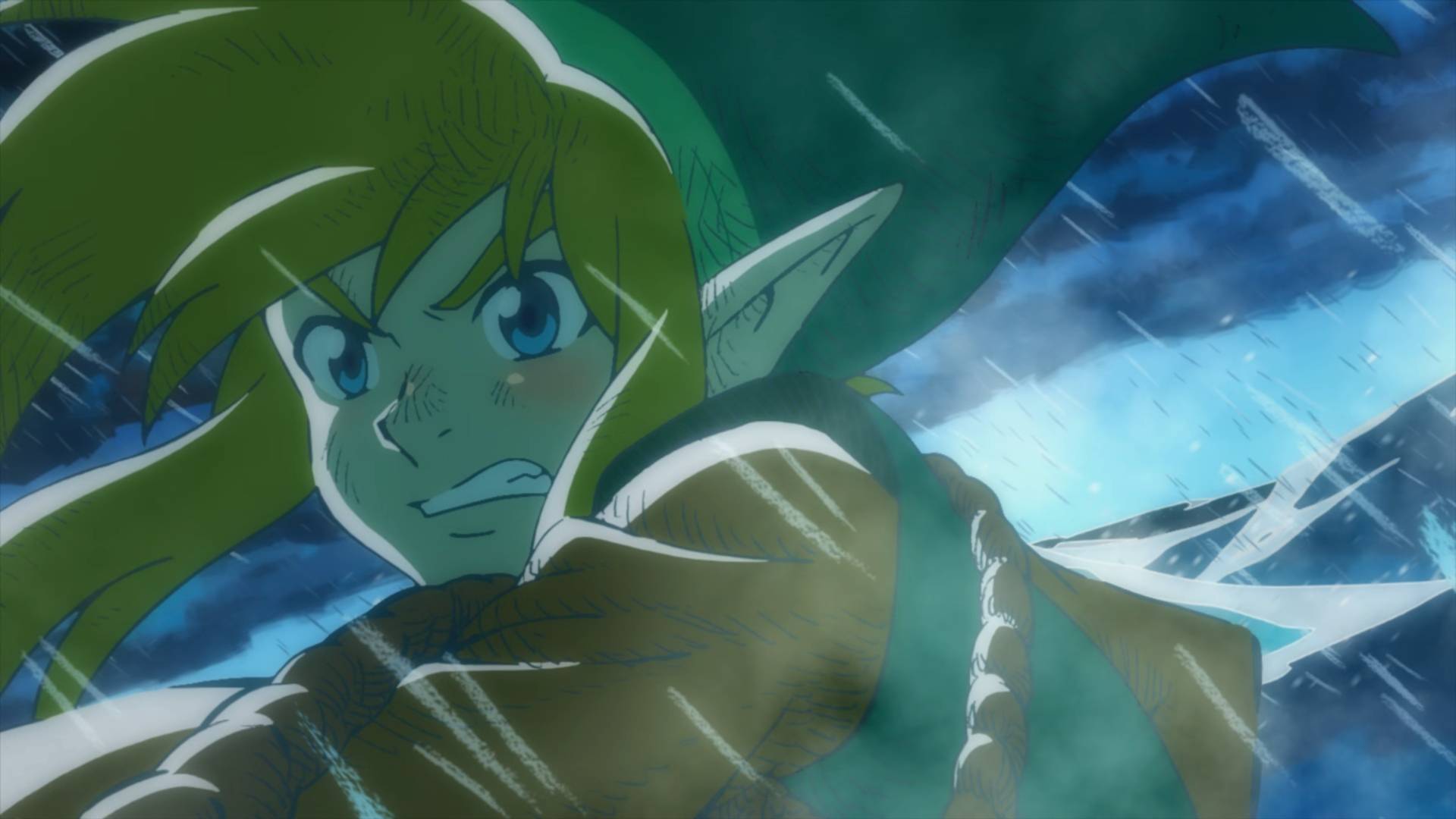
The opening cutscene of Link’s Awakening shows Link crashing his boat onto Koholint Island during a storm, losing his belongings, and falling unconscious: dire straits, to be sure. This is where the game introduces one of its strongest worldbuilding elements: Mabe Village and the NPCs who live there. Each person in the village comes together to help Link get back on his feet in some way. The characters all have a surprising amount of charm to them as well, becoming the subjects of some entertaining side quests: rescuing BowWow the dog from a pack of monsters, finding Richard’s missing golden leaves, et cetera. The depth of the NPCs is best exemplified by the so-called “trading quest”: a long chain of trading items from person to person across the land, effectively serving as a guided tour of the island’s social dynamics.


Of course, Link’s Awakening isn’t only about running around and talking to folks. Link’s main goal is to defeat monsters called Nightmares that guard the eight Instruments of the Sirens. Link is told that collecting all of these instruments and using them to perform a certain ballad will awaken a mysterious being called the Wind Fish, who will then grant Link’s wish of leaving Koholint and returning home. Importantly, though, the NPCs found across the island help the player see it as a place where people actually live and thrive, not simply a giant empty level to traverse in service of their own enacted narrative. The Discovery and Fantasy aesthetics are certainly still prominent, but they are not the only reasons players might have for engaging with the game.

The heart of Mabe Village—and the whole game, in my view—is Marin, the player’s primary recurring companion throughout the story. She finds Link on the shore and nurses him back to health; she helps him gain access to Yarna Desert, which contains an important key item; she teaches him how to play the Song of Awakening for the Wind Fish. Whereas Link is often stoic and quiet, Marin is expressive, cheerful, and compassionate. She very openly cares about Link, which in turn compels the player to care about her, as well as her family and home.

But as the player progresses through Link’s Awakening, the game’s truer, more melancholy nature starts to reveal itself. Through subtle hints and more explicit dialogue, Link learns that Koholint only exists within the Wind Fish’s dreams. (This is why the “Nightmares” are named as such; they are corrupting the Wind Fish’s dreams.) In turn, Link deduces that if the Wind Fish were to wake up, the island and all of the people on it would, in no uncertain terms, disappear from existence entirely. Mabe Village, Marin, the Wind Fish itself… all gone. This revelation totally recontextualizes the player’s past actions and their remaining journey. With every step they take, the player is bringing the world they’ve grown so attached to closer and closer to oblivion.
Despite this harrowing twist, the formal elements of Link’s Awakening compel the player to continue on their path just as before: defeating the Nightmares, collecting the instruments, awakening the Wind Fish, returning home. The game puts forward a tragic subversion of the hero’s role in a story, as Link seemingly both saves the land and annihilates it in one stroke. This is felt in full force at the game’s conclusion when Link finally does meet the Wind Fish, who delivers a short but poignant monologue about how Koholint will fade from reality, enduring only in Link’s distant memories and those of the player.
You’ve won, sure, but… at what cost?


As the narrative unfolds, Link’s Awakening does something truly remarkable: making you love something that it was always going to take away. That, in the end, is what makes it one of the most emotionally rich and quietly heartbreaking entries in the Zelda series.
Ethics Question:
Link in Link’s Awakening doesn’t really have an identity. He is broadly “courageous” and “loyal,” but those traits have more to do with what he does (defeating monsters, rescuing dogs, et cetera) than with who he is. The most noteworthy thing about Link is that he’s the only character who isn’t from Koholint; and even then, he looks almost exactly the same as the island’s native residents, further diminishing his uniqueness. In this way, Link’s body acts more like a pure gameplay tool than a manifestation of his identity. Perhaps he is left intentionally silent and generic to make it easier for the player to map their own narratives, goals, and desires onto him. That said, modifying his character arc to give him a louder voice, literally and figuratively, could go some way toward making him feel more like a fully-fledged character than a mere vessel.