Hades is a roguelike RPG developed and published by Supergiant Games. It was released on Steam, Nintendo Switch, PS4 and PS5, as well as the Xbox. Its intended audience is people aged 13+, and probably gamers with decent computers or consoles due to its moderate graphical intensity. I would also posit that it is intended for people with a prior understanding of Greek mythology, as Hades is largely an evocative space built upon Greek mythological lore and conflict. (To be honest, it’s one of my recent favorites and I picked it up a few weeks ago. I know, I know, I’m late to the party). For this Critical Play, I define “care” the same way one would “care” about the protagonist in any other story: living through them and empathizing with them enough so that in times of desperation, you physically feel desperate as well. Namely, Hades invites the player to care about the world through building a magic circle through the narrative events made possible through its evocative space, deriving mechanics which ultimately incentivize the player to progress through the game, and thereby its narrative.
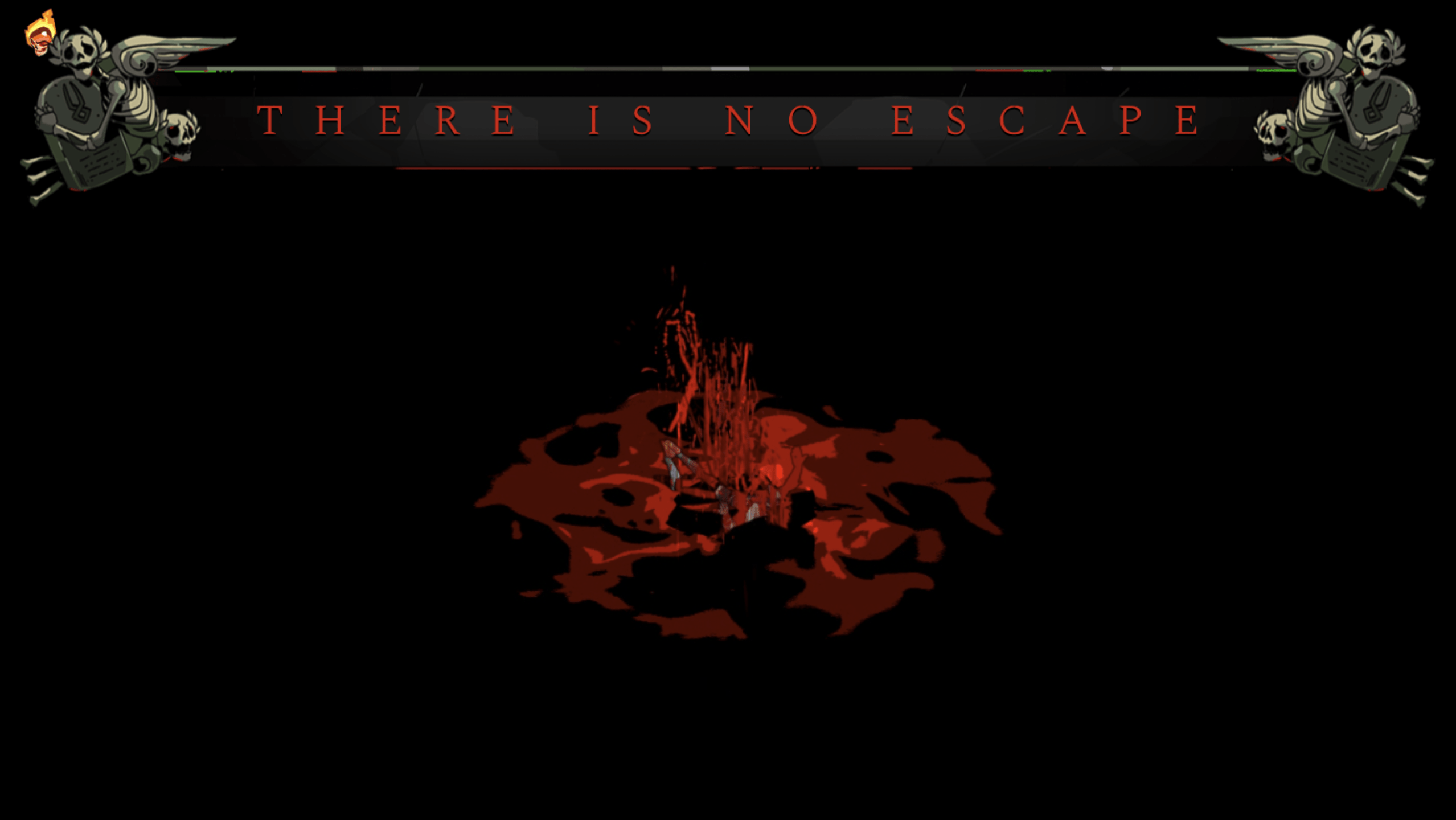
Hades is inarguably an evocative space built upon Greek mythology, building a magic circle which grounds the player in the narrative. For example, Hades narratively justifies the mechanic of resurrection by evoking Greek mythology. When the player dies, the player UI is replaced by a screen which says “THERE IS NO ESCAPE” in a blood-red text, with Zagreus’s hand reaching aimlessly out of a pool of blood, accompanied by a dark and dooming instrumental composed of ancient Greek instruments (Fig. 1).
Zagreus, instead of dying, emerges from the waters of the Styx back to the House of Hades, the starting zone of the game, as if he had never truly died. The player must understand this narrative contextually; they are resurrected because they are immortal, as it stands within the magic circle of Greek mythology, and therefore they must begin caring about Zagreus as a character because his character allows the player to have multiple chances at reaching the objective. The player is yanked back into the foundation of Greek mythology the game’s narrative is built on, and must understand the narrative events in this mythological context.
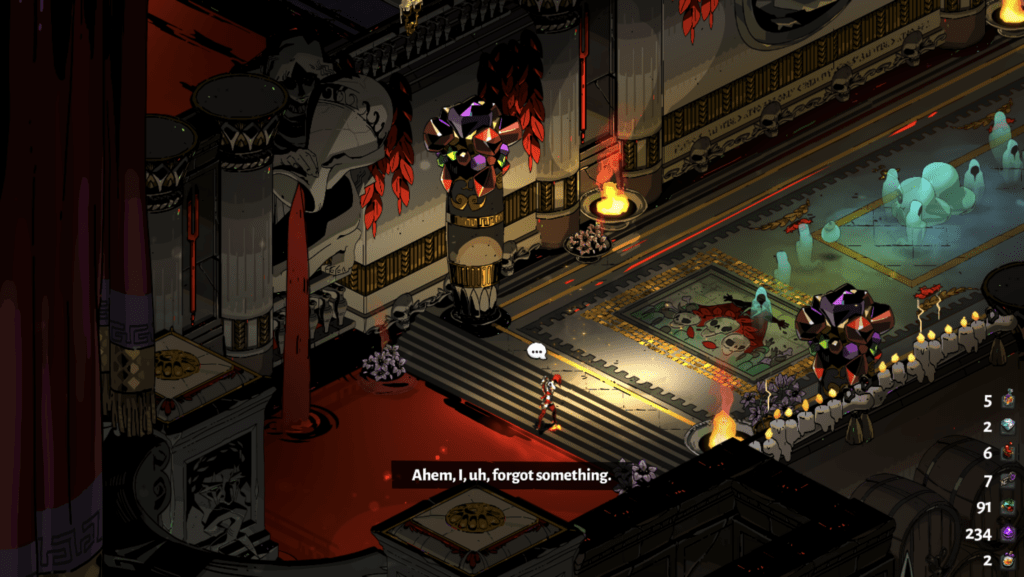
The player shares a meta-understanding of Zagreus’s immortality, conscious of the fact that he has an infinite amount of chances to escape, and motivating the player to care about the character through his reinforcement of the objective of the game. When Zagreus emerges, as the player would expect from Hades’s evocation, he remarks something, like “… Each time I die like that, I come back stronger” or “Ahem… I, uh, forgot something.” (Fig. 2).
This plays into Layers 4 and 5 of Pereira’s argument in “The Psychology of World Building,” where narrative events are justified through how the society they occur in functions, and how that world is connected to the worlds outside of it. For example, on each death, Zagreus unlocks new dialogue with the Gods in the House of Hades (Fig. 3).
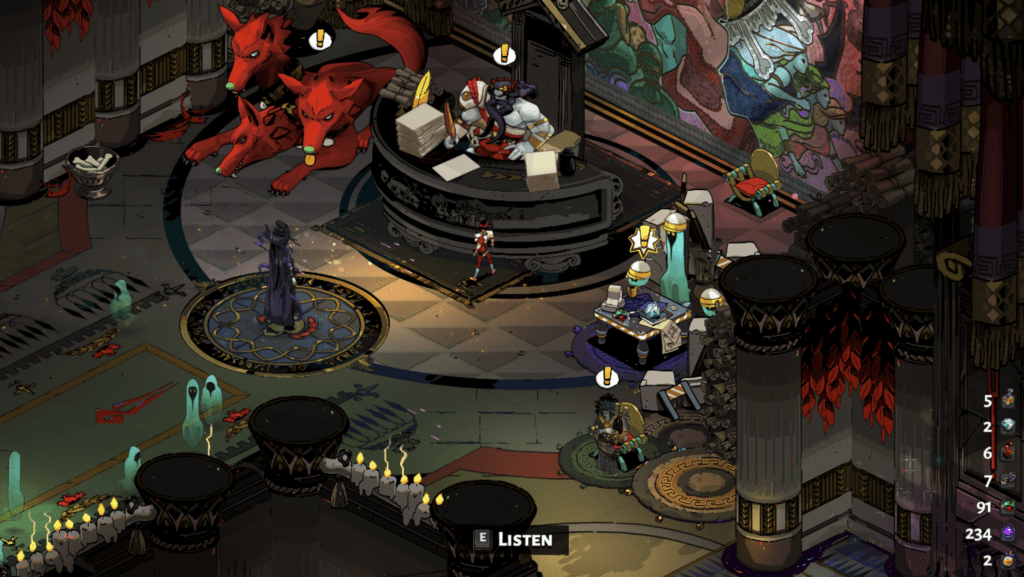
Going back to the magic circle and the characterization of Zagreus, death is not zero-sum, but a means to unlocking narrative and reaching the true ending of the game. The player does not give up on each run, but plays into the premise of the game, using the procedure of resurrection to unravel the events of the story. The player, within the evocative magic circle, cares about Zagreus because of his mechanic-derived perseverance to escape the underworld, a result of the evocative space and magic circle the player is immediately immersed in. Therefore, the player works through Zagreus’s enacting micronarratives to get him closer to the overworld,
Finally, and perhaps most importantly, dialogue with the Gods and mythological creatures in Hades is paramount, unavoidable, and a means to the objective of Hades, uncovering Pereira’s insistence on supporting characters. To progress through the game through combat, the player must equally interact with unskippable dialogue with Gods, monsters, and three-headed dogs. We see this from a core mechanic of Hades, which are the godly boons: the gods want to support Hades in escaping the underworld, and many of them are loving in their dialogue, referring to him as a kind nephew or dear brother (Fig. 4).
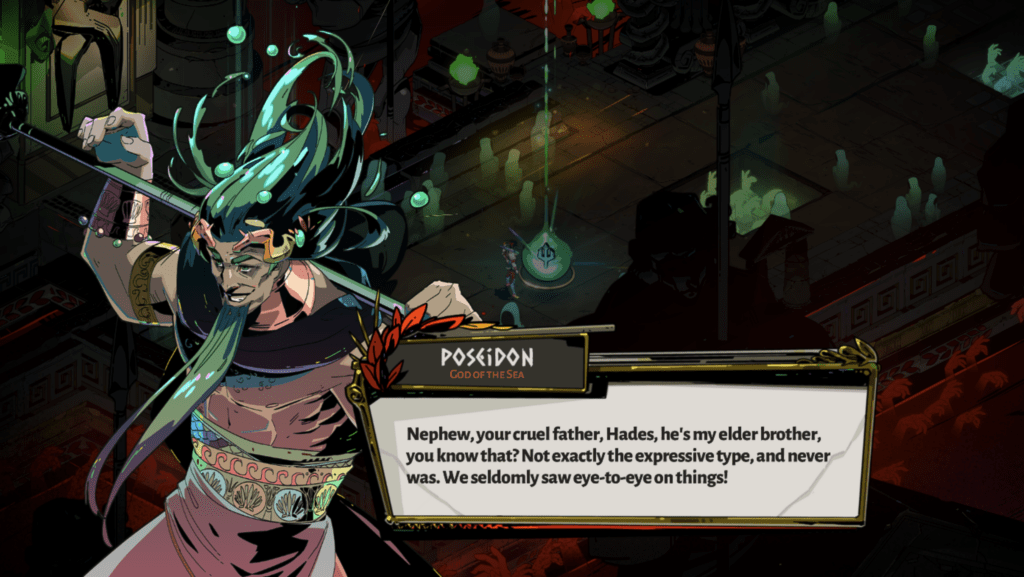
With the gods literally empowering the player, they can further characterize Zagreus as someone who is generally likable on Mount Olympus with stakes among his guardians, and therefore they will further progress him to his objective.
Hades does a wonderful job of characterization and concept design for each god and generally-important character. However, there are some deeper implications to consider; for example, the anthropomorphic enemies in Hades are characterized by caricatures, the strong “Wretched Thugs” having overly muscular upper bodies, the body-slamming “Wretched Louts” having larger bellies, the magical “Wretched Witches” having frail, skinny bodies and generally being characterized as elderly women. Their respective methods of attack are not at all dependent on their body, but are emphasized by their body types nonetheless. These create stereotypes of who has power: a frail witch can only exhibit power through magic, and not through physical prowess, and someone with a larger belly cannot fight normally, but rather through body-slamming. The one with the most autonomy is the “Wretched Thug”, with his obvious display of muscle. These traits implicitly create a hierarchy of who is the most powerful, ultimately reinforcing certain stereotypes in our society.