For this week, I chose to play Factory Balls, a 14 level flash game developed by Bart Bonte that was eventually extended to a 221 level full game. The full game is available on Steam, but a free demo of the first 25 levels is available on the web browser (which is how I played it, for this critical play I played the first 15 levels). The game is designed for players who like to figure out puzzles on their own– typically in a trial and error style. The game is a single-player game and is structured with many levels, so a player can spend just a few minutes on the game, or several hours.
I have mixed feelings about Factory Balls’ mechanics. It is a compilation of abstract logic puzzles which certainly have strengths (although even these are double-edged)– like the player’s feeling of accomplishment from a challenging kind of fun and adherence to some of the 12 rules for puzzles. However, there are some glaring weaknesses: strange balancing decisions, incohesive mechanics, and no hint system.
To start with the positives, one thing Bart Bonte clearly playtested thoroughly was rule 9: “Puzzles should have no destroyable states”. For instance, the following is level 9 of Factory Balls, which includes a recycle bin mechanic in the bottom right.
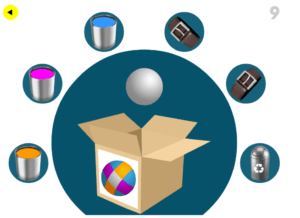 Level 9 of Factory Balls
This level requires the player to leave white in the center of the ball, so if the player messes up, they would be in a destroyed state (or softlocked) if the recycle bin didn’t exist (recycle bin just makes the ball white again). This mechanic creates the dynamic of allowing trial and error in level 9, which creates an aesthetic of feeling more forgiving / fair for the player (which also corresponds to rule 1 of puzzles, which will be discussed later). Overall, level 9 practices rule 9, and this recycle bin mechanic is used repeatedly in the levels that I played afterwards too.
Furthermore, Bart Bonte follows rule 1 to an extent: “You are on the player’s side”. I argue this due to the fact that a tutorial does exist on the first level.
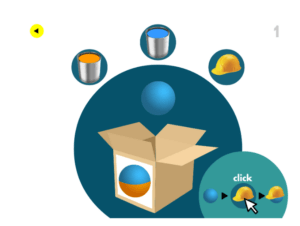
Level 1 of Factory Balls
However, while Bart Bonte is on the player’s side by including this tutorial, his approach feels flawed; it doesn’t feel like a tutorial, it just feels like a solution (it feels like if you ChatGPT a homework: you read a solution, but don’t understand it). It is quite easy from the player side to just follow the instructions on the bottom right– clicking through without understanding what is happening. It would help on this first level to give the player less autonomy and deliberately explain that the hat protects the top side of the ball rather than assuming the player infers it. I appreciate that this tutorial exists at all, but it could be improved upon greatly.
Unfortunately, there is a reason I articulated that Factory Balls follows some of the 12 rules, as it unfortunately breaks several. The most egregious example is rule 6: “correlations should make sense”.
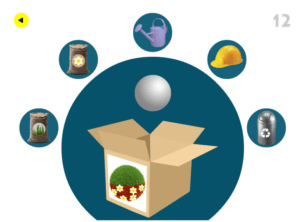
Level 12 of Factory Balls
As a disclaimer, I only played the first 15 levels, but level 12 makes absolutely no sense in terms of correlations. Firstly, the player needs to figure out they can water both the grass and the flowers multiple times, which is fine, but grass apparently turns red if the player waters it 3 times. This mechanic is not used prior, or on levels 13-15, rendering it extremely random and creating an aesthetic of incohesiveness with the rest of the first 15 levels, while already not correlating with real life at all. (I did some research and it is used again on levels 17 and 23, but overall it still feels very disconnected from the rest of the levels). Overall, I wish this was introduced more smoothly and not used as sparsely; the correlations here also need to make more sense.
Secondly, I personally argue that this game breaks rule 7: “A puzzle should not take more than 5 minutes to complete” as well. I believe there is a sharp difficulty spike from level 9 to 10; levels 1-9 took me less total time than levels 10-15 individually. Level 10 is the biggest offender, which took me nearly 20 minutes with a hint after 18.
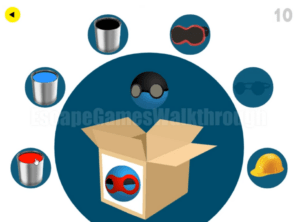
Level 10 of Factory Balls (credit to EscapeGamesWalkthrough as I forgot to screenshot during my playthrough)
I think an increase in difficulty is expected throughout the game to keep the player engaged, but Bart Bonte should have made this difficulty increase more gradual. To play devil’s advocate, abstract logic puzzles typically are difficult to balance for a relatively broad audience; I guarantee Bonte didn’t want the solution to be too obvious, but I’d probably have spent 30 minutes on just this puzzle if I hadn’t looked up a hint, violating rule 6. A hint system (whether togglable or it occurring after a certain amount of time) would be greatly appreciated in these cases, as I felt immense frustration (both with the game and with myself) for not being able to figure out the puzzle, given how simple it looked (the game is much harder than it looks).
To end on a positive note after my negativity, one thing all the levels (except level 12, I really don’t like level 12) gave me was the challenge kind of fun. Every completed level gave me a sense of accomplishment, which I really appreciate from a design standpoint. These levels all develop your toolbox and make sense once you complete them, especially from level 13 onward, where I was beginning to feel confident about my own puzzle solving abilities.
Ethics Paragraph:
Factory Balls generally doesn’t make big external assumptions, but makes several more subtle, internal ones. The only external assumption that I saw was (sorry to bring it up again) but level 12, which assumes that you know how to grow grass (by watering seeds) and assumes you know how to turn grass red (by watering it three times).
Other than that, there’s a few internal assumptions made, some of which I brought up in the critical play. For instance, the game assumes that you know exactly how the hat works after the tutorial– I thought the hat was just a decorative piece at first / didn’t realize it blocked the top half until I went back later. It also assumes you know exactly which regions each obstacle will block off, (which of course can be found with trial and error still, but it is still an assumption). It does not assume that the player will be perfect and find the solution immediately which is a positive, hence the existence of the recycle bin, though an undo tool could be nice as well to make that an even stronger strength.