For my critical play this week , I chose the game Myst. Myst was first released in 1993 for Mac by Cyan, I played Myst: Masterpiece edition, a remaster of the game that came out in 2000 (which updated it’s graphical resolution and sound bitrate). I think Myst was originally designed for players who liked point and click adventure puzzle games, which in 1993 was a much more popular genre than it is today. I only played about an hour and a half of Myst, and pretty large chunk of that time I spent struggling against the point and click controls. I don’t think this was in any way a fault of the game or it’s design. I think it was instead due to the fact that in the last 32 and a half years the kinds of games that are popular have shifted greatly, and despite playing a lot of games (and even a bunch of point and click games) the game (reasonably) assumed some familiarity with the conventions of games of the era.
I would argue that in this original version of Myst there is only one programmed puzzle mechanic, click a pre-rendered graphic to gain raw information. All of the seemingly different mechanics present in the game, things like interacting with objects, submitting combinations, and moving around the world really just boil down to this one mechanic. This simplicity in puzzle interaction allows for every single input into the game to feel like a step in solving a puzzle. The pre-rendered world also allowed for the game to represent puzzles with much more semantic depth than had the game been rendered in real-time (using the technology available in 1993).
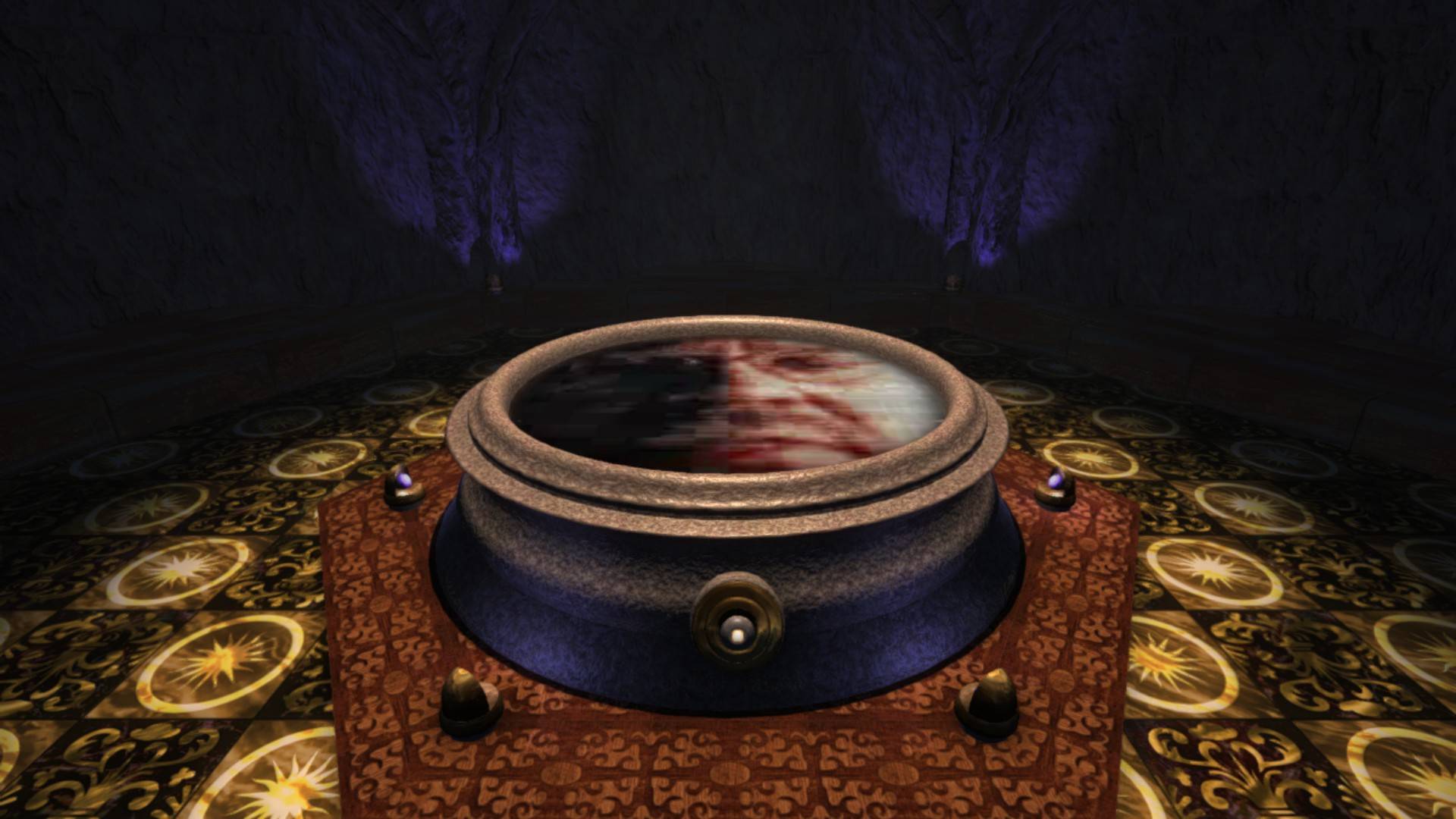
Myst’s interactions with objects in the game world boil down to clicking on specific points on the screen to change which render is being shown to the player. For puzzles this can be things like books, paintings, notes, buttons, and the list goes on. I obviously did not play Myst for long enough to deeply dive into the myriad of puzzles it presented, but I decided I would play at least until I solved a few puzzles. The technical mechanics of the puzzle solving that I witnessed all followed the same loop, click to move around the world, find places that accepted input, continue moving around the world, and then find some form of information that fit this format. All of the puzzles I encountered followed the same technical implementation, but the prerendered graphics meant that, by simply changing the visuals of the pixels I was clicking, the puzzles had very distinct meanings in the context of the game. One example of this puzzle solving loop came when I found a place that took a date as input.

This didn’t just serve as an input field though. Finding this input field was a way of the game giving raw information, it meant that somewhere on this island was a date in this format. Later in the game I explored another building and eventually found dates that fit in this panel.
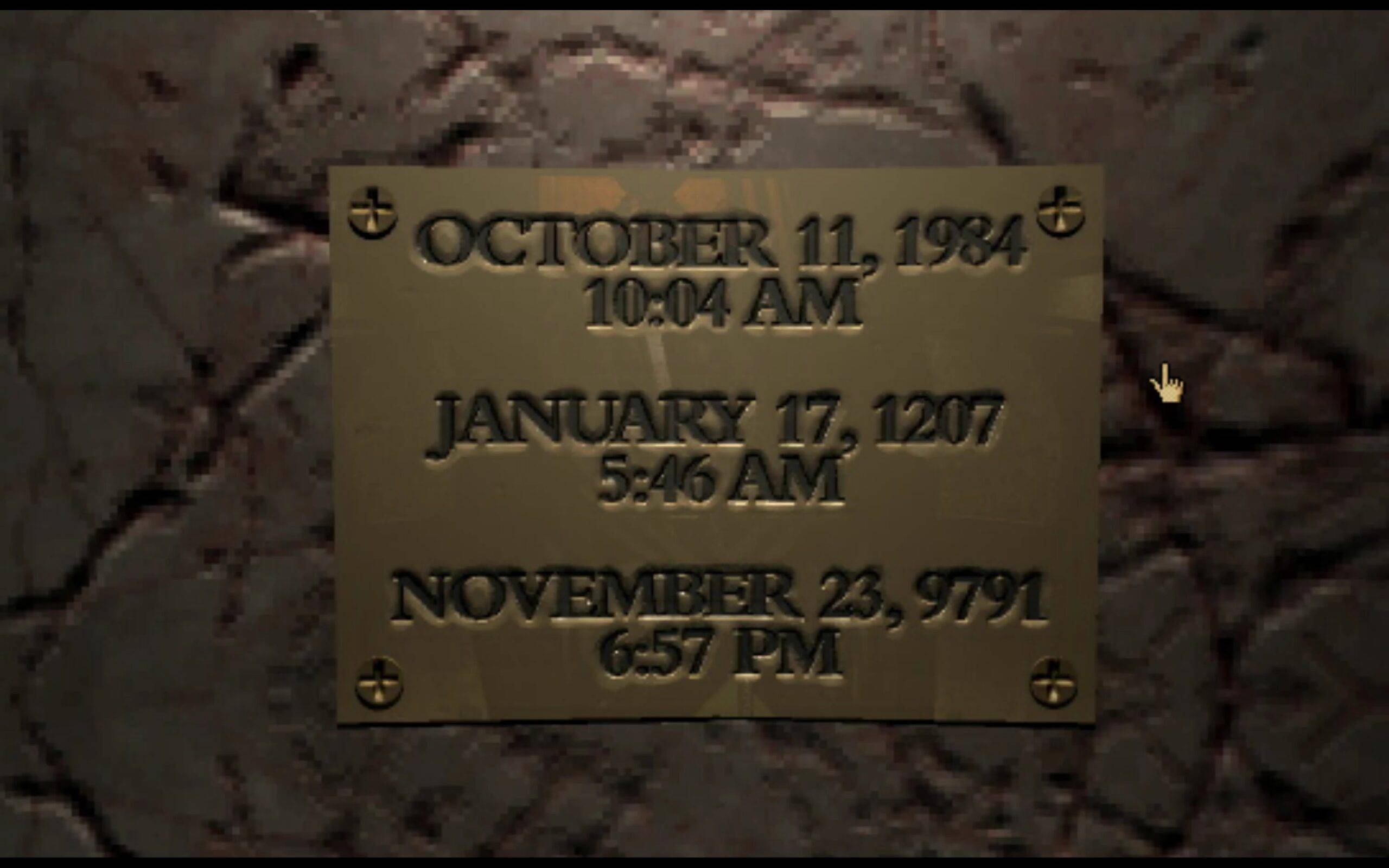
Even though logically it feels like these two game world objects are fundamentally different, one is a lock and one is a key, they both serve as raw information that leads you further on the journey. When these dates get input into the earlier interface, there isn’t some magical door that unlocks, instead we are shown images of constellations which again, tells us that somewhere on the island of Myst is a use for a pattern of stars. Another of the early puzzles is one that has you counting the number of switches on the island, the flow is similar, you find a room with a hologram and a number input field, you find a note saying you need to input the number of switches on the island into the number pad, you count the switches, you input the number, and then a video plays giving information on what to do next. One neat part of the click-for-information mechanic is that it lets all of the information present in the game exist on the same plane of importance. The game has no expository cutscene telling us who we are and what is going on, instead we find a note which refers to us by name, and then read diary of the entries that refer to us. This makes uncovering the narrative the same exact kind of puzzle as entering the dates, we find one piece of information, and then later find another which then requires we apply the information we already found to understand the full context. This method of narrative combines the embedded and embodied together, we are uncovering the story as it unfolds.
In the original game, movement works exactly like opening a book or examining an object does. You where you want to go then and the screen snaps to a fixed render in that general direction. I found this to make navigation feel like the other puzzles in the game. Every time I moved I got information about what I could see and had to use that information to determine where I was now and where I wanted to go, but I think the pre-rendered graphics do sometimes have a bit of the “hunt the pixel” issue we saw in the puzzles reading. Moving required me to click on empty space, and it was unclear when I was and wasn’t able to move to specific places.
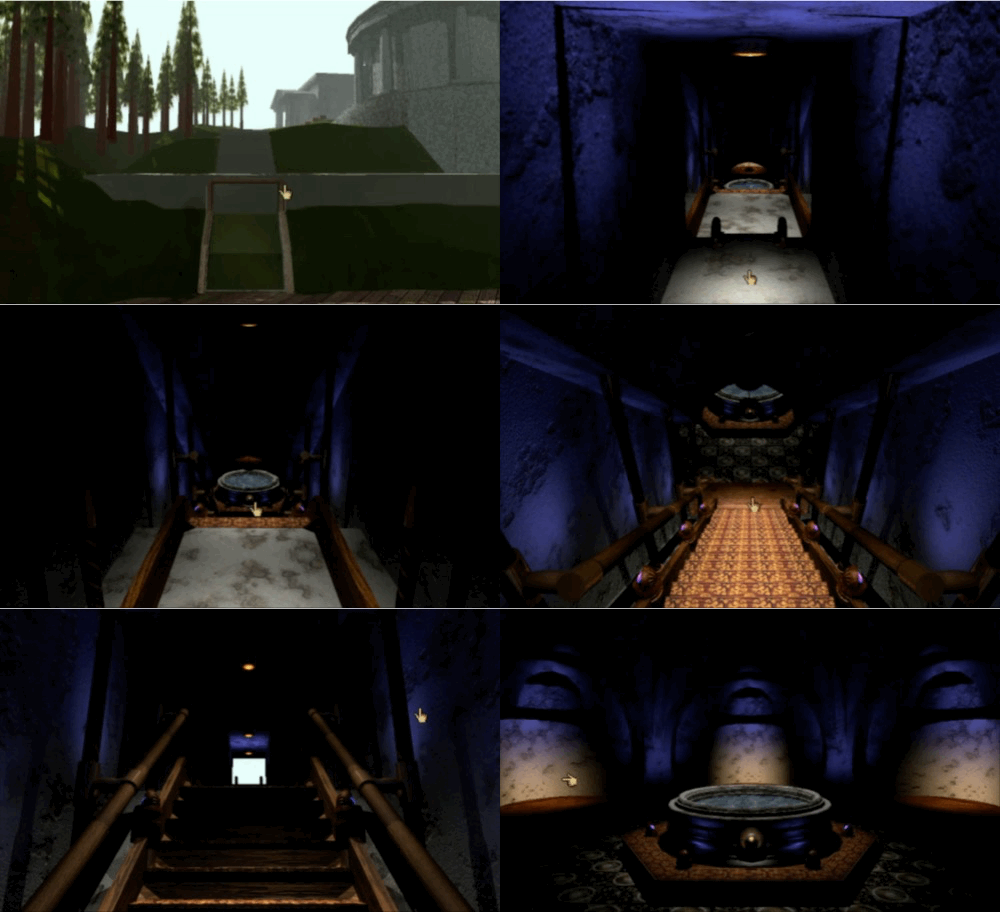

I played the original version of Myst because I wanted to see the original vision for the game. Upon actually launching the game and playing it, I realized that the game designers created a fully 3d world, but it seemed hardware limitations forced the game to be pre-rendered. This is when I downloaded realMyst, this was a game made by the same developers in 2000 but instead renders in real-time (Thanks Moore’s law!). The game remains point and click (with optional WASD controls), and the puzzles have not changed at all. Instead of snapping between renders, there’s smooth camera movement between the positions. This smooth interpolation between the already existing renders completely changed the game experience. Instead of every step feeling like a triangulation puzzle, the movement was much more immersive. It was easy to focus on the puzzles and embedded world building themselves, instead of fiddling with the movement.
Ethics:
I think Myst (as far as I saw) did not rely on specific external knowledge in the design of its puzzles, but I do think it relies heavily on the player being familiar with adventure games of the era. I spoke a lot about the movement earlier, but the biggest thing I saw being referred to online was the save and restore functionality. Saving in Myst is as simple as saving in something like microsoft, but the game offers you upwards of 10 slots for save games. It seems like swapping between saves is a mechanic needed to fully enjoy the game, but it’s one I don’t think many kids today have familiarity with, since most things on computers auto save now. The idea of saving and swapping between many save files is one that peoples who have more recently gotten access to computing would likely have difficulty with.