Critical Play
For this week, I chose to focus on Luigi’s Picture Poker, which immediately caught my eye due to my addiction to this as a kid when I 100%d Super Mario 64 DS. The original game was produced by Nintendo and is available on the Nintendo DS as a minigame through both Super Mario 64 DS and New Super Mario Bros (DS), though for this critical play it is available for free thanks to Marcy4000, who recreated the game in a web browser for free. It is a single player game specifically designed for children due to being a largely simplified version of Poker– though it can be played by adults it is likely not Nintendo’s intended audience.
This game is a notable exception from the rest of my critical plays, as it was extremely addicting for me as a kid, but not as an adult. Though I believe I am currently not the intended audience, I will argue for what elements made the game addicting for 9 year-old me, but not for 23 year-old me. Luigi’s Picture Poker can be addicting due to its illusion of control, betting system, and usage of clustering techniques, but fails to retain older audiences due to its poor game balance, lack of stakes, and general lack of depth.
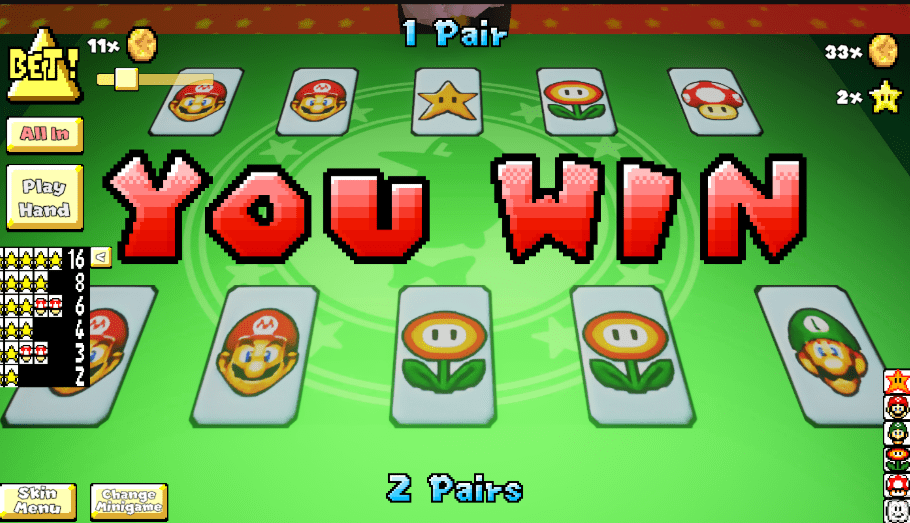
As always, I’ll start with the positives first– I loved this game in 2012; the biggest factor for this was Nintendo giving me an illusion of control.

Example of swapping out a “star” card in Luigi’s Picture Poker
What distinguishes this from traditional Poker is that Nintendo allows you to swap out any amount of cards in your hand. Unlike traditional gambling machines which sometimes have a STOP or allow you to spin reels in a specific order, this felt engaging to my child self– “I have control over which card(s) I want to get rid of– so it must be my fault when I lose– so I have to learn and be better!”. Nintendo pushes this internal thought process hard and effectively tricks children with the “illusion of control” rather than outright giving control (as the card you get back still is random).
Another addicting mechanic is the betting system, and particularly the “All In” button.

ALL IN BABY
The bright red text is a deliberate choice by Nintendo which makes the player’s eyes wander towards the button, making it extremely clickable. This creates an interesting aesthetic: the dopamine a player feels when succeeding an “All In” is immense, but failing is a crushing blow. Nintendo deliberately designed this to keep the player either chasing that dopamine hit or recovering from their mistakes. This also exists in Poker and accomplishes the exact same purpose mechanically, though the dynamics are different with real vs. fake money.
Lastly on the positives, Luigi’s Picture Poker employs clustering, which kept 9 year-old me on my toes.
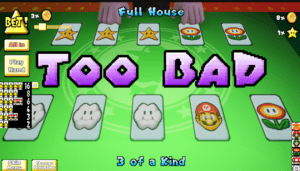
Example of a “Near Miss”
Luigi’s Picture Poker uses virtual reels instead of physical, so it can secretly display odds that seem in favor of the player that are actually in favor of the house. The above screenshot shows this, as I got a 3 of a kind when Luigi got a full house. Near misses are extremely common and enchant the player’s experience: “With just one different card, I could have won!”. Nintendo could have designed an alternative mechanic that feels more unfair (e.g, increasing Luigi’s odds of a 4 of a kind / 5 of a kind significantly), but this would feel less addicting and turn off the player greatly– similar to how increasing the number of physical options on a wheel turns off gamblers greatly.
However, I did only play this game for 15 minutes for my critical play, as the game just wasn’t addictive anymore due to its lack of depth. The game revokes many elements of Poker (bluffing, folding, other players) to tailor its gameplay to children, but this takes away from the experience as an adult. This is an understandable design decision since it is a minigame on a E for Everyone DS game, but it made it hard to play for me. Furthermore, all mechanics are static in this game. There aren’t other players whose strategies may change over time, which would introduce dynamic mechanics naturally. Even without this, Nintendo could have benefited from adding a monotonically increasing minimum betting amount as a dynamic mechanic, leading to increased stakes each round.
Speaking of stakes, there just aren’t any in this game due to no real money being involved– which is obviously understandable given the audience. There’s no financial loss; you can just try again if you lose; This is also an issue I have with games like Poker with Friends too. It can be argued from the designer perspective that this itself is addicting as the player can always keep trying, but the lack of stakes and other players made it hard for me to care.
Lastly, the game balance leans too far in the direction of chance rather than skill. While it is more skill based than games like Flux due to meaningful actions, it is less skill based than games like Blackjack and Poker due to the removal of several aforementioned dynamic mechanics. Nintendo designed Luigi’s Picture Poker so the house will win more often than not, which makes it so the odds are weighted against the player while already being clearly more about chance than about skill. The 9 year-old me did not care about game balancing at all, but the 23 year-old me became bored of the game as outcomes felt too random.
Ethics:
Firstly, if money is not involved, I believe that it is always morally permissible to use chance. However, if money is involved, I think the question becomes more complicated. In games with randomness specifically, I think money can be involved theoretically if everyone accepts beforehand that randomness is a part of the game. Additionally, everyone needs to be fully educated on the tactics that are used in games with randomness such as clustering, puffing, virtual reels, and statistics of a card deck (how many of each type of card and suit there are). Additionally, people need to understand that they may not always be at fault for their loss, which can be hard for people to fully grasp. Unfortunately, this is just too many caveats– especially if the game contains a lot of players, which makes these concerns too much for all players to fully understand in practice. As a result, I don’t think it is realistically permissible to rely greatly on randomness when money is involved and I believe that games with money on the line should lean heavily into skill expression rather than pure chance.