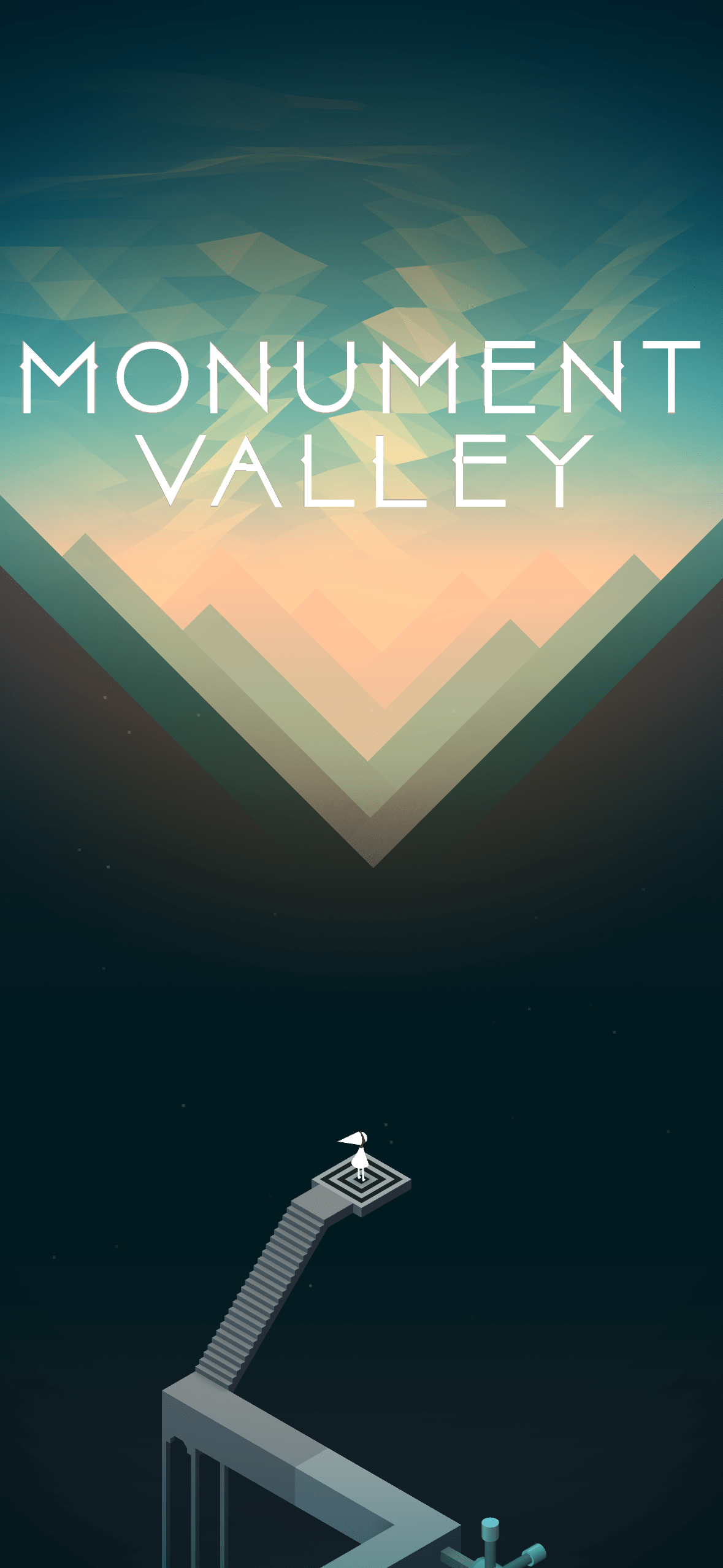
This week, I played Monument Valley on my mobile phone, a 2014 isometric puzzle game directed by Neil McFarland and published by Ustwo Games. Monument Valley was designed to appeal to a broad range of people from as young as 3 or 4 to adults. It is a massively popular game, selling over 26 million copies in the first two years from its release, and spawning two sequels released in 2017 and 2024 respectively. The main game has ten levels, and though it features increasingly complex puzzles, I would argue that the design restraint shown in maintaining the simplest mechanics drives the fun of this game.
The game’s simplicity is apparent directly upon opening the application, as the player is thrown straight into an introductory puzzle. This introduces the two main mechanics that underpin the entire game: tap a location to move the character, and hold to manipulate the environment. These two mechanics never change, and create a linear sense of balance in the difficulty progression. The fact that this mini-puzzle appears before the title screen creates an even playing field where every player has everything they need to complete the game before the title credits roll. There are no power ups or special abilities to unlock; the only upgrades are in the player’s own ability to solve the puzzles through the levels. This player-based scaling creates a high sense of motivation, as the player has autonomy to engage with the world within the ruleset, and relies on their own competence to finish. This creates a sense of balance as chance has little to no effect on player success; skill is the only vehicle to completion.

Introductory Puzzle.
Monument Valley is classed as a puzzle because the only objective is to solve each level, as opposed to defeating some kind of opponent. This creates a dynamic of trying everything the player can think of without consequence. On particularly challenging levels, I found myself rotating the screen over and over again, sliding paths back and forth, and tapping areas to see if Ida, the main character, could get there. Constraints are the facilitator of fun here, and the design decision to maintain two simple mechanics allowed for increasing diversity and complexity of dynamics. For example, in the first few levels, you can only slide a single path forward and backward or turn a single crank. From the introductory puzzle, it is also clear that the game will play with geometry and perspective, which also gets more complex, allowing players to rotate the whole structure to create new paths. At level 5, the Crow People are introduced, creating a new barrier to overcome. Throughout this difficulty curve increase, the player still only has two options of what to do: tap to move, or hold to rotate.
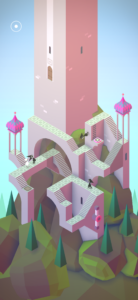
Crow people blocking Ida’s path.
Aesthetically, the game does an incredible job of guiding the player toward their objective in each level. The designers employ spatial pacing to have a “tower” on each level with a floral button that the player need to reach to complete the level. The sound design plays a huge role here, as every move the player makes is accompanied by satisfying audio feedback like grinding stone when a part of a building is being rotated. The surreal aesthetic of floating maze-like castles in the sky creates a pleasing sensation that combines with the stellar soundtrack to create an immersive experience for such a mechanically simple concept.

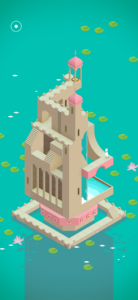
Increasingly complex rottional puzzles that allow the player to turn the whole structure to create new paths.
This immersion is further deepened with the underlying narrative. On the very first level, we are shown a caption reading: “Ida embarks on a quest for forgiveness”. This raises a question, “what does she need forgiveness for?”. We also start to wonder “who are the crow people, and why don’t they seem to like Ida?”. These simple narrative breadcrumbs create a sense of mystery that helps pull the player along in their quest to solve each puzzle.
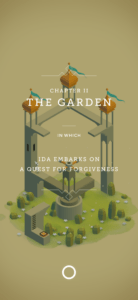
Narrative hints of Ida’s motivation.
The simplicity of the mechanical ruleset reminded me of another game, Baba is You, where the player must use computational logic to manipulate the world in a way that allows them to solve the puzzle on each level. Baba is You was also massively popular, and leaned into the idea that the player “co-creating” the world was a fun dynamic. Monument Valley’s commitment to it’s basic mechanic also reminded me of Cube Escape: Paradox, an escape room puzzle game, where the player can only click on objects in the environment to attempt to solve puzzles. In summary, Ustwo games’ restraint was its greatest asset in creating this game, as constraining mechanics allowed them to explore complexity in the spatial puzzles.
Ethically, the area of most concern in the game is how visually-oriented it is. Colors play a huge role in solving the puzzle, with players needing to step on squares shaded sightly differently in order to rotate certain objects, which could be challenging for a colorblind player. Visually impaired players would likely be unable to access this game as well, with depth perception and the ability to perceive visual hierarchy central to gameplay. Apart from visual accessibility, the game requires you to come in with little to no prior knowledge to fully access the fun.


Example of slightly different colored squares that affect whether the crank is available or not.