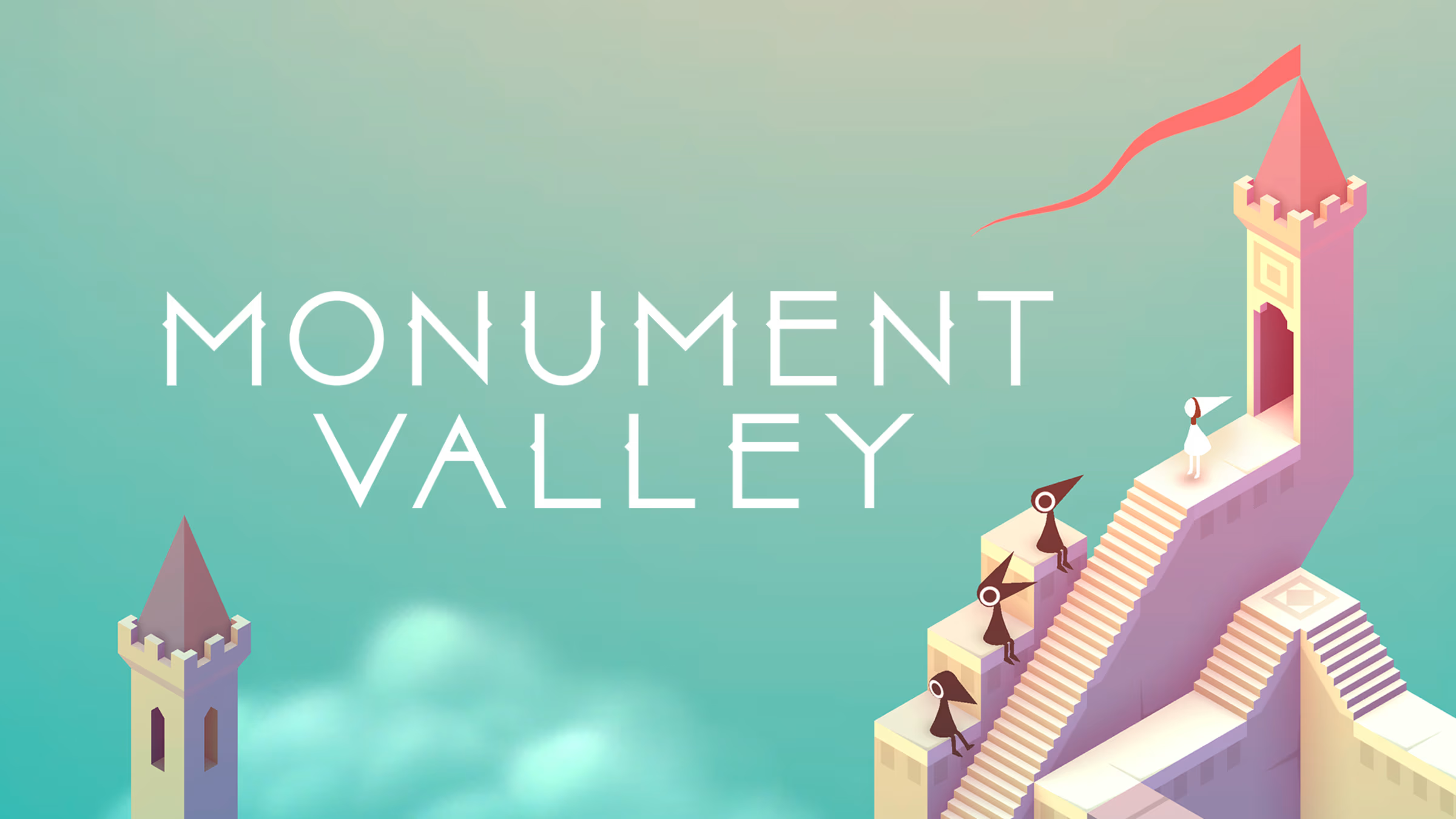
Monument Valley
Platform: iOS / Android | Developer: ustwo games | Target Audience: Casual to mid-core gamers, ages 12+
There is a moment in Monument Valley when you rotate a pillar and watch a staircase fold through itself, connecting two platforms that should never meet. The princess Ida steps across the impossible junction without hesitation. That moment is not just a solution to a puzzle. It is the entire game in miniature.
In Monument Valley, players would guide the silent princess Ida through a series of geometric, M.C. Escher-inspired monuments. The core mechanic is simple: tap to move Ida, drag or rotate architectural elements to alter the world, and find a path to the exit. But what makes the game wonderful lies in how deeply those mechanics work with its emotional and aesthetic experience. In the game, the mechanics of spatial manipulation are not a means to an end. The puzzles do not just challenge the player; they produce wonder, disorientation, and, ultimately, a quiet sense of restoration.
Scott Kim defines a puzzle as something that is “fun” and “has a right answer.” Monument Valley satisfies both conditions, but it goes further: it makes the journey to the right answer feel like a revelation. Bob Bates calls this the “V-8 response,” the moment when a player slaps their forehead and thinks. Monument Valley engineers this feeling constantly through perceptual reorientation.
The primary mechanic of rotating and sliding architectural components exploits a phenomenon that cognitive scientists call impossible figures. Escher’s drawings of infinite staircases work because the human visual system commits to a local interpretation (this step goes up) without tracking the global contradiction (the staircase loops back on itself). Monument Valley weaponizes this gap. Players are asked to inhabit the contradiction, to move through it as if it were ordinary.


The MDA framework helps explain why Monument Valley’s approach is so effective. The mechanic (rotate geometry) produces dynamics (path-finding through impossible space) that generate a specific aesthetic: discovery and fantasy. This is a deliberate design choice. ustwo games stripped out nearly every conventional game element to preserve that aesthetic pipeline. There’s no inventory, no dialogue trees, no fail states to speak of. When there is nothing to fail at, the player can fully inhabit the act of looking.
One of the game’s most insightful design decisions is its use of the Crow People, who block Ida’s path and can only be repositioned but not defeated. They stand where they have always stood. Ida has to move around them, or reroutes them through environmental changes. This mechanic quietly argues something about the game’s themes. Obstacles are not enemies, and navigation is a matter of perspective rather than force.
Where the game is less successful is in the relative brevity of its challenge. Several chapters are more visual poem than puzzle, solvable in under a minute. For a player seeking the sustained frustration and release, Monument Valley can feel too easy. Monument Valley 2 attempts to address this by adding a second character and mechanics that require coordinating two figures simultaneously, which is a meaningful step toward greater complexity without sacrificing the game’s essential tone.
ETHICS: WHOSE BOX ARE WE THINKING OUTSIDE OF?
Monument Valley presents itself as universally accessible: no text-heavy tutorials, no language barriers beyond a handful of poetic title cards, and a visual language drawn from abstract geometry rather than any single cultural tradition. In many ways, the game’s core mechanic of rotating shapes requires no prior gaming literacy.
However, the game is not without embedded assumptions. The aesthetic language of Monument Valley, the pastel palettes, the Escher-influenced geometry, is deeply rooted in a particular Western, fine-arts-educated visual tradition. Escher himself is a canonical figure in European graphic art and recreational mathematics, familiar to players who have encountered him in school curricula or museum contexts. A player without that exposure will still find the game beautiful and solvable, but they may miss the layer of art-historical reference that enriches the experience for others.
Overall, Monument Valley is a beautifully designed puzzle game. Its mechanics are inseparable from its meaning: to rotate the world is to change your perspective, and to change your perspective is to find a way forward. ustwo games understood that the most powerful thing a puzzle can do is not frustrate the player into cleverness, but invite them into a new way of seeing the world. The game’s greatest achievement is making the impossible feel like the most natural thing in the world.