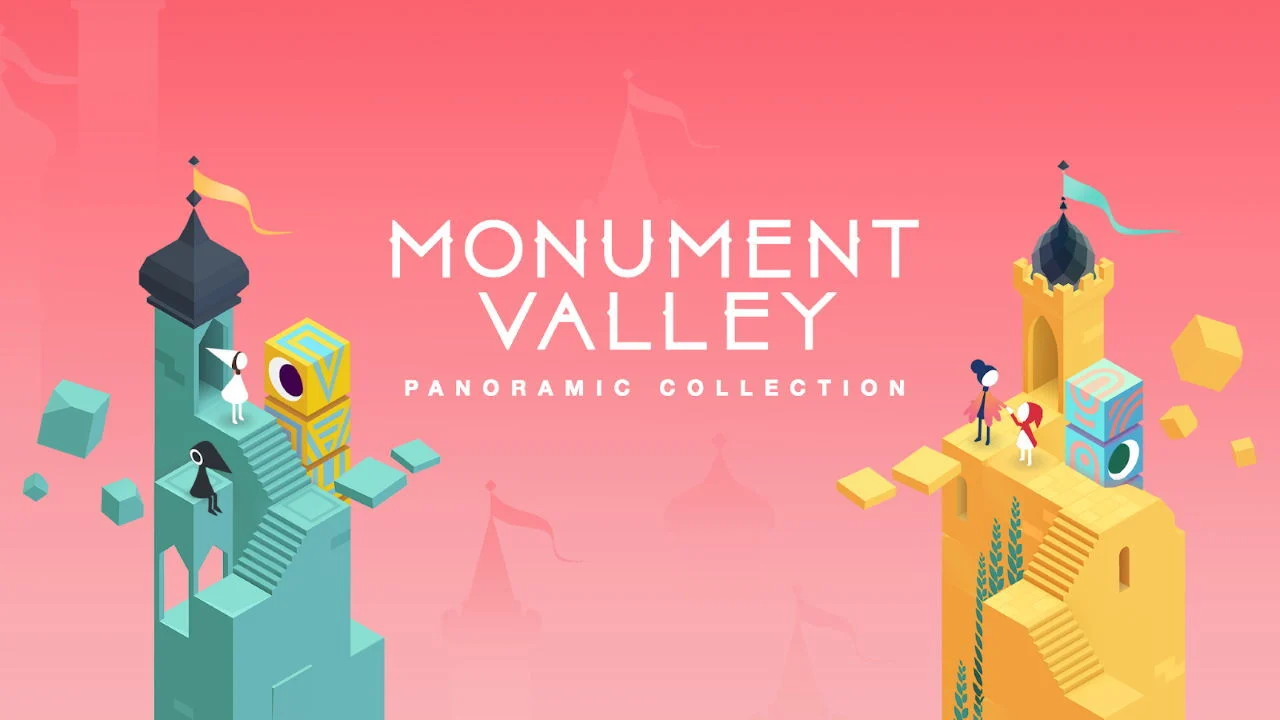
Monument Valley is an absolutely beautiful single-player puzzle game developed by ustwo games, a London-based studio. The game targets a broad audience, from casual gamers to non-gamers, though those who appreciate music and a relaxing puzzle experience may be drawn to the game more. You get to play as Ida, a silent princess who has to navigate sacred architectural spaces.
These spaces hold mysterious geometry, optical illusions, and shifting pathways. A lot of puzzle games focus on logic and difficulty, but Monument Valley uses perspective to create an emotional and atmospheric experience. The mechanics of the puzzles let the movement of the players be a continuous process of reinterpretation and experimentation, which leads to a range of complex emotions, like a mix of confusion and wonder.
From the beginning, Monument Valley establishes a puzzle’s need for a “perceptual shift.” The game is very simple, consisting of just clicks and movements. There is virtually no text anywhere in the game, which directs the player’s focus to the architecture of the game itself. I quickly realized that I have to reinterpret what I am seeing to find the solution.
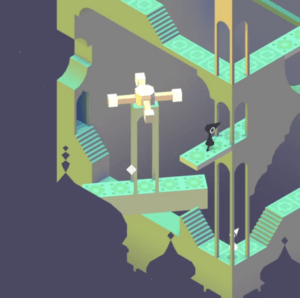
For example, in this scene, I rotated the central structure to bridge two disconnected pathways and create a route. The geometric environment itself is the puzzle, and players have to rethink how space functions rather than just travel through it. Even though the interaction is fairly straightforward because the player only drags a rotating object, the emotional effect is a lot deeper. A key theme the game tries to teach the player from the get-go is that the world changes and reveals different parts of itself depending on how YOU choose to explore and move through it.
A staircase that looks impossible to ever reach on the map can become possible if you look at it from a different angle. The ability for the players to connect their reinterpretation to where they can physically move in the game creates a dynamic of control and discovery within the inner self of the player. This plays into the aesthetics of exploration and challenge. Finding the answer becomes almost synonymous with the mind of the player.
Another thing to notice is how the puzzle is natural to the environment. The game is intentionally designed with an vibe of pastel colors, soft music, and minimal interface. This leads to feelings of calmness, which deters players from spiraling into the confusion of the impossible geometry. Something noticeable is how the buildings themselves are the puzzles that fit right in. The environment of this game and the mechanics of how to solve the puzzle are actually inseparable. This encourages the players to slow down and think differently about the space itself. The game doesn’t rely on mechanics like time pressure or threats to make puzzles more difficult; instead, it consistently tries to support a thinking environment for the players to think about the puzzles differently.
There is a lot of manipulation of perspective in this game. On one level, I could drag a pillar until two pathways aligned with a moving component, even though they did not physically connect.

The puzzles work through treating geometric perspective as reality. Unlike puzzle games like Portal 2, which can focus heavily on physics and momentum, Monument Valley encourages players to focus on observation. This creates a very different pacing experience. I often found myself stopping to study the environment of each new level before interacting with anything, but I was never stuck forever. We learned in class that good puzzles are not too easy and not too hard. This game requires some tricky perceptual reinterpretations, but the simplicity of the options and limitations on the interactions a player can make in this game guides them toward an answer that is usually simple once it’s learned.
The puzzles in this game can seem impossible, but once players discover the new visual logic of the world, the solution suddenly feels intuitive. This taps into another element of puzzles where players realize how it all makes sense (the “click”). The various levels repeatedly create these moments by steering players toward understanding without ever directly explaining the solution. This is a layer of player empathy in the game. The designers must have anticipated how players will think in the game and gradually steer them toward the intended solution.
One of my favorite examples from the game is a button platform that allowed me to rotate a section of the building and uncover a new route. Given its contrasting color to the path, of course, I would step on the button, but the designers must have thought about what I would certainly decide to do in the game to move on to the next level.
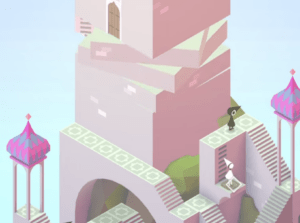
Speaking of empathizing with players raises important ethical questions. Puzzle games often require “out of the box” thinking, but Monument Valley specifically assumes that players are comfortable with abstract visual reasoning and spatial interpretation. Though the game contains almost no written instructions, which makes it accessible across language barriers, many puzzles still rely on recognizing optical illusions or mentally reconstructing impossible three-dimensional relationships from a fixed viewpoint. Players with certain visual impairments, motion sensitivity, or neurodivergent processing styles can find these mechanics difficult to interpret.
Overall, though, I think Monument Valley does a great job of preventing puzzles from turning into “designer puzzles” that only make sense from the designer’s perspective and fail to provide players with the information they need to reasonably solve them. This game avoids becoming unfair most of the time because it teaches players its visual logic gradually from easier levels to harder levels, but there were still moments where I solved puzzles through guessing and checking. An optional layered hint system could make the game more inclusive without damaging its minimalist aesthetic.
This game showed me how puzzle mechanics can shape emotional experience just as strongly as narrative or dialogue, and I really enjoyed that the reward of each puzzle was changing my understanding of the environment. Reconstructing a different reality through play is pretty sick.