
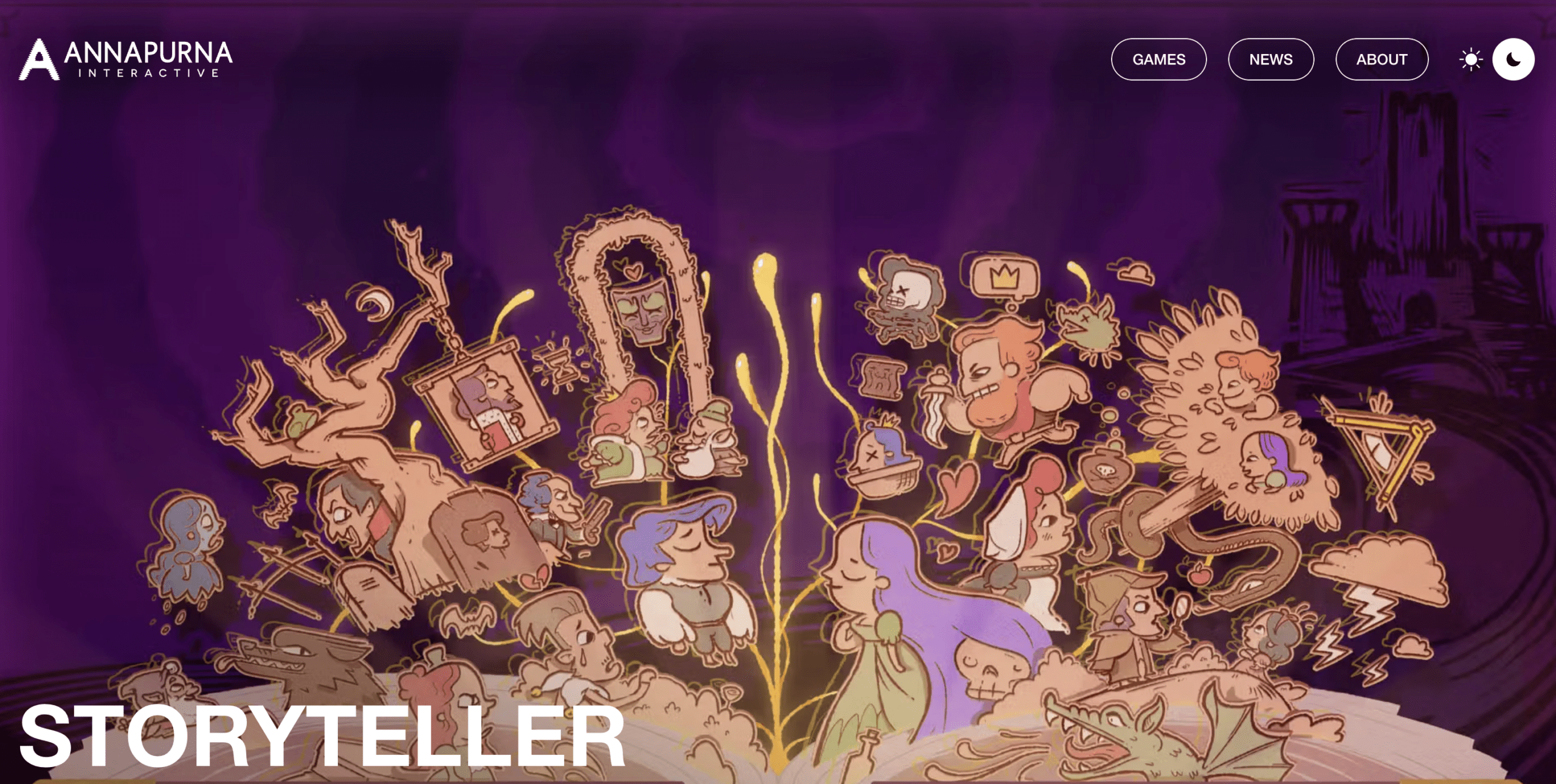
Game: Storyteller (2023) Creator: Daniel Benmergui Interactive Platform: PC, Nintendo Switch, and Netflix mobile Target audience: players who enjoy narrative, logic, and experimental puzzle games
Most puzzle games ask players to open a locked door, or find the missing object. Storyteller asks a different question: how do you make a sentence become true? The fun does not come from physical mastery, as in Portal, or tactile object manipulation, as in The Room. It comes from discovering that emotions and story events, like love, jealousy, death, deception, operate like formal systems.
In MDA terms, Storyteller’s mechanics are simple: panels, draggable characters, settings, objects, and hidden rules about how characters react. The dynamics emerge when those rules combine across time. A character who falls in love in one panel may become heartbroken later; Dracula can transform someone into a vampire; a murder changes how other characters behave if they see it. The aesthetic experience is a mix of challenge, discovery, and narrative pleasure. The player is staging a tiny drama and then watching the game judge whether the drama means what the title says it means. I sat through the first puzzle “Adam Loves Eve” for longer than I needed to, just watching the two tiny figures blush at each other. Watching the story pieces finally connect felt unexpectedly satisfying.
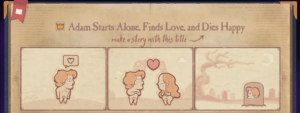
I understood this staging logic more clearly in a relationship puzzle where a spouse is rejected by their own partner. At first, I treated the puzzle like a simple romance sequence: two characters meet, fall in love, and then separate. But the title would not confirm until I understood that emotional outcomes depend on what the characters know, remember, and experience across panels. The game was not asking me to summarize a relationship from above. It was asking me to stage the conditions under which rejection and heartbreak become mechanically true. Once I saw the broken-heart reaction appear, I realized that emotions in this game function more like switches in a logic puzzle.
The Dracula puzzles push this system further. Dracula’s bite is both an event and a transformation rule: once bitten, a character stops behaving like their old self and starts following vampire logic. This means a puzzle can shift genres midstream, from romance to horror, depending on the order of panels. In one deception puzzle, I spent several minutes trying to hide Dracula’s bite from the groom by shuffling panel order, assuming the deception was supernatural. I rearranged the panels five or six times. None of them worked. The actual solution required the bride to believe Dracula loved her. The deception was romantic, not physical. I had been solving the wrong kind of story entirely, and the title had let me assume the wrong one. This is Storyteller at its cleverest: the title suggests one interpretation, the tokens suggest another, and the solution requires the player to translate emotional language into mechanical conditions.
However, the same design can become frustrating when the game gives too little feedback. Puzzles sometimes fail even when I had the right characters and general sequence, because one character did not witness an event at the right moment. I had one puzzle where I moved a single character one panel to the right and the title confirmed after twenty minutes of rearranging everything else. The rule was logical in retrospect: that character needed to see an event before it could affect them emotionally. But the game said nothing while I was stuck. Compared with The Room, where gears, locks, and objects provide visual or tactile feedback when a solution is close, Storyteller sometimes becomes difficult in a way that shifts from productive frustration into plain guessing. A useful improvement would be a light hint system that identifies the missing condition without giving away the answer, something like “someone needs to see this” or “this character does not know what happened yet.”
Ethically, Storyteller shows how puzzle games depend on assumed cultural knowledge. Its puzzle vocabulary comes largely from Western fairy-tale and gothic traditions. These symbols are treated as intuitive. A player familiar with European story conventions may immediately understand that a baron represents power, that marriage marks romantic completion, or that Dracula means seduction and danger. A player from a different cultural background can still learn these rules, but they may have to decode the symbols before solving the mechanics. I noticed this when I paused on a baron puzzle and realized I was drawing on a very specific set of assumptions about what aristocratic villains do and want. Those assumptions felt automatic to me, but they would not be automatic to everyone.
This does not make Storyteller unethical, but it does reveal that thinking is never completely neutral. The game’s puzzles depend on specific cultural assumptions about stories, especially Western fairy-tale and gothic traditions. One improvement would be to add chapters based on other narrative traditions. Different cultures imagine love, justice, family, spirits, and social obligation differently, and those differences would produce new puzzle mechanics. Storyteller is strongest when it proves that stories can operate like machines. A wider range of story machines would make that argument even more powerful.