“Colonialism is not satisfied merely with holding a people in its grip and emptying the native’s brain of all form and content. By a kind of perverted logic, it turns to the past of the oppressed people, and distorts, disfigures, and destroys it.”
—FRANTZ FANON, The Wretched of the Earth
“The past is never dead. It’s not even past.”
—WILLIAM FAULKNER, Requiem for a Nun
“I tried to leave you behind but I am made of everything you ever put me through.”
–WARSAN SHIRE, British-Somali poet
Synopsis
Remnant is a point-and-click historical horror game about the lasting vestiges of colonialism and how they seep through the lives of people today.
The game is set in Pelau Siring, an imaginary, remote town somewhere in Southeast Asia. For decades a colonial territory, Pelau Siring was liberated in the early 20th century only to find itself dependent on a new kind of extraction: tourism. Its beaches, its ruins, its balmy weather, its people were all quietly repurposed into a product for visitors who arrive, consume, and leave without much of a second thought.
Our protagonist and five college friends have just returned from a ten-day vacation there. Upon returning home, the group begins to fall ill with mysterious and unexplainable psychological afflictions.
There’s Evelyn, who feels like she’s burning up all the time but has no other symptoms of a cold or flu.
Marcus, who hasn’t been able to stop working for days. He doesn’t sleep or sit down, and his hands twitch for more work even as he grows more sleep-deprived.
There’s Aanya, who doesn’t know how to speak her first language, Tamil, anymore. She’s known the language her whole life, but when she tries to speak it now, it feels like trying to reach for a half-remembered dream that won’t keep its shape.
We are still in the process of coming up with more of the friends’ backstories, but our protagonist is the only person who has not been affected. They must return to Pelau Siring to make sense of this and hopefully reverse what is happening to their friends.
The Afflictions
Each friend’s affliction is a manifestation of a colonial harm and a direct consequence of something they did in Pelau Siring. Their transgression and their affliction mirror each other.
For example, Evelyn visited the site memorializing a massacre where locals were burned alive in a church. She thought it was beautiful in a haunting way, aestheticizing the site of dozens of horrible deaths. Marcus haggled an artisan down to almost nothing for a handmade object that took days to make, then displayed it as a trophy of good travel. Now, he feels anxious and compelled to work and labor all the time.
To reverse each affliction, the player must investigate its corresponding history, recover what was buried or erased, and perform an act of acknowledgment.
Gameplay
The game begins with the protagonist’s return to Pelau Siring. They arrive knowing something is happening to their friends, and nothing else. The town looks the same as when they left it.
As the protagonist moves through the town’s locations by pointing and clicking–a church, a museum, a town hall, a colonial-era factory, abandoned old homes–they uncover artifacts of Pelau Siring’s buried history: colonial ledgers, missionary journals, land registry maps, old letters and diaries, a labor contract written in a language the signatory couldn’t read. As they uncover more information and piece together a history the town and its visitors have never officially acknowledged, they figure out what they must do to reverse the afflictions of their friends.
The player is given 7 days. Each day the player can visit up to three locations. The player may visit a location by clicking the place on the village map. Upon visiting a location, the player may freely investigate the area by picking up items or interacting with the environment (Ex: the player may open a locked door after picking up a key). Once the player decides they have dealt with all interactable elements in the location, they may choose to leave – after which, the player selects the next area to investigate by clicking on the village map again. Time matters. Every night the player doesn’t act, the afflictions worsen and the game recaps to the players what has happened to their friends while they were away. Evelyn will eventually set herself on fire. Marcus’s heart will eventually stop from sleep deprivation. Aanya’s tongue will disappear from her mouth.
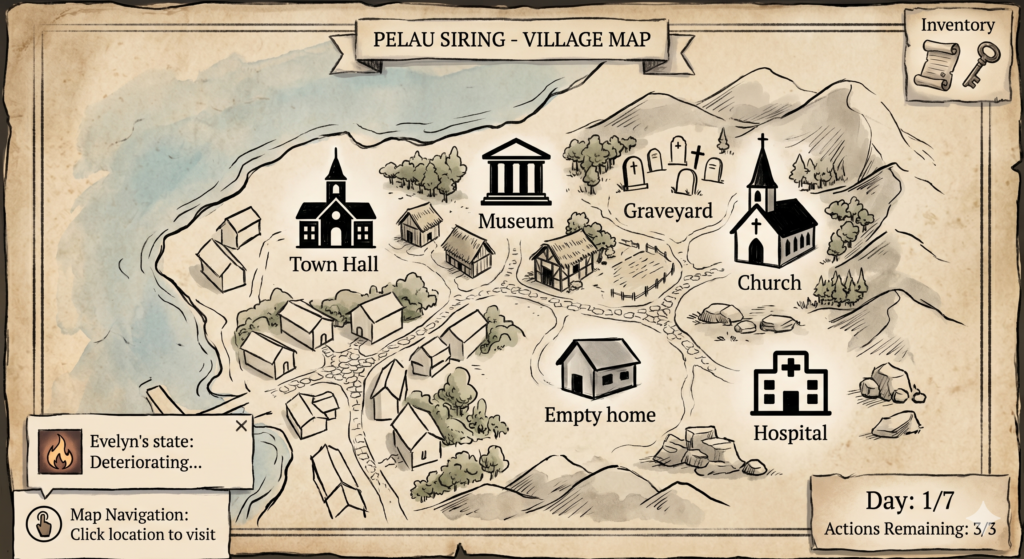
[Fig 1. Example UI prototype, generated by Nano Banana. Players will be able to explore locations through clicking on the map.]
To reverse each affliction the protagonist must investigate its corresponding history and complete an act of acknowledgment. For example: at the site of the massacre Evelyn visits, the names of the decedents are not recorded anywhere. The protagonist must cross-reference a survivor’s diary found in the church basement, a partial census from the town hall, and the oral testimony of a local descendant to recover all fourteen names, then return to the burned foundation and inscribe them there, in the place where they died, in the language they spoke.
Tone
Remnant is eerie, desolate, and grief-forward. We are not interested in making colonized people into vengeful monsters. That framing feels problematic as it reduces complex historical trauma to a threat that must be neutralized. The feeling we are reaching for is not fear but grief. We want players to feel the grief of understanding a tragedy too late and too partially, the grief of acknowledging what was done and what was lost and can likely never be recovered.
We want the game to feel dark, but not hopeless. Difficult, but not cruel. The ending the game reaches for is not triumph but rather witness and acknowledgement. The possibility that seeing something and acknowledging it is worth doing even when it cannot undo what happened.
Setting
Pelau Siring is an imaginary town with vague Malay and Indonesian influences, deliberately unanchored from any single real place. We made this choice as we did not want to claim the specific history of any one community as material for a game, nor to risk misrepresenting a real place’s lived experience.
Instead, Pelau Siring draws from the shared structural features of colonial histories across Southeast and South Asia, histories our team has personal connections to. Our research drew on Japanese colonization in Korea, French colonization in Vietnam and Indochina, and British colonialism in South Asia. The specific mechanisms of colonial harm such as forced labor, language suppression, cultural erasure, land seizure, and systemic violence appear across all of these histories with devastating consistency. Pelau Siring exists in that overlap.
Environmentally: dipterocarp forest, mangrove inlets, rubber tree plantations in geometric rows, strangler figs, tropical heat and sound.
Who This Is For
This game is for people drawn to subversive narrative experiences, players who want games to ask harder questions than the medium usually allows.
When we began ideating for this game, we Googled existing games about colonialism to understand the landscape we were entering. Almost everything that appeared in the results were settler games — games where the player builds a civilization on new land and frames colonial expansion as adventure and achievement. We found it disturbing that the dominant gaming representation of colonialism is one where you get to play as the colonizer , to cosplay extraction and conquest as fun.
Remnant is interested in the other side of that story. It is not interested in the colonizer’s “adventure”, but the wound that adventure left, and the people still living inside it. It is a game about consequences, buried histories, and what it means to pass through a place and what you leave behind when you do.
Appendix
Jaduk: https://mechanicsofmagic.com/2026/05/03/individual-concept-doc-p2-6/
Mai: https://mechanicsofmagic.com/2026/05/04/checkpoint-1-individual-concept-doc-7/
Nicole: https://mechanicsofmagic.com/2026/05/04/checkpoint-1-concept-doc-27/