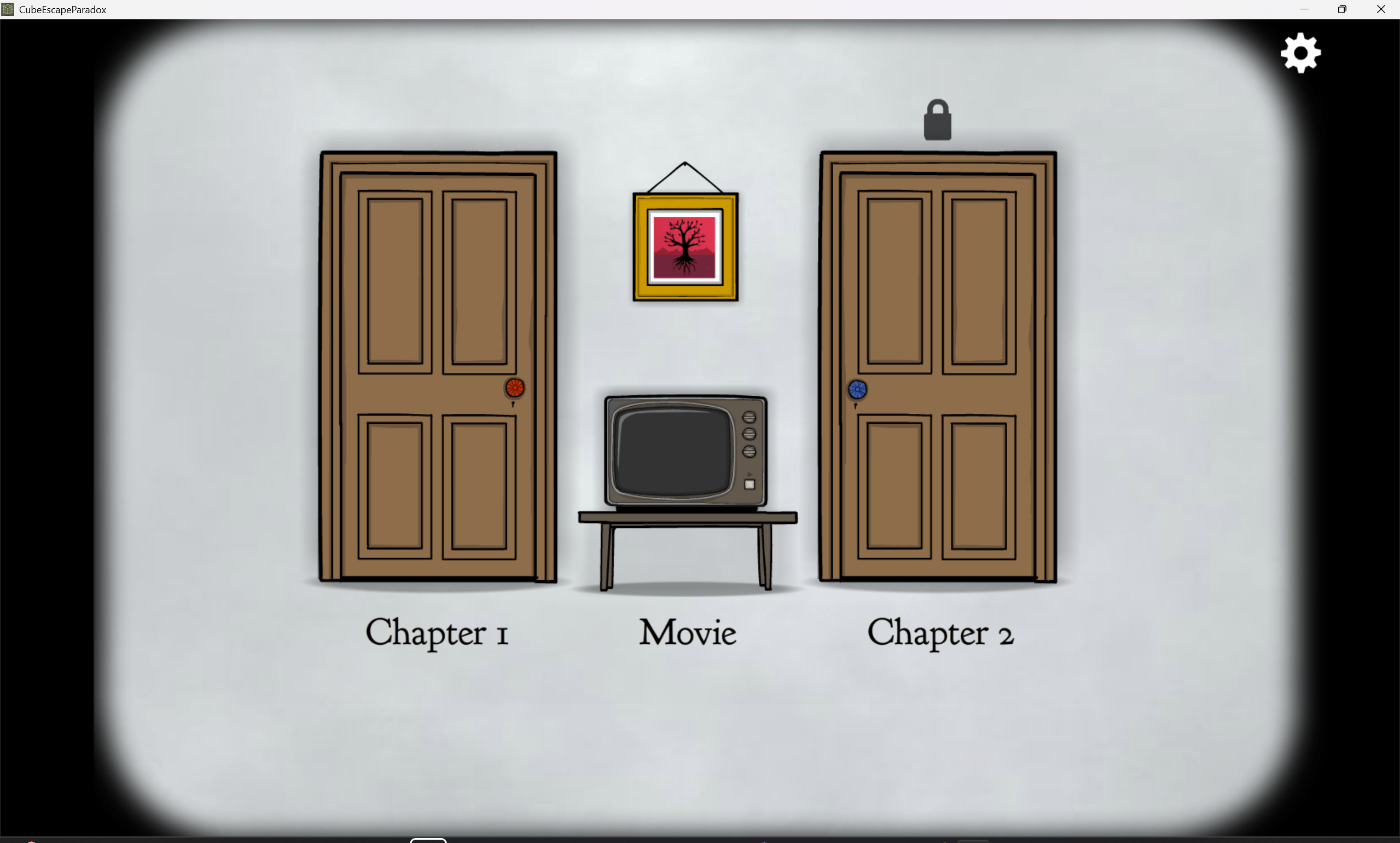
For this week, I played Cube Escape Paradox, which is an escape room, murder mystery game created in 2018 by the game studio Rusty Lake. This game is available on both Android and Windows (specifically Steam), and I played it on Steam in a Discord call with friends. It is tailored towards adults who like escape rooms and seek a fun challenge. Ideally, the game is played with just one player solo, but it is completely possible for multiple players to share a copy of the game and work together.
My central argument is that Cube Escape Paradox pushes its story– the murder case of Laura Vanderboom– through both a largely emergent narrative and strong architectural functions of constraints, exploration, and atmosphere.
The game begins by throwing you (Dr. Vandameer) into a traditional looking home after showing a woman (who we later find out is Laura Vanderboom) being murdered by an ominous person in a black mask. The opening cutscene otherwise is pretty short and throws you right into the story. Rusty Lake makes a concerted effort to not reveal anything (not even about the controls, which I eventually figured out was just pointing, clicking, and dragging. This decision by Rusty Lake conveys properties of an embedded narrative, as there are never explicit instructions telling you how to progress, but rather clues scattered throughout the map in a way where you need to make logical deductions.
One mechanic that requires the player to utilize the psychogenic domain of information is the light. Specifically, Rusty Lake encourages the player to practice cognizance and constantly seek for information. The light can be toggled on and off at the very start of the first chapter, and if toggled on, it rewards you with a piece of a photo (which can be later used to re-create a photo to give you the password for a typewriter).
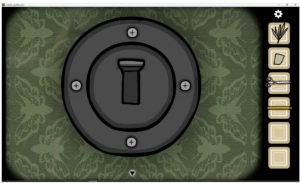
Light Switch in Chapter 1 of Cube Escape Paradox
Rusty Lake could in theory have explicitly told the player to toggle on the light to reveal the photo piece, but they make the decision not to. This decision pushes an embedded environment: it persuades the player to use stage clues and see what clues lead to changes in the environment; preaching proactiveness rather than reactiveness.
My favorite mechanic that pushes this embedded narrative forward is the cigarette / letter minigame, which additionally integrates tests of skill.
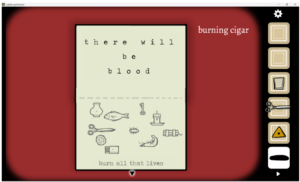
Burn Minigame in Cube Escape Paradox
Here, the things you burn with your cigar correspond to the letters above, which eventually reveal a TV channel. This mechanic creates a complicated dynamic of need to use the clue provided (i.e. “burn all that lives”) to eventually deduce the TV password. Importantly, Rusty Lake does not explicitly tell the player about these associations, and this general dynamic of needing to figure out how mechanics may be associated is used repeatedly, creating an aesthetic of accomplishment once you finally understand a piece of the puzzle. Given that the embedded narrative here is a murder mystery, this design makes the player insistent on not only escaping the house, but finding out exactly how Laura Vanderboom was murdered (as the TV channel reveals the final piece of evidence for the murder case). Minigames like the “burn” one successfully interweave a fun architecture via tests of skill with a serious murder case.
Furthermore, Rusty Lake designs an architecture revolving around carefully constructed constraints to support its already heavily constrained point and click gameplay. These constraints are constructed in a way to push the embedded narrative forward.
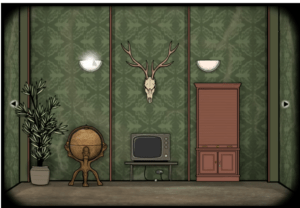
Evidence Room, which contains a broken TV wire.
For instance, the above room exemplifies my claim, as it allows the player to access a TV, but it starts with a broken wire on the left, meaning the player can’t use the TV until it’s fixed. The designers make an explicit choice to leave one of the wires plugged in, leaving the player to think, “how can I fix the second wire?”. I believe this decision is intentional, and it keeps the player on the lookout for any material that could fix the problem (i.e. tape). Once found, players will recall this constraint immediately and feel a natural excitement to push forward, encouraging the player to explore while not being handholdy in the process.
Lastly, Cube Escape Paradox controls its story by practicing secondary architecture via its generally unsettling atmosphere. Some examples of this are included below.
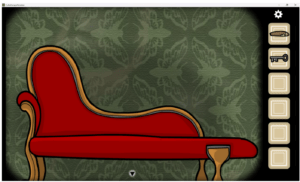
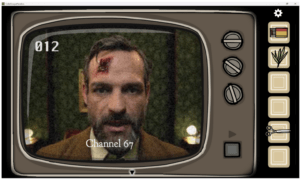
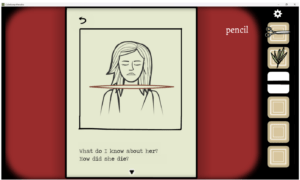 Sample images from my playthrough of Chapter 1 that play with contrast using color and violence
In all of the above examples, the color red is prominent, and it is contrasted with comparatively duller colors (darker green, a dull tan color, and a light beige color in the respective three images), making the red colors throughout the game really pop. Rusty Lake also utilizes blood, but does so in a sparing manner, really making it stand out when used (used in Image 2). Even the design of the furniture is strange, specifically the chair in the first image is bright red and is an uncommon structure that feels quite traditional compared to more modern furniture today. When combining these above factors, Rusty Lake creates an immersive atmosphere that makes the player feel like they truly are a detective in the 1950s, which excellently aligns with the narrative they are trying to portray.
Ethics Paragraphs on Accessibility:
Cube Escape Paradox does not really address accessibility features explicitly as it has a carefully selected target audience. It does have two significant strengths in this department– though I’m not fully convinced they are intentional. Firstly, there is not much reading / a ton of rules. The controls are very simple and the narrative is self-explanatory, so there is not a big barrier to entry. This also makes the game more accessible to players who have reading disabilities. Secondly, it specifically does not have any color related challenges, so it should be generally playable as someone who is colorblind (there is one minigame that requires you to name things that are red, but they aren’t specifically colored red in the game, so that shouldn’t be an issue).
Regarding weakness, as I described above in my argument, the game is quite brutal to newcomers to the escape room genre, it is very cryptic with its hints and most mechanics must be figured out on the player’s own (unless the player looks up a guide). I specifically played with two other people, and all of us had done escape rooms before, and there was a moment where we even got stumped for roughly 20 minutes on one section as we were too stubborn to look up the solution. The game could potentially be more accessible to a general audience if a built-in hint system was integrated into the game, but this would potentially take away from the explorative nature of the game, so I generally think it’s fine to not include it even if it would be more accessible.
Lastly, the game requires an insane amount of memorization for some minigames and logical deduction (some of which is quite finicky) for others. Those with a weaker short term memory or learning disability may struggle greatly with this game. There are external methods to circumvent this (playing with friends so people remember select things, screenshotting symbols, and writing down clues on an external device), but nothing explicit within the magic circle that Rusty Lake constructs.