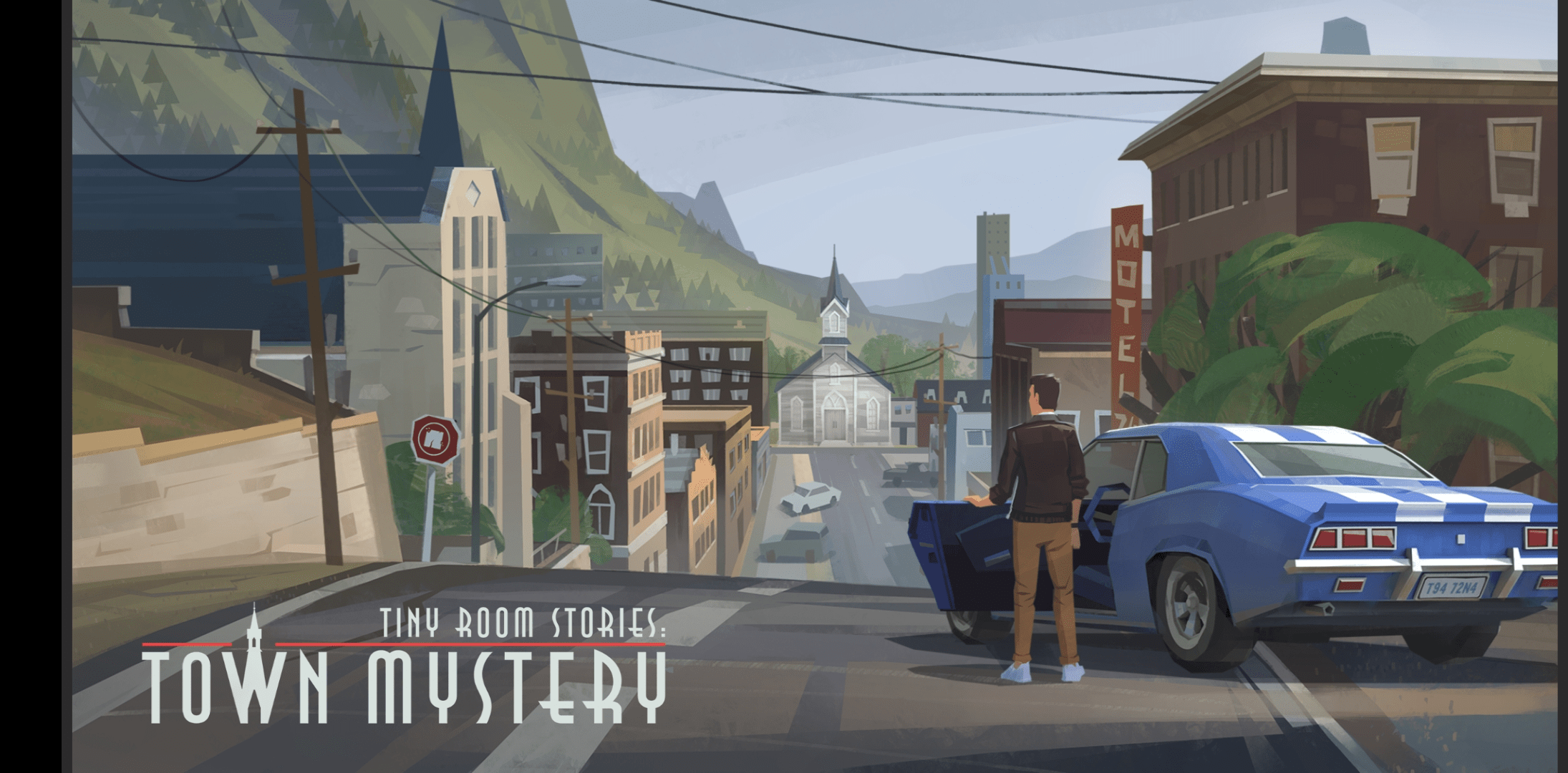
Historically, I’ve usually been fairly dismissive of mobile games. I’m certainly not one of those people who would say that “mobile games aren’t REAL video games,” but the short-loop mechanics of games like Crossy Road or Candy Crush Saga just never appealed to me. Given my preconceived notions about mobile gaming, I was a bit perplexed by Kiary Games’ Tiny Room Stories: Town Mystery (hereafter referred to occasionally as “Town Mystery“) at first. An isometric point-and-click puzzle-adventure game, with multiple award wins and overwhelmingly positive reviews… playable for free on my iPhone? Out of sheer curiosity, I decided I had to give it a try.
In some ways, Town Mystery is similar to other sorts of games on the App Store. For instance, the game’s graphics are very simplistic, and most of the its action is guided by simple touchscreen controls, no doubt appealing to its target audience of mobile gamers and casual puzzle gamers. The game has a surprising amount of depth to it, though, and by the end of my time playing it, I found myself pretty invested in solving the… well, the town mystery. I would attribute much of that investment to the game’s approach to integrating the mechanics in the foreground with the story hidden in the background. In Tiny Room Stories: Town Mystery, players do not simply view the story or carry it out; rather, they actively reconstruct it by interacting with their environment, resulting in a sort of “excavation through examination.”
Town Mystery’s isometric camera gives rise to one of its most interesting mechanics and, in turn, one of its strongest forms of storytelling. In many point-and-click games like Full Throttle and Monkey Island 2, players are restricted a two-dimensional plane, and they usually cannot shift the orientation of that plane in any meaningful way. Instead, Town Mystery allows players to rotate the three-dimensional orientation of every space they’re in. This allows the game to cleverly hide or display important information within its architecture, as certain pathways or objects may only be visible and interactable from specific viewpoints. Each building in Town Mystery becomes its own “super-puzzle,” within which lies many rooms filled with “sub-puzzles,” each of which holds some amount of narrative weight. This mechanic adds a layer of intrigue and challenge onto the game’s already potent focus on the Narrative and Discovery aesthetics. Players must adopt spatial awareness as well as narrative comprehension; they must read each room closely for key visual details like they would read a paragraph closely for key words.
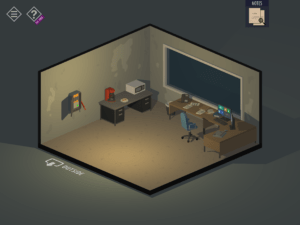
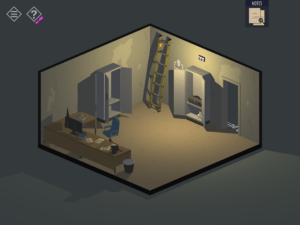
A room might present different objectives depending on its orientation, encouraging players to investigate thoroughly.
The relationship between narrative and gameplay is also demonstrated by the game’s approach to difficulty and satisfaction. Like many games in the general space of “mystery,” Town Mystery leans heavily into environmental storytelling and embedded narratives. This is where “excavation through examination” applies, as players scour each room for anything that might help uncover the mysteries that are buried (literally and figuratively) deep within the walls. Interestingly, though, the rate at which players uncover information is directly proportional to the difficulty of the gameplay itself. Simpler obstacles (e.g., “read this letter that tells you exactly what to do,” “use this object on another object in the same room”) typically reveal smaller details, often only relevant to the specific level they’re in. More complicated obstacles (e.g., “decipher this unreadable code using a key found in a completely different area”) provide more meaningful information about certain non-player characters, the town of Redcliff, or even the protagonist himself. While big objectives often give players big answers to big questions, they might also introduce new big questions, incentivizing players not to leave any stone unturned.
Even in just this one minute of gameplay, I felt like the game was able to share much narrative information via its architecture. Hopefully, upon watching it, you feel similarly.
It’s worth briefly mentioning here that Town Mystery is not immune to the context of “mobile games” in which it sits. This is most evident in its approach to advertising; after solving enough puzzles or completing a chapter, an unavoidable video ad will play: unavoidable, that is, unless you pay a small fee. I hesitate to call this a “game mechanic,” so perhaps the designers are not really responsible. Nonetheless, these ads seriously impact the game’s flow and detract from its otherwise very strong intentionality toward narrative pacing. It was disappointing to finally open a hidden door after multiple failed attempts to solve a complex cipher, only to be met with a video about Raid: Shadow Legends. Still, for the most part, Town Mystery remains an impressive experience and a testament to how thoughtful design choices in narrative, gameplay, and environment can elevate any game on any platform.
Ethics Question:
Despite its relatively intuitive gameplay, Tiny Room Stories: Town Mystery does have some accessibility barriers. The biggest barriers are arguably to those with (a) visual impairments and (b) motor impairments. The game’s puzzles rely heavily on visual clues, asking players to identify fine, small details in rooms or puzzles. Furthermore, the game’s tactile interface requires specific tapping or swiping motions to manipulate objects, navigate between space, or rotate the environment to see it at a different angle. Sadly, Town Mystery does not go very far to address these concerns. The main character has occasional dialogue pop-ups saying that “there is nothing useful anymore” in a given space, which I suppose provides a very mild hint about exploration. Players can also watch an ad to see a walkthrough of a level, but “watching an ad so that the game beats itself for you” does not seem to me like a valuable or intentional accessibility feature.