For this week’s critical play, I played Act 1 of Tiny Room Stories: Town Mystery (Which took approximately 2 hours). The game was developed by Kiary Games, and the game is meant for those who are fans of puzzles or escape rooms. I played the game through Steam on windows, but it’s available on Mac and Mobile as well. The game’s narrative is woven into the mystery through mechanics like, room rotation, embedded contextual evidence not needed for puzzles, and the internal monologue of the protagonist.
First, the room rotation mechanic allows for details to be hidden around corners inside of rooms. This mechanic creates moments of tension when entering a room for the first time, as it increases the amount of time it takes to gain a full understanding of what is in a room. This mechanic reinforces the game’s narrative structure by reminding us that–despite there not being a modelled player character moving around the game world–we are embodying a character in this world. Needing to rotate the camera to certain angles to interact with a computer gives the player sense of movement without comprising the affordances of the point and click genre.

Although this does not explicitly add more information to the narrative, by grounding us within the environment this mechanic immerses the player into playing the game not as a disembodied mouse cursor, but actually immerses us in the shoes of the protagonist. It heightens the effectiveness of the other mechanics at reinforcing the narrative. This also serves as one of the primary answers to the question of how the architecture of the setting controls the story. The physical layout of each room actually controls the order that you can collect information regarding the story. This sort of more immersive control style also allows the physical space to feel more tangible, creating a feeling of actually moving through these spaces as we advance the story, it makes forks in the road feel like something we are walking through instead of like clicking around on something like google street view.
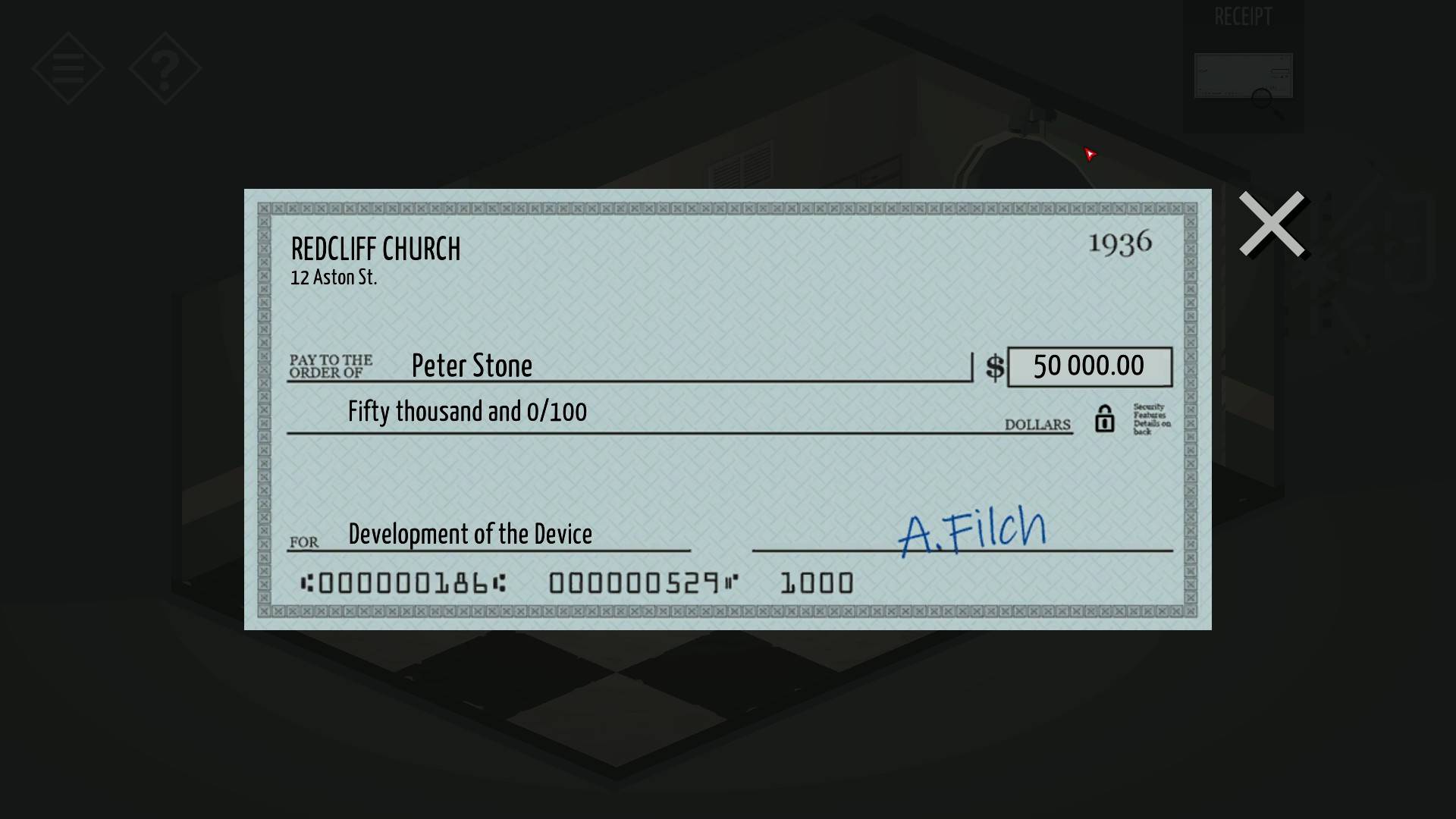
The next and more explicit mechanic which weaves narrative into the mystery is the inclusion of embedded narrative evidence within puzzle hints. Lots of the notes with things like passwords on them give us information not just on solving the puzzles, but also hints as to the narrative of the game. There’s an aspect of the Frozen Moment applied here. Everyone in the town of the game has mysteriously disappeared, so the only to hear from other characters is through what they’ve left behind. One example of this is a check at the end of Chapter 2. None of the numbers on this check are solutions to puzzles, instead, the check is the lead in to the next level. If the game had no narrative this would not be necessary, we could just go to the next room, solve more puzzles and repeat. Instead this check tells us our father took 50 grand for the development of some mysterious device and that the person paying him was from a church–the destination for the next level.
Another example of this is on the map given to the player at the end of Chapter 3 and into Chapter 4. On this map is a sticky note explaining the meaning of the X’s on the map. At the same time though this sticky note contains a note presumably for employees of the shadowy organization we are investigating.

This little embedded sentence gives us narrative information, it tells us that there’s more than one person colluding on this project, and that something timely/urgent is going on. This gives a sense of uneasiness regarding the Frozen Moment this game takes place in and adds to the game’s mystery. What exactly happened so urgently? Why are even the members of the shadowy organization missing? This sticky note highlights that this isn’t just some nefarious plot, but instead that something has gone wrong, plans have changed, all through one sentence on a sticky note, that doesn’t explicitly say any of this.
Lastly, I want to talk about how the player character’s internal monologue helps the narrative feel woven into the mystery. One of the issues that can arise when telling a story through an embedded narrative is that players can miss details important to the narrative. Having the internal monologue gives a sort of interpretation safety net. Players who like finding the hidden details and piecing together the narrative can still do so, but, in case any player missed something, the player character can point something out. This is far better than the alternative of making the narrative more obvious, because it doesn’t compromise on the mystery and discovery fun. For example, going back to the check discussed earlier, if the player didn’t realize that Peter was the player character’s father, the check may not seem meaningful. Because of the internal monologue mechanic though, after dismissing the check they would see this:
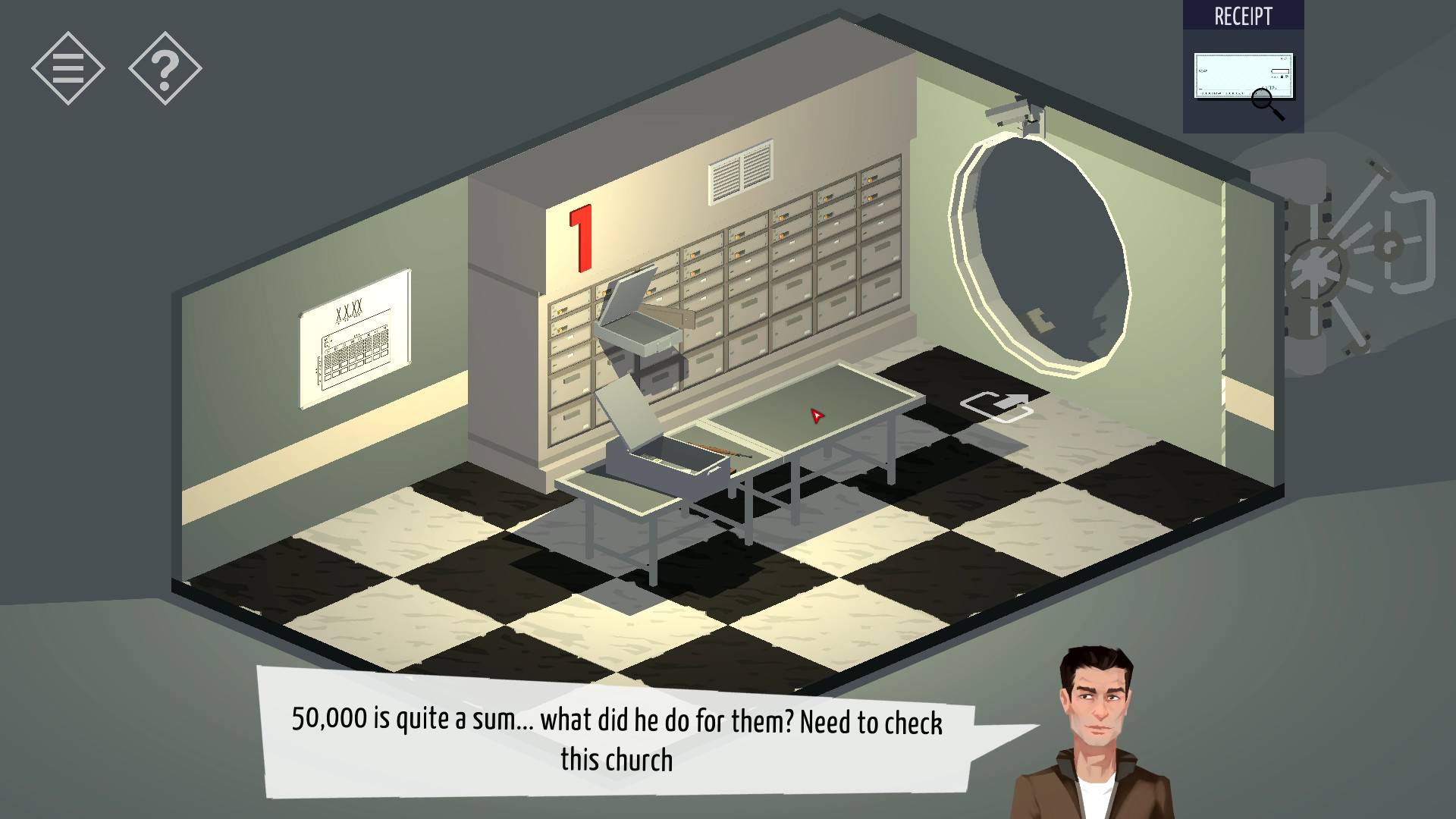
Since the internal monologue comes up after the check goes away, the mechanic ensures it does not compromise the mystery.
Ethics:
One accessibility barrier to this game is how visual a lot of the evidence is, even things written on documents often have double meaning beyond the simple text–meaning that even if a screen reader could somehow parse the whole game, there would likely still be a lot of missing context for a blind or low vision player.
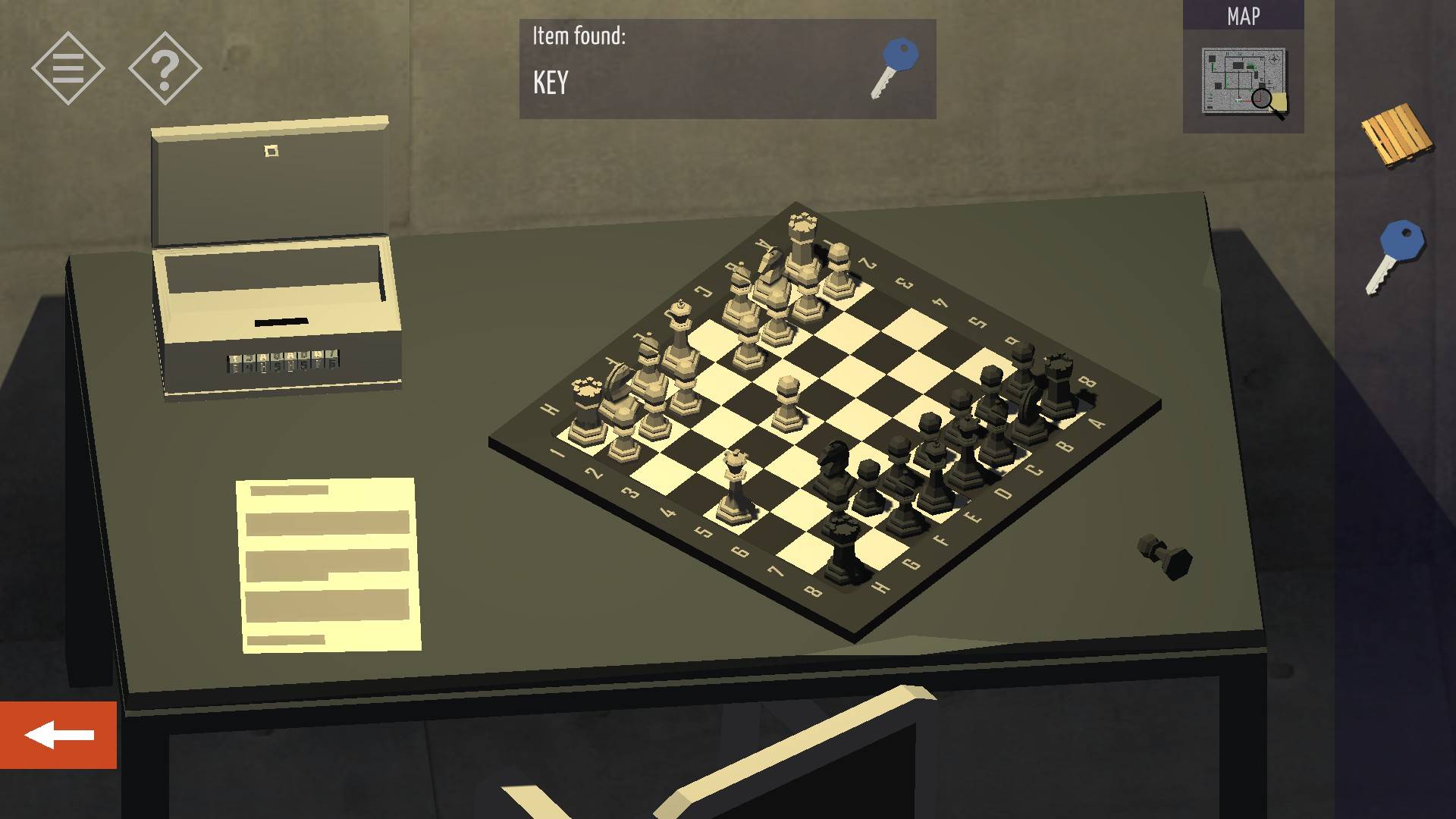
Another accessibility barrier is the amount of existing knowledge the game expects of a player coming in. I think the two primary examples of this would be the sudoku puzzle and the chess puzzle, which both require external knowledge on the mechanics of these games to solve. For the chess puzzle in particular, the game attempts to explain the move annotations, but without knowing the rules of the chess, like how the pieces move and take, the puzzle would be impossible. A key aspect of the puzzle is that there’s a knocked over pawn on the table, implying an additional move not seen on the board. The game does include a hints button, which I’m sure would probably explain more about chess or just outright give the answer, but I think that would probably be rather unsatisfying to players missing this shared context. I think any kind of chess instructions beyond just how to read the numbers off the board would have gone a long way here, and are something that I’ve often seen in in person escape rooms with chess themed puzzles. The same all apply to the sudoku puzzle, but it boils down to that making players feel out of the loop is exclusionary. Even if there’s something like a hint system to help out, requiring players to opt into getting help reinforces things like the western conceptions of intellectual superiority associated with chess knowledge.