Team Meerkat: Akary Buenrostro, Justin Hall, Reyna Duffy, Sally Wang
Artist Statement
Séance is a 6 player murder mystery, social deduction game with many opportunities to bluff. Séance lasts from 45-75 minutes depending on how observant your housemates are to the clues at the scene.
There are two teams– the good team, which consists of four Samaritans, and the evil team, which consists of the Suspect (murderer) and Accomplice (tamperer). Samaritans must find and eliminate the suspect. Through séances and investigations, the Samaritans will learn sequential hints about the suspect’s weapon and room. But watch out! The Accomplice is the Suspect’s partner in crime; they can deceive the Samaritans by tampering evidence of the murder, leading to weaker hints, making it harder for the Samaritans to find the Suspect.
The suspect prevails if they last five rounds without their combination—weapon, room, and identity—being discovered. The Suspect is still an active murderer! They have two opportunities to attempt to kill ANY Players during the Lights Out rounds! Can the Samaritans catch the suspect dead in his tracks? Will the living players communicate through the beyond with the assassinated players successfully by asking the right Yes/No questions? Or will Evil’s mischief prove victorious?
Concept Map and Ideation Exploration
Concept Map

Ideation Exploration
We looked into a few other ideas before ultimately landing on Séance. We knew we generally wanted a social deduction styled game, specifically focusing on fellowship and the psychogenic domain of achievement. After discussing the first stages of what would be Séance, we originally diverted from it as we believed it would be too complicated. Here were some other ideas we considered, but ultimately left behind:
- Mafia with minigames: This was an idea that Sally proposed that we thought was intriguing; this is essentially a Trivia Murder Party inspired Mafia game where after each night, members can play minigames to receive clues about the other team. However, we ultimately decided against this as we (and Mai) believed it was more of a mod of Mafia than its own standalone game.
- Contact-inspired game: This was a word-based, bluffing game where members of the good team had to try and get closer to a chosen word by a moderator and the imposter wanted to divert them. However, we tried playtesting this idea on game night on April 13th, but it just was too simple of a game and was very unengaging.
Initial Decisions About Formal Elements & Value
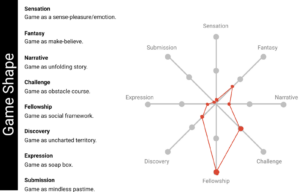
As stated above, we desired a game that prioritized fellowship, discovery, and challenge as primary types of fun, with fantasy and narrative layered in through a murder mystery framing, which we drew inspiration from Clue. However, Clue by itself didn’t interest us due to it not being team-based, and leaning much more into challenge than fellowship. We were drawn to the tension that comes from deception between two conflicting groups, so we drew inspiration from the game Mafia. However, Mafia has a big limitation of being very boring if you die early.
Thus, we wanted to design a continuously engaging game giving each group a built-in reason to lie. Séance builds this environment: one player is the killer (Suspect), one is their hidden ally (Spoliator, which was later renamed to Accomplice, we really wanted all S names but it got confusing!), and the remaining players each with different starting knowledge are trying to figure out who is who through a series of group investigations that the evil team can quietly undermine. To accomplish all of this, we came up with an idea containing the following elements:
Objective:
- Samaritans, the Sheriff, and the Scapegoat correctly identify the Suspect along with their Weapon and Room.
- The Suspect and Spoliator work to prevent this by tampering and hiding evidence, eliminating players before the final vote, and optionally targeting the Sheriff for an automatic win.
Players: We wanted the game supports variable player counts (5+) across five roles:
- Good team: Samaritans, Sheriff, Scapegoat
- Bad team: Suspect, Spoliator(s).
- More players will result in more Spoliators and Samaritans. All players participate in the same rounds, but each role begins with a different amount of private information, creating layered asymmetry across both teams.
Resources: Every player selects a Room card and a Weapon card from a shared pool as their personal evidence. Players track information in personal notebooks, and a shared Clue Notebook records evidence surfaced through Séances. A central map tracks where each player claims to have been at the time of the murder.
Procedures: Séance rounds cycle through a rotating Expedition Leader who picks a crew of three to investigate a room. The crew secretly votes to Succeed or Fail (one single fail by a member fails the entire vote). A Succeed produces a clue written into the shared notebook by the GM; a Fail produces nothing. When the Spoliator is on the crew and votes Succeed, the clue is tainted and the GM writes a false card from another player’s evidence instead of a true clue. The spoliator can choose to fail one time throughout the game, whereas the Suspect can always fail. Failing a mission leaks information about the Sheriff to the evil team, revealed later in the endgame. An Investigative Journalist chip activates after Round 2, letting one player privately check another’s evidence each round. The evil team wins automatically if they can correctly identifying the Sheriff and their weapon and room.
Outcomes: The good team wins by reaching a unanimous correct accusation of Suspect, Weapon, and Room, or if the Suspect incorrectly names someone else as the Sheriff. The evil team wins if the group votes wrong, or if the Suspect correctly identifies the Sheriff and their evidence.
Conflict: The good team has numbers but unequal information. The Sheriff knows who the Spoliator and Scapegoat are but must stay hidden, the Scapegoat knows which evidence cards were left out of play, and Samaritans start with nothing. This asymmetry means the good team has the pieces to solve the mystery but has to figure out who to trust before they can pool what they know. The Suspect and Spoliator exploit this by tainting the shared clue record and failing missions strategically to learn more about the Sheriff. Everyone is managing what to share, with whom, and when.
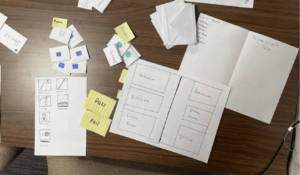
Original Materials (Original Board Map with 6 rooms, pass fail tokens, and weapon and room cards). Envelopes for each player to hold materials like in Secret Hitler, Reyna made herself.
Testing and Iterating History
The Initial Playtest: Playtest 1 (4/16)
Our first playtest was conducted in class with five players and one of us running as GM. At this stage we were still fleshing out key details, and our main goals were to test whether new players could pick the game up quickly, what it actually felt like to GM, and what the game actually was—whether the game had too many moving parts.
The feedback we received confirmed our suspicions. Players were confused by the number of roles. The Scapegoat in particular raised immediate questions, and the distinction between good and bad roles was unclear to most people at the table. The Sheriff was able to narrow down the Suspect almost immediately due to the extra information they started with (knowing unused rooms), which short-circuited the deduction process the game was built around.
On the positive side, players were engaged and discussion between rounds happened naturally, which confirmed the social core of the game was working. The partial clue system was well-received in principle, even if the execution was unclear.
Iteration 1
Overall, the main takeaway from playtest #1 was simplification and consolidation. Players complained about our game having far too many moving parts. Specifically, changes were made to:
- Mechanics and Roles:
-
-
- Suspect: We removed the Suspect’s ability to taint evidence and made that the Spoliator’s exclusive mechanic
- Scapegoat: We removed the Scapegoat entirely as it didn’t add enough distinct value; while it did provide a mechanic of a certain 50-50 of knowing Spoliator/Scapegoat, creating a dynamic of uncertainty for the Sheriff, that’s all it really did.
-
- Sheriff: The above changes led to the Sheriff getting nerfed, as the Sheriff now no longer knew who the Spoliator was after this iteration. There was also no reason to know the unused weapons/room (WAY TOO OP).
- Weapons & Rooms: Now, we had three types of weapons (short-ranged, medium ranged, and long-ranged) and two colors of weapons (yellow and blue). With two weapon types, there overall there would be 12 different weapons. For rooms, a similar logic applies. Likewise, rooms could be distinguished by indoor/outdoor and first floor/second floor. With two rooms per section, this would now be 8 rooms. We hoped this would make life easier for the GM in giving clues.
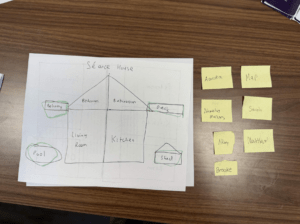
Image of Room Map after Iteration 1
- Lights Out: One flaw of our game was that good-aligned members had no reason to lie, which is a key value we wanted. To combat this, we added a brand new mechanic called Lights Out. This new phase allowed the suspect and spoliator to team up on the final night to exchange notes and kill a good-aligned team member if they can guess their room correctly. This led to dynamic tension as the game progressed closer and closer to Lights Out, ultimately leading to that aesthetic of uneasiness that we were looking for.
- We got feedback that it is generally good if the game is sided towards the good team, so removing the Scapegoat and nerfing the Suspect were changes we made that addressed exactly that. We also changed the win condition for the good team: as long as the suspect was identified, the good team wins, regardless of if their weapon and room were found.
“The Brooke Playtest” (Playtest 2) (4/20)
Our second playtest was conducted during game night / office hours on April 20th. We had a six person game: 1 GM, 1 Sheriff, 1 Suspect, 1 Spoliator, and 2 Samaritans. Two of our group members were in the game—Justin as GM and Akary as the Sheriff.
Our second playtest was overall a success—once the game started, discussion was natural and players were genuinely engaged. There were memorable moments of MDA that occurred for the first time, specifically when Brooke (who was very helpful for this playtest, hence the name!) was the suspect and was able to convince Aanika (the spoliator) to clear her, fooling the good team. Furthermore, players almost unanimously clustered in the same starting room (“bedroom”), which validated the bluffing incentive even for good-aligned players! Once the game was running, the discussion it generated was fruitful.
But that was the problem— this only occurred once the game was running. There were still a ton of moving parts and lots and lots of rule clarification, which alone took nearly 10 minutes before Round 1 even began. Players still asked fundamental questions about what rounds, expeditions, and mission failures actually meant during the game.
The GM burden remained too high, particularly around clue-giving. Even with Justin running it, mistakes were made, and it raised a real concern about how a new player would manage it.
A few specific mechanics surfaced as issues. Expeditions vs investigations were confusing, and the Sheriff role became redundant in its nerfed state. The win condition change was also complained about.

Updated Materials from Playtests 2 (and 3). Notably includes a new map with more rooms, a round progression sheet like suggested by class modules, a weapons bank, and a clue giving guide for the GM. Very few materials have been digitized at this point.
Iteration 2
GM Notes
It was clear that the number one issue of our second playtest was that the GM was overwhelmed with the amount of information that they had to keep track of and read and improvise, so we made a GM script and tried to condense the amount of information significantly. Additionally, we created a flowchart for the GM to follow for clue giving regarding rooms.
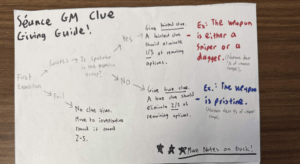
Original GM Clue Giving Flowchart Guide
Mechanics Notes
- The win condition was solidified—the good-aligned team has to identify the suspect, their weapon and NOW their room too—as Brooke highlighted currently “the good team (has) no real incentive to find the suspect’s exact weapon and room”. We interpreted this as there is no clear way for how the team should go about uncovering these clues (as the rules did not state whether investigations revealed info about weapon or room first or when/if the switch happens).
- This mechanic injects the tension the suspect and spoliator feel of having to “do something” before their information gets fully disclosed.
- The Sheriff role was removed entirely, due to being essentially just another Samaritan role.
- The number of players was increased from 5 to 6 + a GM. This was done since the win condition was made harder for the Samaritans, providing balance.
- The number of rooms was decreased to make it easier for the Samaritans, for similar reasoning as the point above.
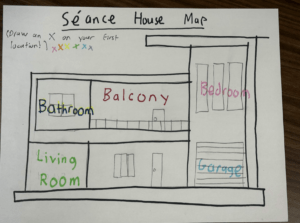
Updated Map for Playtest 3
“The Unfortunate Playtest” (Playtest 3) (4/21)
In this playtest, we had seven people from our class play the game, six players and one GM. We sought answers to the following questions:
- Is the GM still overtaxed?
- Where, if existing, are the balance issues? Evil 1 – Good 1 so far in our playtest.
Unfortunately, even with the condensed rules, our GM was certainly still overtaxed, as setup took 10-15 minutes and there were constant questions asked to Akary (who was moderating the playtest, not the game). However, more importantly, the players (aside from a select few) were visibly unengaged due to a combination of long setup and ineffective audience, making it hard to evaluate the new mechanics (player and balance changes). Even with this unfortunate playtest, we still picked up something valuable; our target audience was actually more narrow than we thought it was– it is better if our players really love social and logical deduction.
Iteration 3
This was tricky as we believed several issues were due to our audience from Tuesday’s class simply not enjoying social deduction, given the engagement from Playtest 2. Despite this, we made a few small changes:
- More polished role cards: Players had trouble remembering what their responsibilities were, but obviously can’t ask what their role does during the game. Thus, we put a role description on their role card.
- Seer and Sleuth: Expeditions and investigations had long winded descriptions and were poorly defined. We renamed the expedition leader to the Seer and the investigator to the Sleuth, and added distinct cards for them. We believed this would lessen confusion regarding those mechanics, allowing players to focus on the strategy and letting tension build naturally. Reminders of Seer/Sleuth mechanics were printed on the back of the cards as well.
- Made weapon, room, and role cards more distinct. Before they were all just white pieces of paper and got easily confused (and we had to restart the game largely because of this). This led to us making more distinct designs for each type of card.
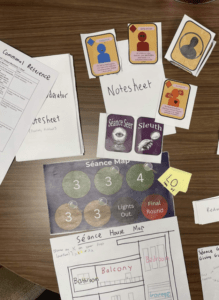
Updated Materials for Playtest 4. Includes a digitized progression map, as well more defined, digitized role, Séance Seer, and Sleuth cards
“By The Pigeonhole Principle”: The 20% Playtest (Playtest 4) (4/22)
By this point, most of the major mechanics were more polished and tested, but we needed to confirm several things:
- Is the GM finally not confused? Specifically, does clue giving make sense?
- Was the game balanced?
- Is our actual target audience actually engaged throughout the game?
For this playtest, again seven people played our game (1 GM + 6 Players). Jeffery was our GM and did an amazing job, and our GM clues were finally clear. However, there was confusion with the final vote, so we had to clarify mid-round that a strict majority vote was required to win.
Otherwise, the playtest went very well, as players were consistently engaged the whole time and there were clear moments of MDA, especially since Butch was an extremely committed suspect. However, many of the concerns in rules now shifted to concerns in mechanics and aesthetics:
- A scenario occurred where Butch had an opportunity to reveal his weapon instead of his room, giving the Samaritans a 20% chance to win no matter what they do. We originally gave the option for a player when Sleuthed to give either card, but this 20% chance dynamic is bad game design and we ultimately removed this deceptive mechanic.
- The pigeonhole principle (as Butch consistently noted) doomed the strategy of our game, as with a group of 6 people, expeditions with exclusively 3 people led to our game being “solvable”.
- It was way too easy to find Spoliator, as the spoliator was forced to tamper when voting Success.
- The GM just wasn’t having fun, even with the new clear explanations.
- A comment was made that the Suspect should be able to kill players sooner in the game or more often!
Iteration 4
There was one iteration immediately made after, Séance crew sizes selected by the Seer had to be adjusted. In a 6 player game, crew size should generally be 4 to better hide the Spoliator/Suspect.
Akary was also pretty convinced that there was a way to remove the GM entirely, as it was a major, largely unfixable detriment to our game.
Some new mechanics were drafted and talked about in class to be stress tested in Playtest 5.
- Vote cards now consist of Success/Fail/Tamper. Only the Spoliator can tamper. Previously the GM was used to determine Spoliator presence on a Séance crew expedition during a “night cycle”—now that is not needed.
- The “night cycle” would now be modified so that after every Séance round, everyone closes their eyes. This allows the Suspect—being the only person who knows their room/weapon—to mark off on the weapons bank (and later the location map) the type of clue earned by the Success/Tamper of a Séance. This also adds to the mystique of the game, as now everything moves around at night rather than being awkwardly announced by a GM.
- A mechanism to determine the end of the “night cycle” is needed since the Suspect can’t just announce “all done!” So a timer is to be used, a 15 second countdown is to be started by the Suspect after they cover up (like Bingo) the learned information on the weapon/room.
- The Clue Giving guide was updated (and digitized) to help players narrow down rooms when/if weapon is found. A sixth room (Garage) was added to modify the map—rooms are now in three groups of two. All Success = A set of rooms is eliminated (ex. All first floor– bedroom, bathroom, balcony). Tamper = One room is eliminated.
- A second Lights Out phase was added with harder success criteria. Lights Out 1 required Suspect to name Player + Roon. Lights Out 2 Requires Suspect to name Player + Room + Weapon.
“Akary’s Abducted ProFros” (Playtest 5) (4/23)
With the new map, new cards, updated Séance crew size + secondary lights out, updated clue information system and select Moderator question answering the big stress test remained:
- Do the new mechanics make the GM role obsolete?
YES! The game was an overall success! As these were a group of random ProFros and not our curated player population target—only about half of them considered themselves familiar with social deduction—information gained was more aligned with visual clarity of map. This ensured us that our Playtest 3 group may indeed have just been an unfortunate group.
Iteration 5
- The Clue Giving Guide was updated to match the graphics of the previous one.
- Map of Player Locations cleared up. The Garage was removed to become “Porch” instead. Top floor orientation changed to accommodate ease of reading—no longer 2nd floor room, Outside room, 2nd floor room—now became 2nd floor room, 2nd floor room, outside room.
- Spoliator name was changed to Accomplice due to feedback
- Double investigations allowed (Sleuth). In the case that the Suspect + Accomplice are in a chain sequence of confirmations, if we do not allow a Double Sleuth investigation of a person we are then not allowing Samaritans to get necessary info.
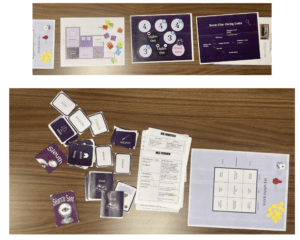
Final Designs for Playtest 6. All materials digitized! Player markers added for rooms map / in case people forget each others’ names!
“Can Zach break the game?” (Final Playtest) (4/25)
Our final playtest incorporated all the above changes and essentially went perfectly. The final playtest had 6 players (Jessica, Zach, Tsion, Kathleen, Justin Qin, and Mia) with no GM, and none of Team Meerkat in the game. They were a good reflection of our target players—most people had some familiarity with the social deduction genre, but a few were not as familiar. There were no clarification questions asked to us during the game that we had to answer, all questions were solved by other players or accessing the rules. One hiccup is that because we were testing the order of the rulebook, we did not print enough—so people were given access to a digital rulebook for this playtest only. There was constant fellowship and achievement throughout the game, tension building as time went on, as well as elements of social deduction and logical deduction. They even made a mod of our game, which we were welcoming of!
The reason we title the playtest “Can Zach break the game” is because Zach was the suspect, and employed a strategy we had not seen before (always pass as the Suspect). We were at first worried this would break the game like Butch’s 20% strategy did, but it ultimately was foiled by the Sleuth mechanic, showing that Sleuth and Seer mechanics interacted in a meaningful way, creating a dynamic among the bad team of “If I act good, is it worth the risk of being immediately caught by the Sleuth?”. The second Lights Out phase added made Samaritans scared to share the weapon until the Final Round, which is exactly what we intended. This created an aesthetic of tension that increased all the way until the final vote, where it beautifully climaxes, all of which is intended.
For Transparency:
During the game, Justin and Akary noticed that since we were using the old Sleuth and Seer cards from Playtest 4 & 5, the new mechanic for Double Sleuthing from iteration 5, were not clear. Though the banning of Double Sleuthing by the same player was removed from the rules, it was still written on the back of the Sleuth card itself. We needed to remove the on card or it would make the game nearly impossible for Samaritans to win. Executive decision was made by present members of Team Meerkat to cut out the card without disturbing the game too much or announcing that there was a fault, the only people who had read that mechanic on the back of the card were the Suspect and Accomplice—they had a vested interest in not revealing what was on that card before, else it makes them suspicious to the rest of the group that we’re stepping in to remove it. So at 31:23, Akary returns the card, cuts the piece off, and returns it to the table trying to cover it with some topical conversation.
Iteration 6? (Conclusion)
If we had more time, we would have renamed the Suspect to the Assassin, as people were often confused why the murderer was named the “suspect” and not something more violent. We also would have polished our designs a bit more and added more 3D elements for more of a tactile experience and ease of Suspect movement for weapon/room elimination.
Shoutouts to Brooke, Aanika, Jeffery, Zach, Tsion, and many more for all of the help with our game!
Final Playtest Video and Prototype
Final Playtest Video Link: https://youtu.be/9CVCk62zN9k
Link to Print and Play: https://drive.google.com/file/d/19TAxnS0lXoTJDV0rD5q9N3WYcEfT3PqO/view?usp=sharing
Separate Booklet for Print and Play: https://drive.google.com/file/d/1L-xMmY7dZjkdwh5Fzn8PYGmS8OrjPjS6/view?usp=sharing
Timestamps of Interest
- 07:22-09:55 – Players figure out how to cover noise as well as make it easier for the suspect to give clues! Though rules stated timer use they improvised this on their own! They really enjoyed the making noise mechanic, which since we were inspired by from playtesting Sabrina, Jeffery, and Brooke’s Golden Ark game we will change this in a future iteration!
- 11:51-12:09 – Tsion reveals their weapon, Fair Broadsword, funny moment everyone got a good chuckle. Zach jokes, “Hello Ms. Fair Broadsword”, funny because seconds after the reveal Mia had explained it was a bad idea to reveal weapons before round 5.
- 24:30-25:10 – Accomplice investigates the Suspect, but the possibility of this occurring is indeed noted by Jessica.
- 31:28 – 31:38 Players are excited and are even thinking about this game being played in the future! Mia says, “the next time we play”!
- 36:45-38:00 – Players create a mod (mechanic where the suspect can “attempt” to kill themselves during a Lights Out) mid-game! This was not specifically outlined as a “banned” mechanics so we let it play out as a potential mechanic/strategy and have updated our print-n-play rules to outline this.
- 42:30: Kathleen notices the magnifying glass on the player progression sheet and why it is there.
- 43:25-43:50 – Players like that you go to sleep and when you wake up things have moved, ‘it truly feels like a real séance!’ Noise adds a lot to the aesthetics too.
- 49:30 – Good Sleuth strategy discussion. Generally great strategy discussion around this point of the game
- 54:30 – Comment (and subtle hint lol) by Jessica to use social deduction instead of just logical deduction, we intended for both to be used in tandem!
- 55:38 – “Am I being a sheep?” from Justin
- 1:01:58 – Tsion is locked in and flips the map so the suspect can’t make up something as easily, but Zach still is able to make up which weapon he has, countering it
- 1:07:42 – Key moment of social deduction (“intuition” / vibes). In a debrief section after the game they were able to articulate why they had those “vibes”, Zach grew increasingly quiet for someone who had dominated much of the conversation in the beginning.
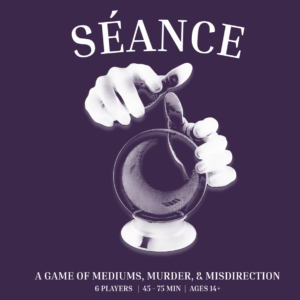
Front of Box
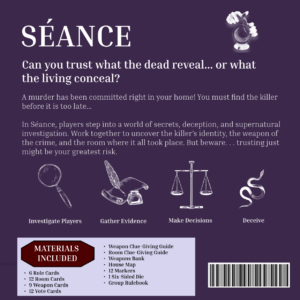
Back of Box
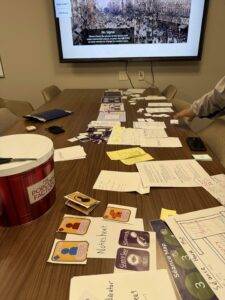
All of our materials across all of our iterations for the project!
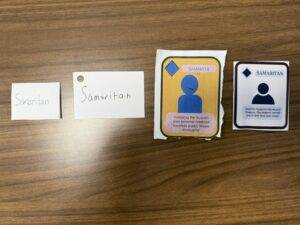
Evolution of the “Samaritan” Role Card

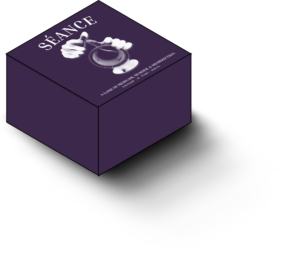
3-D Box Designs