

(The first jumpscare in this game made me pee my pants a little. It was more of a walking-in-shame-to-the-bathroom simulator.) Year Walk is a horror walking simulator for ages 16+ due to the explicit violence and additional horror elements of the game. It was created by Swedish mobile game developer Simogo in 2013, and was later released on Steam, where I played it. In Year Walk, I argue that walking transforms embedded narratives into enacted narratives by forcing the player to wander until they connect critical patterns together to progress in the game.
The player walks to unearth the mise-en-scene of the world they were dropped in until they finally ease into a deep, enacted unsettledness curated by Year Walk’s embedded narrative. There are weird quirks around the game that hint to the fact that the game will eventually end up as a horror game centered around scary folklore, outside of the warning in the assignment spec. When the player searches their encyclopedia, they can see a description of the Year Walk tradition, saying that walking during a special time of the year allows the walker to “foresee the future,” and that the practice was “over a thousand years old and most certainly pagan” (Simono). This provided lore, combined with the mise-en-scene: the abandoned campfire, the broken wheelbarrows, the runic gravestones, the carvings on the wall, the way the music changes in certain buildings which you can only reach through walking, all add to this mystique surrounding the game, and therefore all the mysteries littered around the game immediately create a creepy narrative for the player to unearth. Interestingly, these “background elements” are slowly contextualized as the player gets closer and closer to the church, changing the embedded narrative to a much more enacted one, where you as the player realize your stakes as a fictional character in the game. When your only goal is walking, you focus on the details and cache them into your memory. Then, when you are prompted to solve certain puzzles, you realize that iterating over the clues hidden in plain sight are finally coming together to solve a common goal, by which point you have a foundation for how to solve the puzzle to progress later into the game.
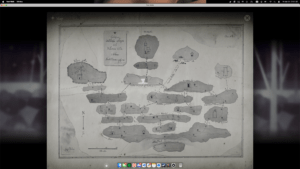
The player, whose only movement mechanic is walking, is forced to follow a literal gameplay loop that makes them problem-solve narrative-related mysteries in real time, putting them in the shoes of the fictional character whose POV they are looking through, thereby implying an enacting narrative. The most literal example of this is with the Huldra’s tree, where you walk in random circles and stumble back to the beginning point until you realize that the chorus in the background must harmonize with the instrumental of the scene. The player realizes that the Huldra is a singing monster, and lures victims with a song. Without this realization, the player gets more and more lost, which fits with the haunting flavor of the Huldra.

These loops incentivize the aesthetics of discovery and exploration, where the player encounters boundaries of the game and must walk until they find a pattern, and once they do, they can finally progress and understand the full story of the game. In these mechanics, the embedded narrative becomes an enacted one once everything clicks. Furthermore, the game literally incentivizes the player to walk in these lore-revealing circles using a walking speed mechanic found in the settings, which allows the player to walk faster to move around the map quicker. This makes it apparent that there are no chase sequences in the game, but it also tells the player, “Hey, you should walk around… like a lot… if you want to make it through this game.”
Year Walk has a very dark story progression based on the murder of powerless children and main characters in the story (who may also be children). Violence is what inspires the spirits in the game to haunt the player. In this sense, I think violence is inseparable from Year Walk; it is a precursor and therefore a foundation for what transpires: the main sequence of the game. However, as the player, you never enacted in violence (As a horror game, this is to be expected, and I do believe that violence is key in a lot of horror games to freak out the player.) Contrastingly, when we played Krunker.io in class, violence was much more of a social experience and a means to victory. Death occurred frequently and you respawned often, and while the whole experience was built on gun violence, it was still inherently fun. Violence in Year Walk was more of a storytelling element meant to solidify the game’s role in the horror genre, whereas violence in Krunker.io was more of a means to an end and created an aesthetic of fellowship and casual fun.