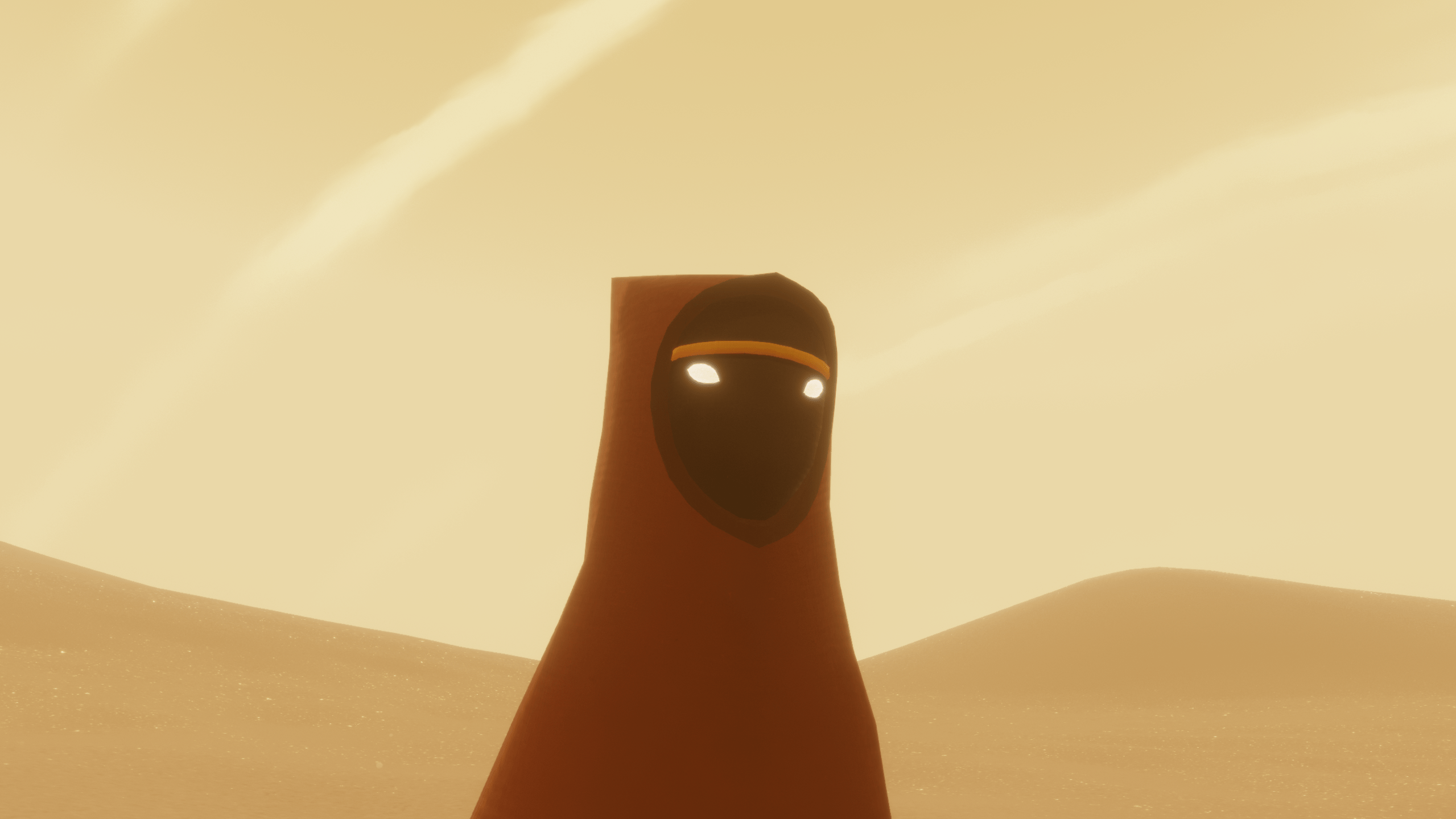
What kind of name is Journey, anyway?
In a landscape of titles like Tom Clancy’s Rainbow Six Siege and Dragon Quest XI S: Echoes of an Elusive Age, a video game with a one-word name really sticks out. Furthermore, the word itself reveals next to nothing about the game it represents. After all, aren’t most games a “journey” of some sort or other? It’s a weirdly basic way to brand a game, but perhaps that’s the vague marketing that the developers at Thatgamecompany were going for.
That vague marketing, to Thatgamecompany’s credit, made me very curious. I could tell after watching the Steam trailer that Journey was appealing to casual players who enjoy relaxing, contemplative experiences: the sorts of games that I, frankly, do not usually play. Still, I was intrigued enough by the art style and the reviews to try it out. After playing it for an hour or so, I can say that it offers quite a lot: a remarkable feat for a game in which much of the time is spent just walking around. By guiding the player with visible objectives rather than textual exposition, Journey compels players to walk from location to location and discover more about the game’s setting and plot for themselves.
This practice of “showing” the story rather than “telling” it is present as soon as the very start. The opening is mostly just panning shots of a vast desert, set to a calm orchestral score. Then, a shooting star appears, rocketing toward an unknown destination. Finally, the playable character comes into view, and the game begins. After a brief tutorial about how to move and look around (presented entirely with graphics, not text), the player ascends a small hill and looks toward a huge mountain, reaching high above the sand, with a piercing light on top of it.

Absolutely no explanatory text is shown to the player during this entire sequence. At this point, I did not know who my player character was, nor why I was in the middle of a desert, nor what that shooting star had to do with anything. But without the game saying anything, as I looked upon the mountain in the distance, the Discovery aesthetic became palpable, almost audible. It was as though the game was shouting at me:
“GO THERE.”
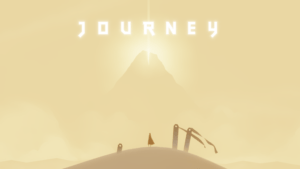
As I continued to traverse the environment, the game continued to offer pieces of information about the world, but always in a visual form: never with text or dialogue. I saw crumbled ruins, reminiscent of a temple. I saw undecipherable glyphs, presumably inscribed by whatever beings once occupied this desert, none of whom remained nearby. I began to conceive of what the overarching narrative here might be, even though the game was hesitant to directly explain it to me. Importantly, the mountain remained in full view during all of these scenes, reminding me of my ultimate goal.
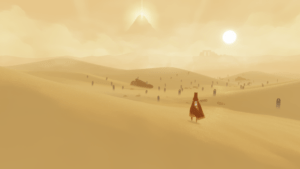
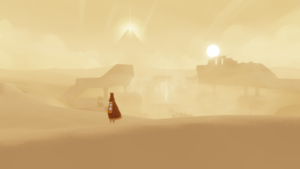
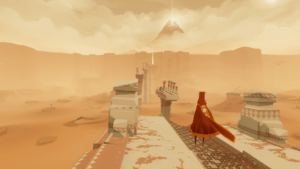
This is what sets Journey apart from other walking simulators. In Firewatch and A Short Hike, players learn the identity of the protagonist and the overall premise of the game through relatively straightforward means. In contrast, Journey’s game designers prioritize an underlying embedded narrative. They trust that simply placing a prominent objective in the visual environment will encourage players to investigate it. Sure, those players might have questions due to the little information given to them—I certainly did—but the designers put faith in those players to seek those answers out, rather than just handing them the answers up front. There are also elements of an evocative narrative here, as Journey draws on several shared storytelling archetypes: the “pilgrim’s journey,” the “ascent to the heavens,” and so on.
Still, the lack of instructions apart from “GO THERE” (which is only heavily implied, not stated outright), as well as the lack of mechanics apart from basic movement, did leave me feeling very lost sometimes. The developers seem to have foreseen such confusion and created a mechanic specifically to account for it. Whenever the player strays a bit too far away from the “intended path,” a strong gust of wind blows them backwards several feet. Personally, I found myself torn on this mechanic. On one hand, considering Journey’s sprawling environment, it felt like the game was inviting me to walk freely and then punishing me for “walking the wrong way.” However, I can acknowledge that it works well with the game’s overall concept of visual, embedded storytelling. It’s a very gentle way of telling players, “What you’re looking for isn’t here. Try looking somewhere else.”
In any case, my point remains that walking is not merely a mechanic in Journey; it is the means by which players become both more informed and more curious about the world around them. Every landmark discovered along the way yields both another question and an answer to a previous one.
Ethics Question:
Admittedly, I have not yet played enough of Journey to completely understand its plot or backstory. However, from the bits and pieces I have encountered in the first hour, it seems to me that the barren desert in which the game takes place was once a proud civilization, teeming with life and showing great promise. At some point between then and now (however long ago “then” was), the land evidently became rather bare, and the people and animals vanished. As such, I wonder if this will be a story about a society that exploited its resources to the point of their own extinction. I have played and enjoyed some games in the past that take this ecocritical lens to worldbuilding and storytelling, so I am curious to see how this game’s approach differs from that of Subnautica or Ori and the Blind Forest, for instance.