
Journey is a 3D, single-player, narrative-based puzzle walking simulator developed by Thatgamecompany, published by Sony Entertainment and Annapurna Interactive, playable on PlayStation, Windows, and iOS. Alone in the dark on an iPad Pro, I played the first four “Levels” of Journey, discretized as visually cohesive environments before a cutscene and leaving entirely. Rated E for everyone, its target audience encompasses both gamers and non-gamers ages 4+; however, its themes are better appreciated by older children and adults seeking a narrative-driven adventure. Journey successfully tells its story through a walking-flying mechanic and no dialogue, with a story that does not progress without walking and intentional level design to direct player movement toward story-infused elements of its immersive world.
Though we can stop anytime to enjoy the tranquil graphics, the story of Journey does not progress unless we move around the map, which makes walking and discovery prerequisites for experiencing the game. A key example is when the game begins: a lone robed figure on vast, empty dunes.

Just as I process that the scene before me is stagnant, nearly invisible white circles appear on the bottom corners of the screen. This encourages the Dynamic of experimentation with controls to find out we can walk across barren dunes, evoking the Aesthetic of Discovery, and due to the immersive stereo-audio environment, Fantasy. The nonverbal cues differ from The Stanley Parable, another walking simulator, where the narrator’s dialogue is an immense part of the game’s meta, immersive experience. However, like in Journey, the player still must walk around to progress, as there is silence until a physical interaction triggers continued narration. In Journey, unless in an enemy-infested area like the fourth Level, there is no feedback to not moving for a long time, as the game does not incorporate the Formal Element of multiple players in the same world. To encourage player movement, Journey could introduce an event triggered by long periods of stillness—like falling light or a guiding ribbon creature—that reveals a path toward more story-laden areas. There are also puzzles necessary for progression like in the second Level, where players need to “revive” all the ribbons to rebuild the bridge needed to exit the Level, shown below.
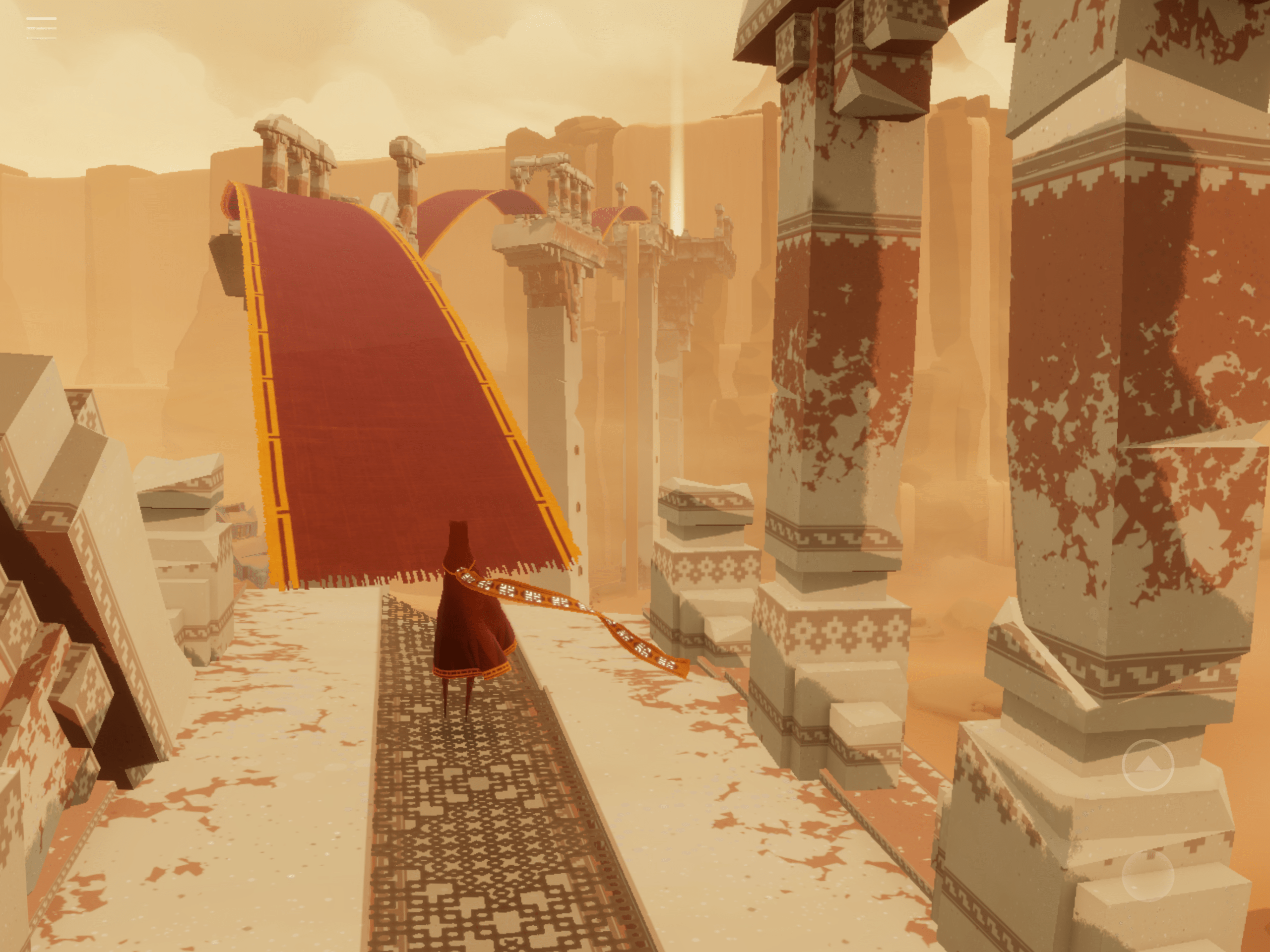
As we cannot proceed without moving and solving the narrative-infused puzzles dispersed across the scene, Journey necessitates walking to continue the naturally unravelling story.
Once the player learns that walking is essential to drive the story told in separate sequential Levels, Journey directs player movement using strong visual design elements seamlessly integrated into each Level’s narrative. In an open desert without text or glaring borders that take us out of the experience, Journey establishes its Formal Element of Boundaries with intentional emptiness of dunes not meant to be explored—if the player wishes to go anyway, a “strong wind” mechanic tackles us to the ground like the image below, making it physically impossible to walk in story-irrelevant directions.
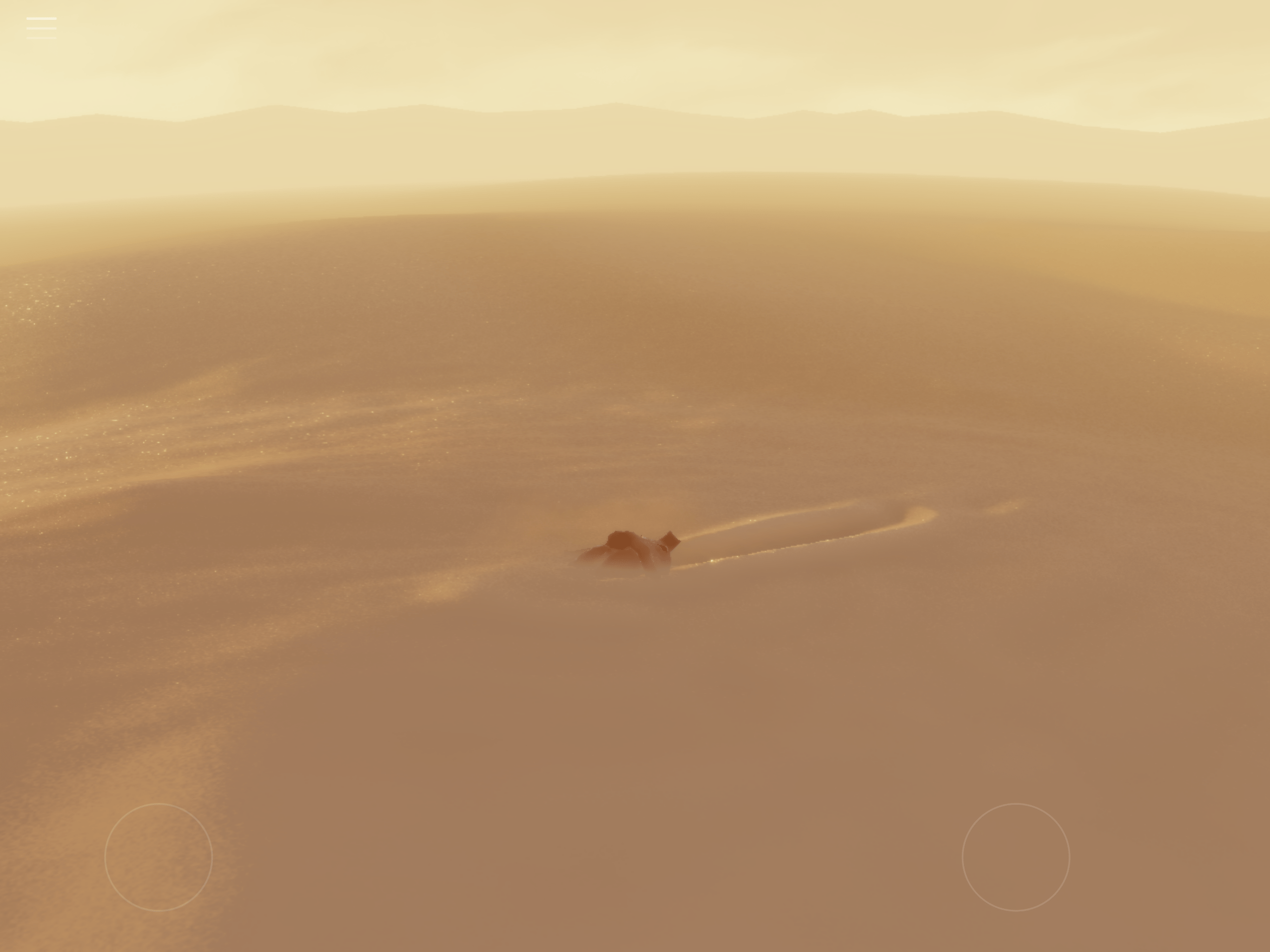
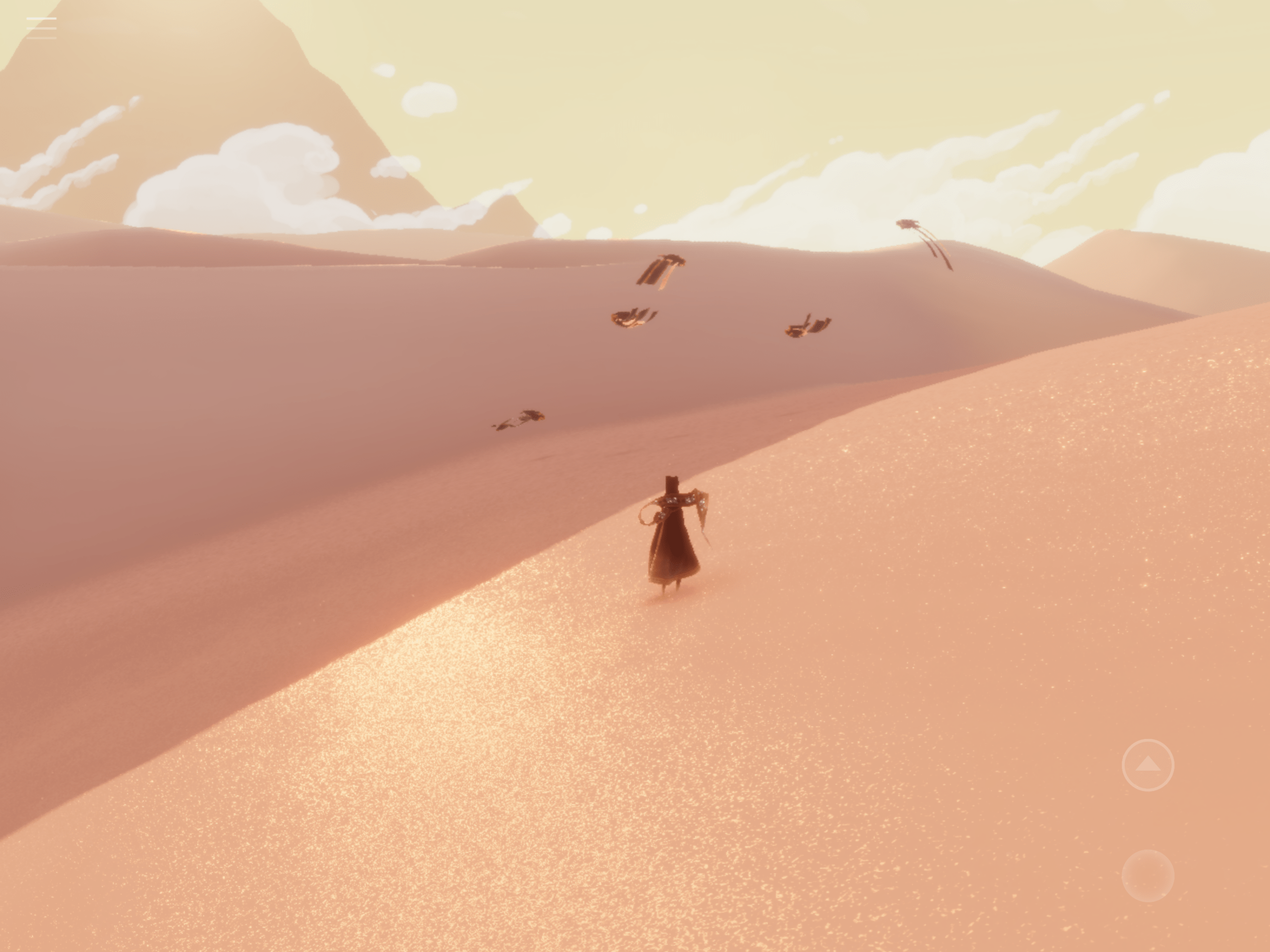
This unspoken strong-wind boundary mechanic is also present in Sky: Children of the Light, a flying open-world MMO RPG developed by Thatgamecompany—a difference is the presence of other players who can guide you toward Enacted story cutscenes by holding your hand. Journey’s ribbons flying wildly in the air and ribbon manta ray creatures both utilize the same pattern—maroon with gold fringes—as the player’s robe, visually indicating that we are on the same side. With the fun of Discovery again piqued, the player must walk closer to learn that they heal us, which reaffirms the visual cue of ribbons as “Friend”, not “Foe”, and teaches us about the world as we walk around to free trapped ribbons. Journey uses this learned knowledge to strategically place ribbons—like ribbon rays guiding us through desolate dunes in the image below—toward and near puzzles, which are Embedded Narratives that uncover lore and allow physical progression in the story.
One more visual design strategy that highlights the overarching story and encourages player movement is the repeated emergence of the mountain peak backlit by a surreal glow, as seen below, enhancing contrast and negative space to remind us what we are walking towards, both physically and narratively.


Journey makes repeated, highly noticeable design choices to guide player direction in their walking exploration, steering them with easily graspable environmental elements and visual techniques that teach and enhance the game’s narrative.
Violence is introduced in the fourth Level of Journey—the NPC mechanical dragon is an Embedded Narrative mechanic that charges at and damages the player, demonstrating its oppressing presence in Journey’s story. The steel dragons’ physical violence toward all ribbon creatures and role as the main antagonist are central to the downfall of Journey’s world and its current desolation. In this sense, the player-harming mechanic is simply a storytelling of this game world, whereas Krunker.io’s main gameplay is killing between players with humanoid avatars and guns in realistic buildings, which are all reflective of violence in the real world. In Journey, the player cannot inflict violence but only avoid it, further highlighting the goodness of the player character; I think the dragons’ aggression in Journey, not too graphic and in an entirely fantasy world, serves the purpose of conveying the game’s story in an ethical way. This is a great example of how elements of violence can serve storytelling if done in an intentional, thoughtful manner that elevates the story I want to tell, not simply mindless killing.
As such, Journey is a highly immersive walking simulator with intentional ethical and visual design, toward Enacted and Embedded Narratives revealed only as the player physically moves around the map—solving puzzles to proceed to the next Level and discover the origins of its unknown, mystical world.