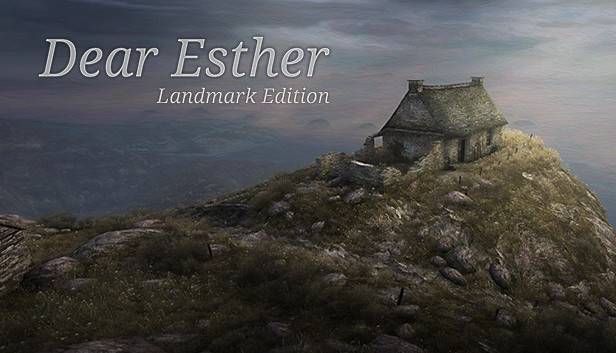
The game I played is Dear Esther: Landmark Edition (2017), the rebooted version of Dear Esther (2012) developed by The Chinese Room and originally designed by Dan Pinchbeck. I played on Steam on my PC but it’s also available on Mac. The target audience seems to be narrative and literary game enthusiasts. I didn’t know what to expect going in since no objectives appeared on screen, no tutorial told me what to do, and no enemy mobs were there for me to fight. There was just an island, a path, and my feet. This made me think about how walking tells the story, and I came to realize that it sn’t about what the game gives you to do but what it refuses to give you and how every design choice built around that rejection can turn into its own storytelling.
To understand why, you can first observe that Dear Esther‘s mechanics are radically minimal: forward movement, looking around, and the passive system of the flashlight, which turns on automatically whenever you enter a dark space. That last detail seems small, but it was one of the first things I noticed. I walked into the interior of a crumbling building with peeling walls, and debris scattered across the floor, and the light just came on.
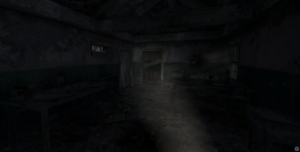
In most games, especially ones in first-person perspective with this eerie vibe like The Last Of Us, the flashlight is the player’s tool that they can use as they choose. In this game, it activates without you, conveying that you are not steering this story but being carried through it. Once I accepted that, my whole relationship to the game shifted, and I stopped waiting for something to do and started paying attention to everything around me. With no fail state, no reward loop, and nothing to collect, the only thing left to engage with is the environment itself; and the narrator, who speaks on his own schedule. Sometimes he comments directly on what I was walking through, his words locked to the landscape. Other times, he drifted into fragmented passages about people I hadn’t met: a figure named Donnelly, a man named Paul, a car crash referenced but never explained. I couldn’t always tell what connected his words to the path I was on. That confusion turned out to be the point.
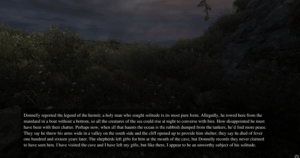
The narrator’s inconsistency isn’t a flaw in the writing. It’s a design choice that mirrors the fractured interiority of a grieving mind. Sometimes the landscape and the monologue align perfectly like when I stood beneath a cliff face and heard him describe how islanders would cut parallel lines into the chalk to warn boats of illness and death. The environment and the words were doing exactly the same work, doubling each other’s weight.
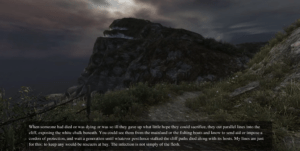
The mechanics produce a dynamic of slow, interpretive exploration. That dynamic generates an aesthetic the framework calls narrative and sensation working together. The abandoned interiors, storm-heavy skies, and eerie caves do not need a cutscene. The decay and isolation convey certain emotions that helped me as I was building the story myself out of the fragments the game scattered across the island, and walking was the only tool I had to do it.
Dear Esther as a designed object: walking, when stripped of every other mechanic, stops being passive. It becomes the act of earning the story one step at a time. Critics who dismiss walking simulators as subtractive miss what games like Dear Esther actually demonstrate: that removing agency isn’t always a loss. Sometimes it’s the most deliberate design choice a developer can make. The pace of your movement, the moment the light turns on without you, the narrator speaking when he wants and not when you need are all shows of not only authorship, but story.
Ethics
The games I’ve played use violence as their central feedback mechanism, meaning you act, the world reacts with force, and that loop tells you what matters and what doesn’t. Dear Esther has no such loop as there’s no violence in it whatsoever, not even implied threat. Even though the game isn’t without harm, the narrator is haunted by a car accident, by grief, by guilt he can’t organize into a coherent confession. It seems the damage in Dear Esther is existential rather than physical. By removing violence entirely, the game forces player and designer alike to find a different grammar for consequence. In a traditional game, death, whether it’s you as the player dying or doing the killing, is typically the main boundary. Dear Esther asks instead: what if the most devastating thing a game can do isn’t kill you, but make you realize something? That question reframes the ethics of the design itself. The game doesn’t need to threaten your body to make you feel the weight of loss, but instead uses the environment and its attributes to convey that same feeling without a single act of violence. The absence of violent mechanics doesn’t soften the experience but sharpens it, as there’s nothing to get in the way the game’s quietly building story the whole time you’re walking.