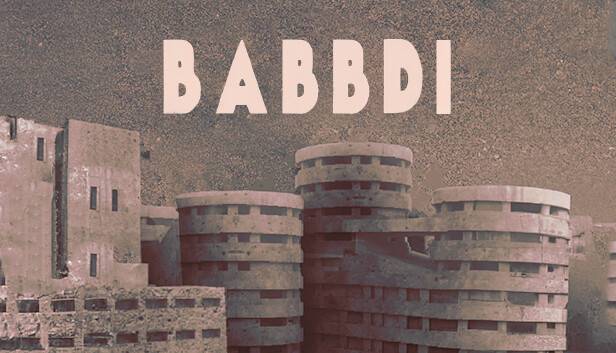
Have you ever been trapped in one of those dreams where everything feels loose and irrational, yet you felt a sense of liberty in the wilderness of its dystopia? That is what playing BABBDI feels like. In this walking simulator, players wake up in the crumbling concrete district of a small town called BABBDI, and the end is to catch a train out.
Walking simulators occupy a controversial position within contemporary game discourse. Some players argue the genre lacks the agency and engagement of traditional gameplay, while others treat these works as interactive art pieces. I playtested BABBDI, a first person digital game created by Lenard Lemaitre and Sirus Lemaitre in 2022. The game is rated 16+, though based on my own resonance with it, I would infer that its intended audience leans toward players who approach games as a medium of art rather than as competitive, adrenaline-seeking entertainment. BABBDI uses the walking simulator mechanic to tell a dystopian fiction and explores the layered social fabric of even a small town through a dreamcore narrative.
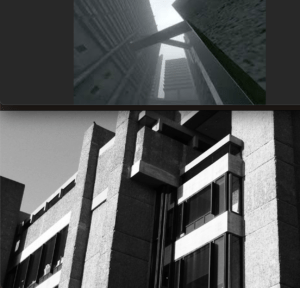
I played for about an hour and a half and then watched a YouTube video by eurothug4000 (https://www.youtube.com/watch?v=hPHq_7d_dXQ) to understand the parts I missed. It was through this video that I first encountered the concept of Brutalism as an architectural movement. Brutalist architecture is defined by raw concrete towers, alleys that resemble slot canyons, and endless stairwells, and the environmental narrative of BABBDI is unmistakably brutalist. What I find especially interesting is how BABBDI collides the utopian promise of brutalism (democratic forms, sturdy materials) against a shabby, dying population of residents who are trying, or failing, to leave. The contributes to a dystopian, gloomy aesthetic that feels heightened by the very grotesque, distorted NPC designs.
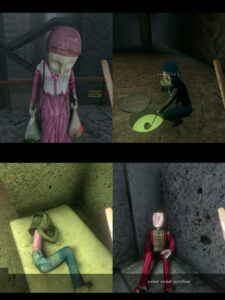
Walking, as the base mechanic, fills the majority of gameplay. No other NPC in the game moves; they all stay fixed in their assigned positions. This dichotomy between the stationary world and the moving player contributes to the dreamcore element of the design, as though the entire environment exists to be witnessed by the player alone. Within the narrative are many marginalized inhabitants: residents dancing beneath the canal who speak only Spanish, one barely making a living on an abandoned mattress, another telling me how their father is sick. A minority of them claim they haven’t given up hope to escape BABBDI, though none make an active attempt the way the player does by simply walking around. They all only offer a single time interaction with very simple information within a few sentences. This reminded me of exploring Beijing (where I grew up) as a kid, wandering into hidden alleys and corners where marginalized vendors and workers lived. I had the same mix of being slightly frightened and confused when strangers spoke to me, often in heavy accents and unfamiliar terms. Walking through BABBDI, in a way, returned me to that childhood disorientation through the frame of a screen.
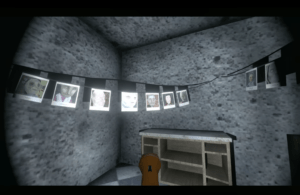
One of my favoriteparts of the game is how players can retrieve special objects and occasionally interact with items, all in very random ways. I loved pushing a heavy stone ball off a stairwell for no reason and gradually discovering different faces of the NPCs while connecting their stories together (it turns out their narratives actually overlap). Smashing open blocked doors with a baseball bat was oddly satisfying.
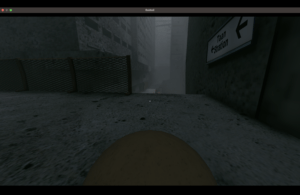
For someone less familiar with digital games, parts of the experience did become frustrating when I had to jump across stones and fell off on the seventh attempt. I can see why some players perceive walking simulators as monotonous, since the genre does not offer the instant satisfaction of most challenge games with their quest and level mechanics. Even so, I appreciate the consistency of the form and treat it more as a narrative story art form within games and cherished the emotion it evoked while I played.
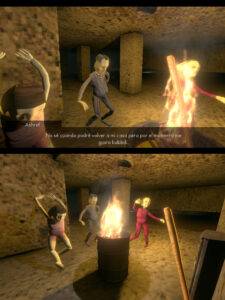
In studio, we have engaged with games that rely on violence as a core mechanic, and my experience with those titles differs noticeably from playing BABBDI. In a combat driven game, violence operates as its own language between the player and the system. Walking through BABBDI, violence is almost entirely absent. There is a baseball bat, and I did swing it, but only to break down doors; I never used it against another character. The NPCs despite looking scary, remain untouchable, locked inside their stationary realities. I think this absence shapes how BABBDI tells its story. Because the player cannot harm or be harmed, attention drifts away from survival and settles on observation, positioning the player as a witness who is walking through a dream life world to find escape. I suspect that if BABBDI introduced combat, the melancholy of its hopeless residents would flatten into background and deviate from its purpose.
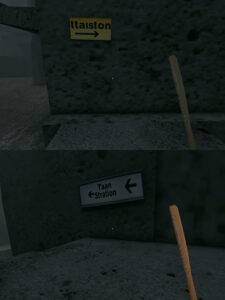
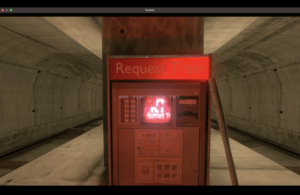
Two of BABBDI’s most defining aesthetics are dreamcore and liminal space. Liminal space refers to uncanny, empty, transitional places, while dreamcore involves the distortion of reality and the kinds of unrealistic behavior associated with dreaming. Dreamcore signals are scattered throughout the game: human like faces rendered in a way that feels uncanny, NPCs who utter a single inexplicable line and refuse any further interaction the way dream people often do, absurd mobility tools such as a baseball bat, a motorcycle, and a flying contraption, along with misordered letters on signs across town. These aesthetic choices blend coherently with the environmental narrative and the walking dynamic, producing a gameplay experience that feels tonally unified from start to finish.
In my understanding, the end purpose of BABBDI is not to escape but to wander, and in that wandering, it insists that noticing a place can be its own kind of meaning.