


Dear Esther is a game developed by The Chinese Room. It was initially released in 2012 for Windows and OS X, though it is currently available on PlayStation 4, Xbox One, and iOS as well. I played the Landmark Edition remaster on Windows via Amazon Games.
In many “walking simulator” type games, walking and examining the environment tells a story to the player. This is most often achieved through the use of what Henry Jenkins called “spatial stories and environmental storytelling” (Jenkins, 674). These tools often work alongside “embedded narratives”, in which game’s spaces become “a memory palace whose contents must be deciphered as the player tries to reconstruct the plot” (686). In this kind of storytelling it is the design of the game’s spaces, and the elements revealed to players as they traverse through them, that create the conditions by which the narrative is understood and felt. In Dear Esther, walking does not tell the story. I argue that Dear Esther fails to deliver its story by way of spatiality and environmental storytelling, instead over-relying on direct narration, and thereby negating both the possibilities of embedded narratives and its potential as a game.
The story of Dear Esther is broken into fragments. Each fragment is a bit of script, all narrated by the same anonymous narrator. Not every fragment is read on each individual playthrough, meaning a player will need to play the game multiple times to receive every possible piece of the story. Each fragment is also revealed in a random order to the player, and the order changes on each playthrough. This is the problem with Dear Esther: the structure of the narration removes the player’s motivation to explore.
In a walking simulator, the player has very little that they can do. In Dear Esther, the player can only walk, look around, and zoom the view in a bit. There is no jump, sprint, crouch, or interact such as other walking simulators feature. With such limited options, it is essential that the few things the player can do still create agency and motivation for the player; they ought to feel empowered to make choices, and they ought to be motivated to explore by the reward of uncovering more of the story. Jenkins says “melodrama provides another…model for how an embedded story might work, as we read letters and diaries, snoop around in bedroom drawers and closets, in search of secrets which might shed light on the relationships between characters” (684). Dear Esther is certainly melodramatic, and its story fragments are largely epistolary, but it lacks that active characteristic that Jenkins describes. The player in a game like Jenkins describes is motivated to explore each drawer and closet because it is their agentic choices (where to explore? how thorough to be?) that reveals more of the story to them. If they want more story, they have to look around more, or in different places. They may even have to go back and explore an earlier area again.
The player snooping (walking) in the bedroom drawers and closets (environment) reveals secrets (story fragments). Dear Esther has these same elements but what’s missing is the connection between them. The player walks to a new area and more of the story is narrated, yes, but what part is delivered is only loosely connected to where the player is. The player has very little agency — there is little deviation possible from the linear path of start to finish — and even less motivation to explore, since the same amount of story is revealed to the player, and in the same random order, necessarily by playing the game. If they are curious about a particular area or part of the story, they have no way to satisfy that curiosity by exploring. Dear Esther would be greatly improved by tying the story fragments to specific areas the player can reach via exploration, rather than being delivered randomly, or having objects the player could find and examine to reveal parts of the story (as many modern games have).
Dear Esther features so few choices, and so little connection between environment and story, that players would be better off reading the script fragments or listening to a compilation of all of the narration.
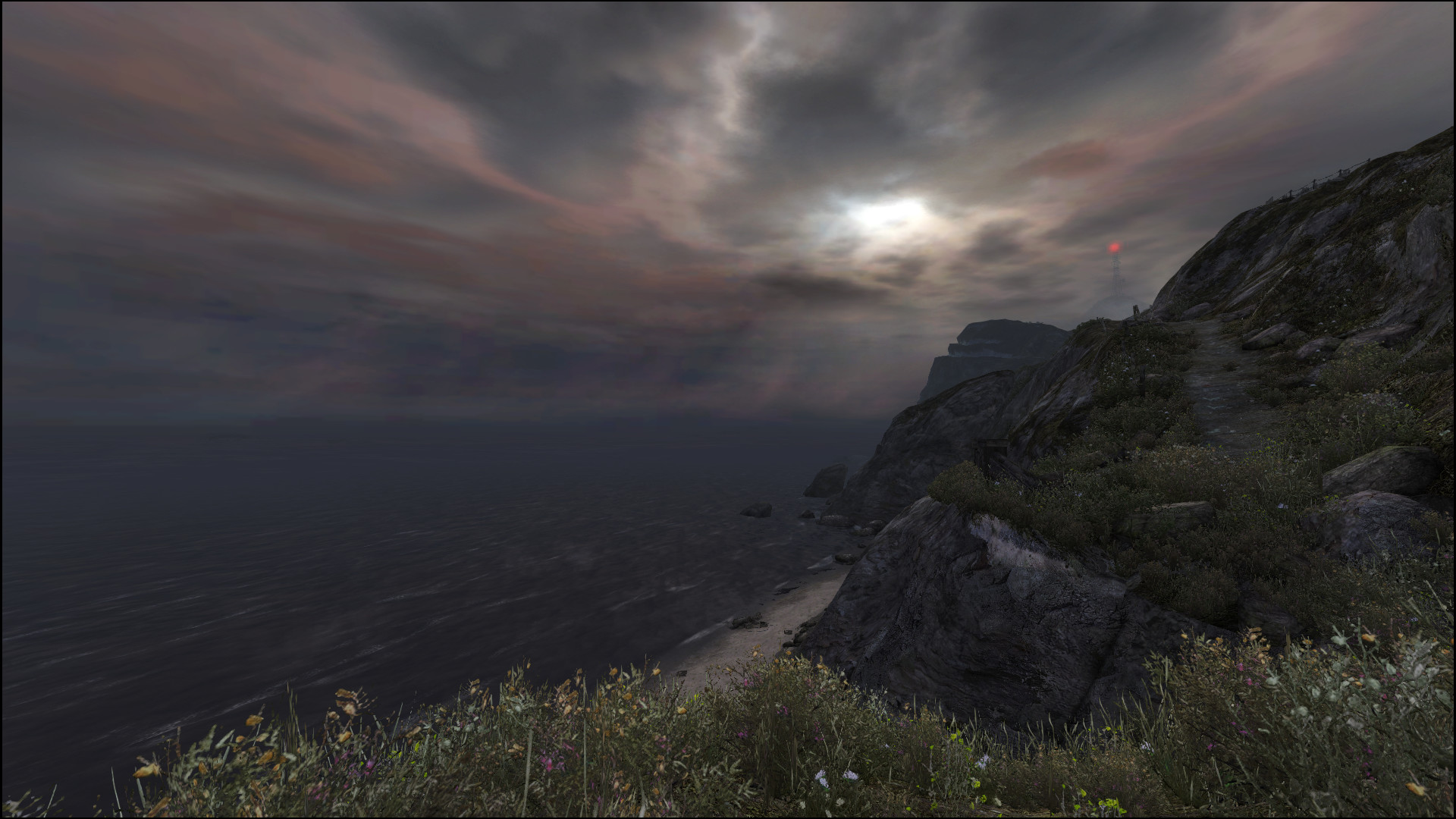
The stunning visuals and interesting environments unfortunately are under-served by the structure of the narrative. Want to know more about this area? Too bad.
ETHICS
There is no violence in Dear Esther that happens to, is caused by, or is even observed by the player or player-character. At most, there is a suggestion of violence; the narrator describes a fatal car accident. There is a brief dream-like sequence which shows a hospital bed, also suggesting violence. If you accept the car crash as violence, then violence is technically pivotal to the story of the game. The lack of what we might call classic violence — guns, blood, attacking, hostile people and creatures, etc. — separates walking simulators in general from most contemporary video games. Without violence, there is much less to compel the player to act, as most games use violence as a way to progress their events (quite commonly, the player must “kill all the enemies in this area to proceed”). The lack of violence creates a loss of compulsory progression, but also intensifies the player’s attention on that which is present; the story, the music, and the visuals become more central to the experience when they are not broken up into sections of enemies or obscured by gunshots and blood. In this way, the exclusion of violent elements increases the player’s focus on and interest in the story.