For this week’s Critical Play, I played the game Places, a free, single-player exploration game created by designer jlv and available on the game’s website, where it can be accessed in-browser or through external applications. Through playing Places and exploring several of its environments, I have found that walking can tell stories implicitly by giving the player room to explore the game’s environment and piece together its story, although on its own, walking is limited as a means of telling more complex, dramatic, or embodied stories.

The mechanics of Places are extremely simple: you find yourself in one of the several outdoor environments, and from there, you can walk, look around, or jump. There are no objects to collect, no puzzles to solve, no goal to reach. Just walking. Rather than focusing on fun through challenge, Places uses its simple mechanics to enable a dynamic of free, unguided exploration, all in service of creating fun through discovery, through the joy of experiencing each of the game’s distinct environments. At the same time, players can seek out narrative information in these environments if they are so inclined. As our recent reading on storytelling in games points out, game designers have several means of telling stories environmentally, such as through evocative and suggestive details. Places takes an approach similar to other “walking simulators” like Walden or A Short Hike, in that it creates vivid, naturalistic environments using both visual and auditory details (see the first image). Embedded details, as well as the absence of certain details, help the player construct the story behind the place they’re in. For instance, in Sketch 5 (see the second image), the player can see greyish particles floating throughout the air, as well as a clear lake surrounded by white grass and leafless trees. One might see this environment and think of a snowy environment they visited growing up, although while exploring, I had the thought that this could have been the site of some disaster, an explosion, a fire, some event that stripped the place of its flora and fauna and left the air swirling with ash. I cannot say whether this was the author’s intention, but striking or incongruous details like these allow for embedded narratives, and by walking through the environment, players can discover these details and use them to construct their own narratives, allowing for the fun of narrative as well as discovery.
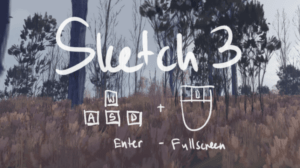
At the same time, Places is lacking in key elements that would help it tell a more complex story. Several formal elements, such as rules and objectives, are barely present, which allows for a freer, more exploratory experience but also means that storytelling through such mechanics is limited. Moreover, unlike other walking simulators such as The Stanley Parable, which has similar mechanics but uses dialogue to tell its fantastical story, Places lacks any enacted narrative elements or explicit conflict, meaning that the game’s story is only accessible through embedded details seen as the player walks, suggesting that without other storytelling techniques, more complex stories like those in the Stanley Parable are likely out of reach. Moreover, since the only controls are walking using WASD and looking around using the mouse (see the third image), there is a risk that players might not feel that they are learning enough information as they play. We heard in our “What Games Are” reading that that fun in gaming consists primarily of learning, and in the case of Places, the slow and intrinsic pace of exploration might deter players from exploring further and seeing everything the game has to show, further limiting the narrative possibilities. As such, walking can communicate implicit story information to players if they choose to seek it out, but has limitations and depends on other mechanics and storytelling techniques to tell more complex stories.
In terms of the ethics question, I have played various violent games, particularly in the first person shooter and fighting genres. In most of these games, violence is not only an element of the experience; it is the sole way through which players are allowed to move through the game and progress. In other words, violence is not only present, but mandatory. Walking simulators like Places adopt a very different, and even oppositional, approach, deliberately stripping down the gameplay and making the conflict either implicit or essentially nonexistent, making for an experience that is refreshing in some ways, but also much less stimulating than more traditional games. In Places, depending on how one interprets the embedded and evoked narratives of each setting, it is possible to imagine violence occurring, but for many players, the fun will come primarily through discovery, allowing for a gameplay experience free of violence, implicit or explicit. The fact that this style of gameplay feels like a statement, like a deliberate choice to make the game very un-game-like, illustrates how omnipresent various forms of violence are in games, and how conspicuous and even “boring” its absence can be. Rather than enacting their stories and conflicts, walking simulators must suggest stories environmentally, requiring more engagement and effort from their players and creating fun through alternative means.