Secret Hitler is a social deduction game for 5–10 players. It is about identifying and stopping Hitler and a fascist takeover, created by Max Temkin, Mike Boxleiter, and Tommy Maranges, and published under Goat, Wolf, & Cabbage LLC. It’s mostly a tabletop game but can also be played online. For this critical play, I played with 8 people from class at board game night using the physical game.
Our group’s social deduction game, Scab! A Game of Worker Solidarity and Betrayal, mods Secret Hitler. In our game, players are divided into workers, who must learn to trust each other and carry out successful organizing missions leading to a strike, and scabs, who must conceal their identity, sabotage missions, or eventually reveal themselves as managers to deplete worker morale. The two games are similar in their political themes and progression-based structure, but differ in key mechanics: Scab introduces resource management, the possibility of an open villain, and a richer narrative/storytelling element that is mostly absent from Secret Hitler. These changes shift the experience from pure social deduction to something more flexible and story-driven.
Comparison
Both games rely heavily on a progression track that structures gameplay and creates tension. In Secret Hitler, the liberal and fascist policy tracks are progress indicators and win conditions. I think the game designers really tapped into the game’s sensual fun in their track and card design. The heavy feel of the cards are incredibly satisfying: the physical act of placing policy tiles adds weight (literally and figuratively), which combined with the visible progression create the dynamics of accelerating gameplay.
At board game night, when four liberal policies and one fascist policy had been placed, Ryan said, “ok, whoever the fascists are, you better lock in” (he was Hitler). Up until this point, the game honestly felt boring because liberal policies kept getting placed. But once that imbalance became visible, everything shifted. Suspicion ramped up, people started talking more aggressively, and the stakes were way higher. I genuinely thought the liberals were destined to win at that point but the fascists ended up winning! That moment really showed how the progression track can suddenly flip the energy of the game.
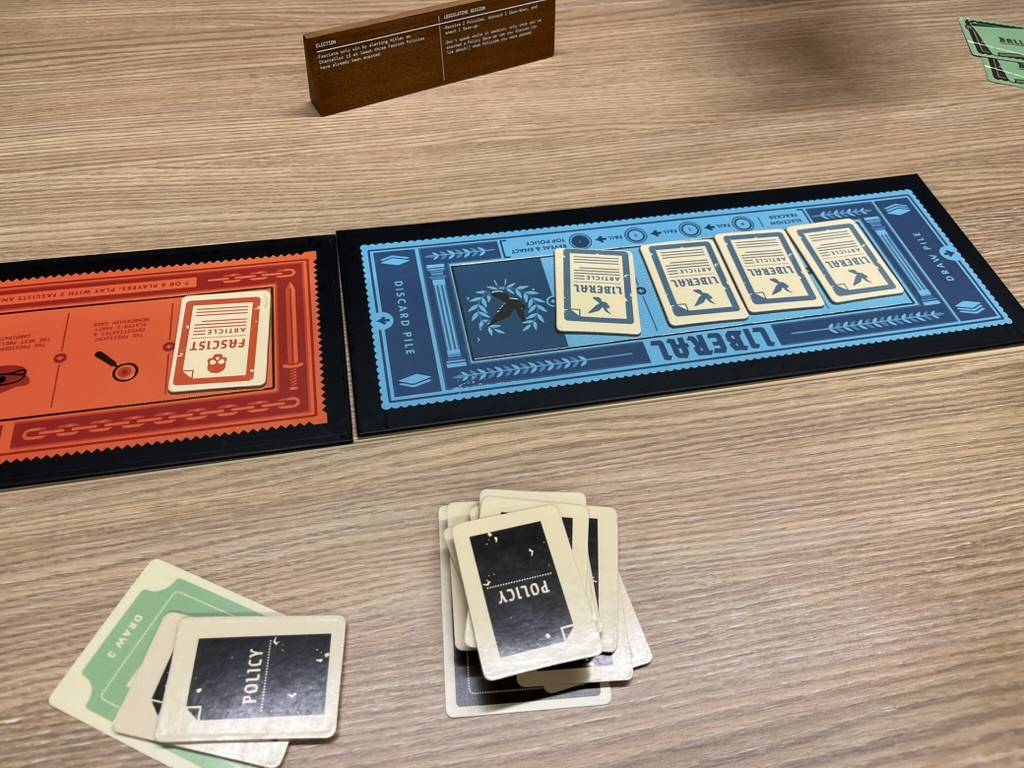
^ The early game, where I thought fascists are destined to lose…
Similarly, Scab uses a mission track consisting of six organizing tasks that workers must complete. Like Secret Hitler, this creates a sense of forward motion, and both games have a kind of “second stage” where things escalate. In Secret Hitler, once three fascist policies are placed, the president starts gaining powers like executing players. In Scab, the transition from organizing stage to a more heightened strike stage increases mission difficulty and allows scabs to reveal themselves and become managers.
These stage-based mechanics create a dynamic where the game accelerates in the mid-to-late game, which is when it actually becomes the most fun. For example, after three fascist cards were played, Mai started accusing Ryan of being a fascist, and that conflict stayed heated until the end (she was right all along).
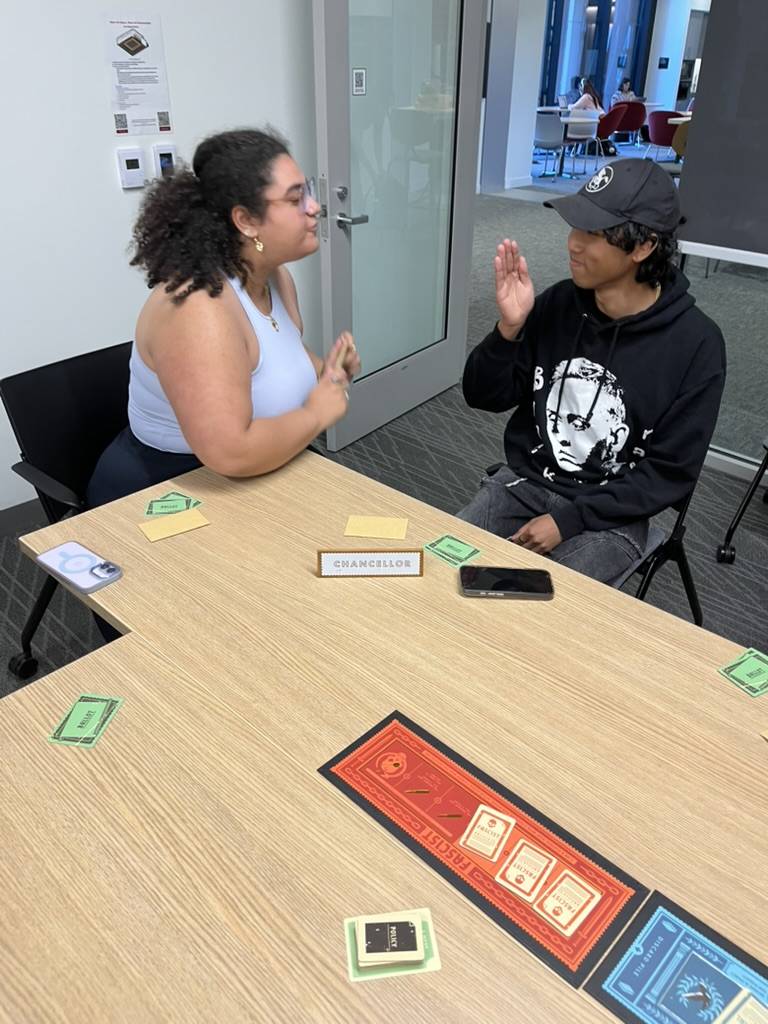
This all feeds into the aesthetic of urgency and high-stakes political struggle in midst of deceit and betrayal! Liberals need to prevent a fascist takeover, and workers must go on strike against their exploitative bosses. In both games, players are pushed into more confrontational behavior as the game progresses, such as accusing, lying, and defending themselves, which deepens the fun of fellowship and challenge.
Contrast
Scab differs from Secret Hitler in many ways. The biggest difference is how each game treats hidden identity. In Secret Hitler, Hitler has to stay hidden the entire game, and if their identity is exposed, the fascists would be at a great disadvantage. For example, at the below critical point in the game where liberals and fascists only need to place one more card to win, whether fascists had kept their identity secret makes or breaks the game.

^ I unfortunately trusted Kalu and he was a fascist, so we lost. This was only possible because Kalu did a good job concealing his fascist identity.
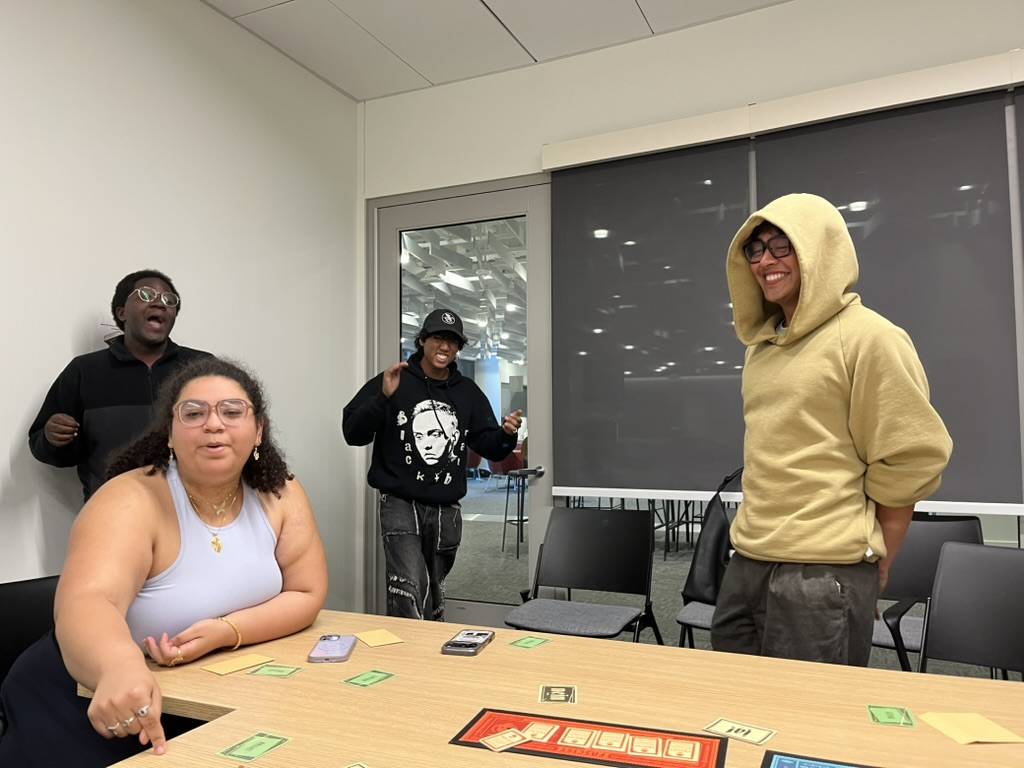
^ The three fascists win after I gave Kalu Chancellor, and Mai was sad :((
In Scab, secrecy is important, but mostly in the first stage. We introduced the mechanic that once the game reaches the strike stage, everyone needs to close their eyes and one of the scabs can choose to out themselves and become a manager, gaining access to playing union-busting cards. As a result, we get the new dynamics that instead of identity being something you must protect at all costs, it becomes something you can strategically give up.
This works because Scab also introduces the mechanic of resource management, which Secret Hitler doesn’t have. The key resource is worker morale. Workers build it through successful organizing missions, while scabs try to deplete it through sabotage and union busting cards. This creates the dynamics of allowing multiple paths to winning. Even if a scab is exposed early, they can pivot and still be powerful by becoming a manager. It’s saying “ok fine, you caught me, but now I’m going to make your life worse anyway.”
Furthermore, unlike Secret Hitler, where policy cards are all functionally the same, Scab differentiates its cards and embeds storytelling directly into gameplay. You can basically retell the entire game as a workplace story by the end, because mission and card names like “make union zines,” “march on the boss,” “sow division,” and “intimidation” create drama and make the game feel like an actual organizing campaign in the face of a boss’s crackdown. These narrative elements, combined with resource management and the ability for scabs to reveal themselves, shift the game’s aesthetic away from pure tension/suspicion toward something more roleplay and story-driven. To win as workers, you literally have to go through gaining and losing morale as the campaign heightens, from having your first successful one on one conversation to staging a successful strike.
In conclusion, Scab expands on Secret Hitler’s social deduction by adding evolving roles, resources, and a clearer narrative arc, which creates a dynamic of strategic flexibility and in turn put forth the aesthetics of partaking in a labor struggle.