
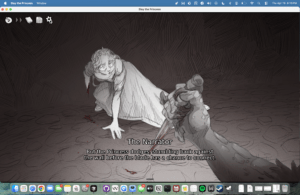
The visual experience of “Slay the Princess” shows that while games prompt meaningful reflection on morality by asking players to engage with violence and its consequences, repeated, constrained exposure to violence and gore risks desensitizing players. In asking how evil a player can be, this game shows that the issue isn’t about a single player’s willingness to choose violence (an “evil” act), but how exposure to evil acts can make them seem increasingly normal. By forcing players to relive and re-enact the same violent act over and over again, there is a real risk of people losing a sense of the horror of their actions, and this sentiment seeping into their real-life actions.
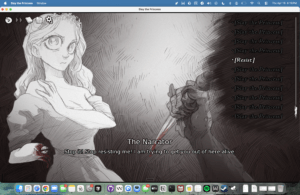
When the player first enters the cabin in Slay the Princess, the act of killing the princess carries weight. There was a lead-up to it, with multiple different options, the narrator and the hero going back and forth, ultimately leading to the interaction with the princess at the bottom of the stairs. The first time the player has to complete this action, they’re not given much background information, but still go through with the actions. There is a sense of “resistance”, even when fighting against the narrator at times, yet the result is still violence (whether that is the killing of the princess and then the killing of the narrator, or just the killing of the narrator by the princess). Choosing violence did not feel neutral, and the scene was tense and difficult to move through. There was blood and gore, which juxtaposed the initial black and white setting of the game, emphasizing that “shock factor”. The game seems to end, but then the player is taken to the “woods” and given more contextual understanding before being looped back into the first scene. That initial tension is repeated, and the player has a couple of different options again, which lead to the same violent ending (even if the death happens in a different way). As the game loops, each new iteration gives slight variations, changes in dialogue, the princess’s appearance, and even the tone of the narrator and the hero, but the core action remains the same. Killing the princess (or dying) is no longer a singular decision but becomes a recurring requirement that the game redirects the player to, regardless of any attempts to avoid it. What had initially started as jarring becomes expected and almost natural.
This shift reflects a larger concern in the discussion of violence in games: does the distance between the player and the scene enable the player to commit horrific acts, and in turn, normalize them? As the New Yorker article states, “Video-game violence… has a unique capacity to…implicate its audience through its interactivity”, and that in games, “we are active if virtual participants”, not just “merely spectators”. Repeated exposure may make violent acts feel routine rather than ethically charged, and it isn’t about the players performing violent acts but rather that repetition changes how these acts are experienced and dealt with. The experience of “Slay the Princess” makes this process evident through its design, as the respiration places the player back in similar positions but with slightly reduced stakes each time. The narrator’s position becomes predictable, and the dialogue options lose their initial shock. Selecting “slay the princess”, when repeated across the different iterations, begins to feel less like a decision and more like the default, inevitable option. At the same time, it feels like the game is limiting any alternatives in the first play-through, where options to do anything but “slay the princess’ feel buried amongst other options (apart from one of the iterations, where it was the only option).
The experience in this game parallels that of BioShock, mentioned in the Gamestudies.org article, which mentions that the game has the effect of “subverting traditional notions of player agency, reminding players of their own lack of choice in pre-programmed, pre-scripted videogames”. In both games, the player initially believes that they have control and are acting freely, but as the game goes on, their sense of control erodes, and it is revealed to be constructed. The moral decision, as it is presented in the beginning, begins to feel like a pre-determined obligation that is imposed by the system. This connects to the core idea of desensitization — if the player really had control, repeatedly engaging with violence may still carry ethical and emotional weight, as it represents a conscious choice. But if the player isn’t choosing to commit the act but performing it as the game requires, and seeing the violent scenes, hearing the grotesque noises, the experience shifts away from ethical reflection. Since the player can’t avoid the violent outcome, each repetition requires less concern and thought.
Regardless of the fact that later in the game, the player’s agency can lead to different outcomes, the visual experience of the early loops shows how violence can be processed. By the time there is divergence, the player might already be conditioned to expect violence and be okay with it, and the repeated exposure to the same blood/gore/sound effects changes the player’s relationship to it. The “shock factor” is no longer present.
Overall, the experience of Slay the Princess does force the player to really think about their actions and how they interact with instructions, and the tension of emotion, pressure, and responsibility (over what would happen if the Princess is not killed). However, the way in which this is done and the visual experience of the violence risks making the moral tension normal, working against the reflection that the game seems to try to provoke.