Critical Play Analysis of Dorfromantik

Game Title: Dorfromantik
Developer: Toukana Interactive
Available Platforms: PC (Steam), Nintendo Switch, PlayStation, Xbox. A physical tabletop board game version has also been released.
Target Audience: Casual puzzle players, worldbuilding enthusiasts, and players seeking low-stress, atmospheric creative experiences.
In general, Dorfromantik builds its worldview through player-assembled human landscapes, arguing that social culture shapes all world features and rejecting innate racial traits common in fantasy games. It uses pastoral utopian imagery to lower entry barriers and deliver enjoyable collaborative creation. However, its idealised rural narrative oversimplifies the complex history of real rural societies, leading to one-sided storytelling.
Firstly, all features within the game world are humanistic constructs without innate, essentialised settings.
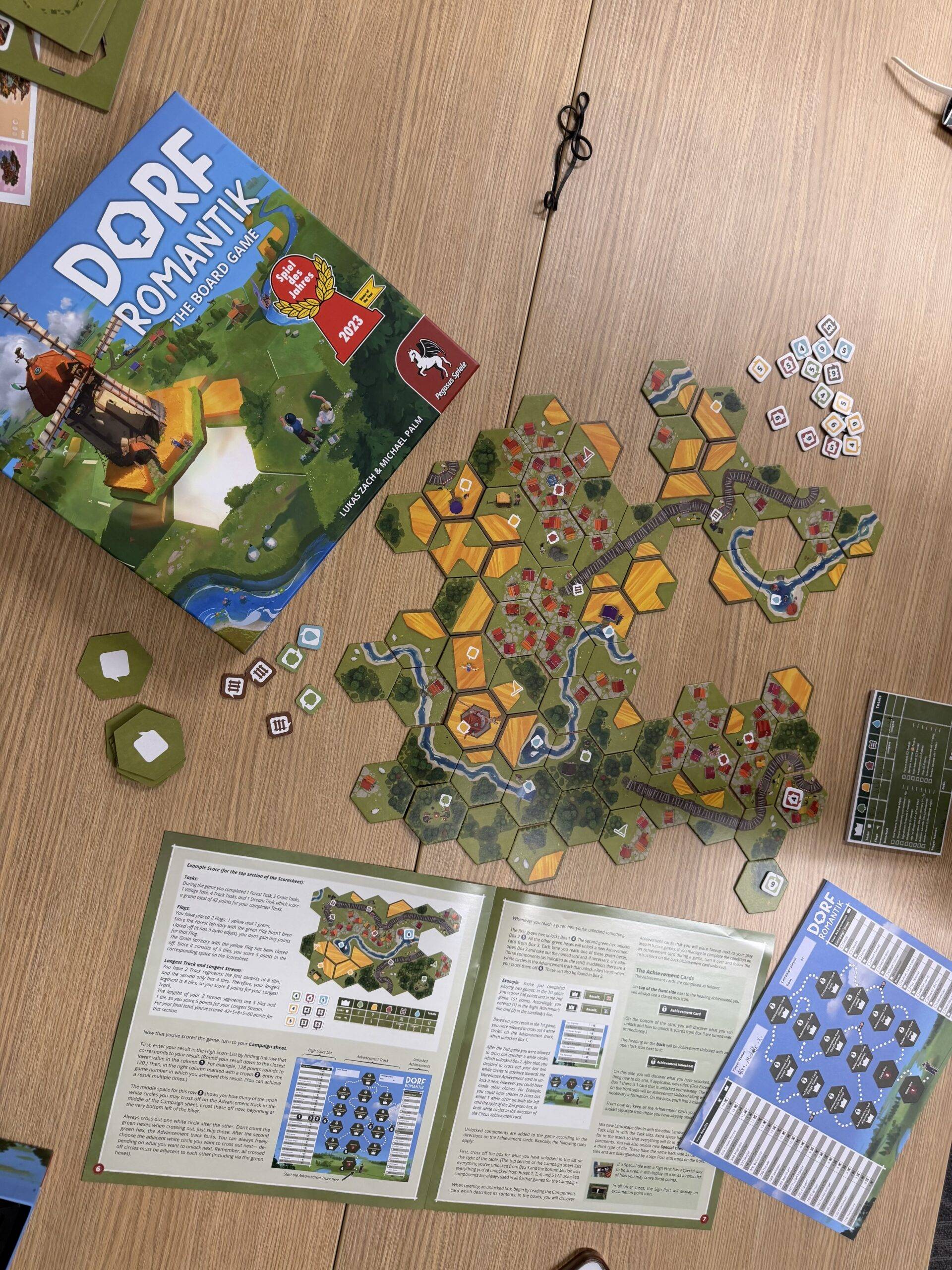
Most fantasy games grant characters fixed abilities based on race. The physical edition of Dorfromantik contains no races or intelligent creatures with built-in traits. The entire countryside is shaped as players take turns drawing and placing hexagonal tiles. Players freely arrange forests, villages, railways and rivers; settlement patterns stem from human choices rather than natural laws.
Under the MDA framework from coursework, the core loop — random tile draw, free arrangement and group co-creation — creates a unique experience with no single correct layout. Communities take shape purely from player decisions. During play, we can build connected villages or scattered woodland cabins. This proves the world is formed through acquired choices and follows an anti-essentialist worldbuilding approach.
Secondly, the game embraces pastoral utopian stereotypes while subverting the established design paradigm of construction games
The game leverages the widely recognised trope of peaceful, conflict-free countryside to reduce cognitive barriers. The physical board game immerses players quickly with soft hand-drawn tiles, relaxed turn order and zero player-versus-player conflict.
It stands apart from Banished and Stardew Valley, which rely on resource shortages and survival pressure. The physical Dorfromantik has no failure states, resource caps or competition; its focus lies in collaborative layout and crafting coherent, attractive landscapes.
Following environmental narrative theory, it uses no script or dialogue — the assembled map itself tells the story. As tiles expand, isolated patches merge into complete countryside, letting players imagine community development. This breaks the convention that narratives require characters and plots, turning players from audience into co-creators.
Thirdly, utopian pastoral design delivers therapeutic experiences alongside prominent narrative and ethical limitations
Stress-free collaborative gameplay offers an inclusive experience. Simple mechanics and creative freedom in the physical board game align with worldbuilding psychology. Players build ideal rural scenery according to their preferences and gain comfort and belonging through creation, which is the game’s greatest strength.
Still, its romanticised rural narrative has drawbacks. It only retains the peaceful, beautiful side of rural life and erases real agrarian struggles such as poverty, class tension, resource conflicts and natural disasters. During play, players only build perfect utopian villages without seeing hardships, simplifying real history.
Design improvement suggestion: add a small set of special tiles such as decaying villages, dry riverbeds and winter woodlands. Without ruining the tranquil mood, these elements add historical depth and stop the pastoral landscape from becoming pure fantasy.
From the narrative ethics of tabletop and digital games, Dorfromantik avoids the antagonism and utilitarianism common in many building games. Its open, collaborative creative loop enables high-quality worldbuilding. By rejecting divisive labels, it builds an equal and free creative space, a key merit.
Even so, its pastoral romanticism bears ethical limits. It deliberately omits historical conflicts and survival hardships, replacing complex agrarian civilisation with aesthetic scenery to create gentle yet one-sided idealisation. While this design satisfies people’s longing for an ideal homeland and delivers comfort, it weakens critical reflection. Player creativity remains limited to sensory pleasure, without prompting deeper thought on the diverse history of real rural societies.