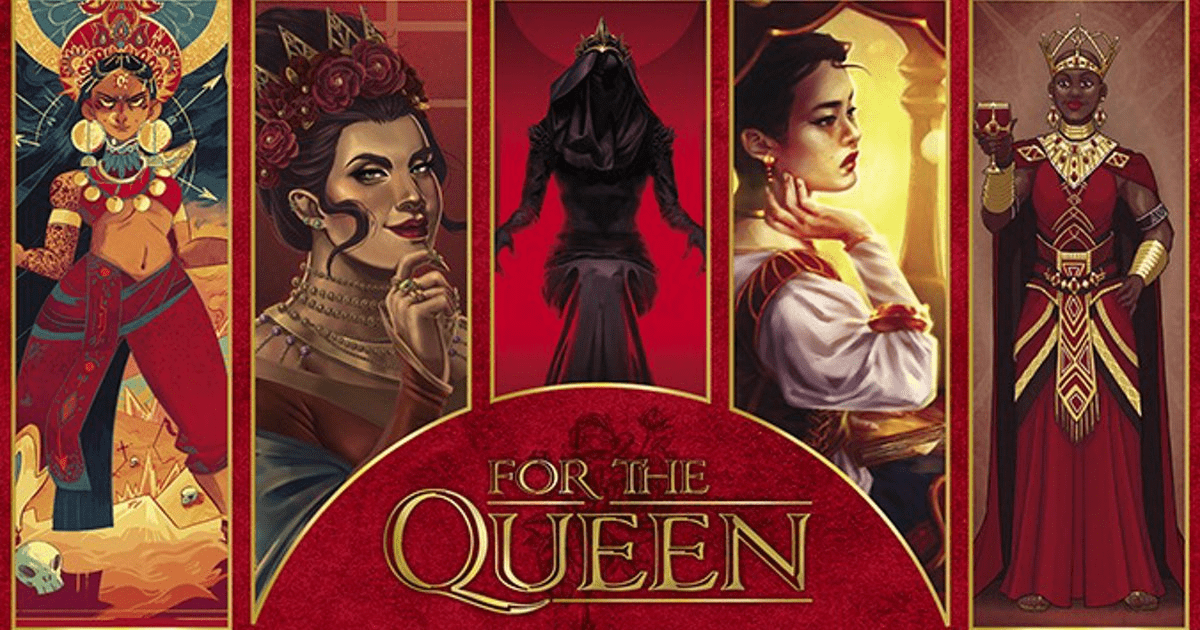
For the Queen, designed by Alex Roberts (II) in 2019, is a story-building card game in which players collaboratively construct a narrative centered around the actions and leadership of a single “queen” character. Players select a prompt from the top of the deck, to which they respond out loud, constructing background experiences and plot twists regarding their “interactions” with the Queen on the spot. The game ends upon reaching the card that reads “The Queen is under attack.” I would guess that this game is intended for players who enjoy flexing their “right brain”, pushing beyond the boundaries of reality or putting themselves in a low-effort LARP scenario.
While the game could be an inspiration for the creative freedom it offers, thematic context, and thought-provoking introspective prompts, it lacks mechanisms for incentive that make a game challenging and relies almost entirely on the players’ personal drive to shape the plot trajectory – something we have found tends to kill momentum.
Story-telling games, from the beginning, exist for niche audiences with creative streaks. Across similar games like And Then We Died and Wing It (other games we considered as competitors), there is a fundamental dynamic of improvised content construction. This could be in the mechanism of passing along an existing story to the next player (like in ATWD), justification for one’s actions and choices (Wing It) or in the case of For the Queen, a combination of the two. There’s a recurring problem with this dynamic: the player is left completely at the mercy of their given prompt or resources and their own abilities to adapt with minimal guidance within the scope of their turn. One might say, yes, that is the point of the game – but shouldn’t the main point be to have fun? What’s fun about being completely stumped and deciding that you’re not cut out for this sort of gameplay?
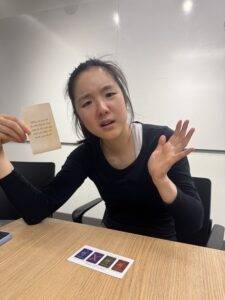
Ambiguous prompts that give little to no support for a player who might already be uncomfortable having to think on their feet (or even Clara, who is certifiably dramatic when she needs to be) can be the tipping point to turning them off from the game. There is too much reliance on the players and too little inclusion of objectives. Consequently, there’s no real outcome besides the story that the players are able to come up with during gameplay. If that’s not satisfying enough, what’s the point of this game to begin with? While our game aims to have players build a story as well, we consider adding a social deduction mechanism for players to guess character roles and earn points through correct guesses, giving them a reason to pay attention.
For the Queen rests between the aesthetics of Fantasy, Narrative, Fellowship (sort of), Expression, and maybe some Abnegation/Submission. This is all great… if you’re an infinite fountain of ideas with an answer to just about everything. These are all dependent aesthetics, in my opinion; i.e., there’s very little motivation inherently built into these categories, and they mostly create a thematic framework for the game rather than giving actual reasons to play the game. Take Wing It, for example. Even there, there’s the tiniest element of Challenge and Competition: you have to make some coherent justification out of the resources you’re given and specifically the three you choose (challenge), and you want to give the best justification in comparison to everyone else (competition). Here, For the Queen falls severely short.
Putting aside this major issue, let’s look at the rest of the game now (setup, visuals, rules, etc.). Setup… didn’t quite make sense to me. There’s a mechanism for selecting a queen character to base the story on, using cards with a wide variety of artistic styles to depict a cultural and thematic range of queens.
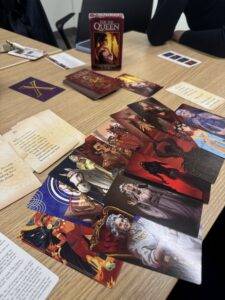
While my teammate Jinhyo appreciated the distinctive qualities of each art style, I was left sincerely frustrated by the lack of visual coherence. “Is that Queen Elizabeth?” I remember asking out loud. Why would a likeness of the real Queen Elizabeth II be thrown into a deck with a demon queen or a queen that looks a lot like an Indian goddess? Also, this queen served no real purpose in gameplay – she was mostly decorative.
Laying out the rules – why were there so many and why did each step need to be printed on a separate card? Maybe it seemed like a playful idea to the designers, to keep the consistency of the rest of the prompt cards (ironic that now they think about consistency), but this was just plain excessive, especially for a game that boiled down to drawing prompts and answering them. The simplicity of the gameplay was not reflected in the environment.
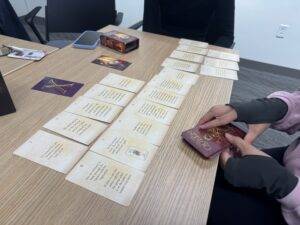
Overall, For the Queen was more of an interview or a thinking exercise than a fun, co-op story-telling game. It’s more a model of what we might want to keep out of our game – we want to encourage role-playing, imagination, and dynamic interaction, but not at the cost of creative burnout. In addition, it would be better to introduce a point system and unpredictability that players approach as hurdles that give them structure to their stories.