
The Resistance is a social deduction game designed by Don Eskridge for 5–10 players with a duration of around 30 minutes. The game targets audiences of both friends and strangers, and can be played both digitally and with cards. In this critical play analysis I aim to compare and contrast The Resistance with our self-designed game The Golden Ark in the class of CS247G.
Both our social deduction game The Golden Ark and The Resistance share the same fundamental mechanic of mission execution and team proposal, share a similar dynamic of misdirection and accusation, and differ in aesthetic as our game highly emphasizes the investigation of hidden identity and adversarial conflicts within teams.

The two games share some basic rules in their winning mechanism. Through team proposal and public votes, the good and evil teams must ensure the majority of tasks are completed to their alignment. Similarly, both games allow evil players to know their comrades at the start of the game, enabling them to collaborate secretly and steer the direction of conversations. In the Resistance playtesting, what was fascinating to me was the unequal information and uncertain identity. As a player on the good team, I was torn between the different rhetorics of players. I enjoyed the formal element of conflict — in this case a social and epistemic one — where it is purely based on trust and truth. Argument and persuasion are the weapons. The boundaries of the game are also a particularly ingenious addition to the game experience: the Resistance can never directly verify anyone, mission cards are played face-down, and no good player can ever be 100% certain of another’s identity.
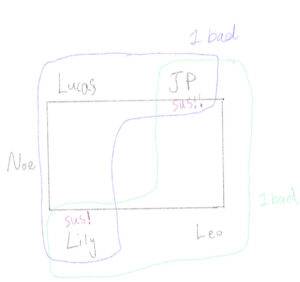
In my game experience, the two failed missions overlapped an evil player between me and another player. This is when the scarcity of resources comes into play. In The Resistance, there are no tokens, presentable cards, or other physical assets. The sole source of information is knowledge. Therefore, when my rhetoric and logical reasoning were not persuasive enough, the evil team beguiled my teammates and won the last mission by strategically playing for the long run. Particularly, JP as the spy played a success card in the early rounds to gain our trust, which served as false resource information for the good team.
In our game, we reduced the number of missions to three instead of five and introduced more complex mechanics. In particular, we have an investigation process that could serve as a critical resource beyond trust alone. A player may investigate one person per round in exchange for one of their vote tokens, which is then discarded. The investigated player places their identity card and one decoy card in an envelope and passes it to the person investigating them. Additionally, we have two good roles that may sink the boat — the elephant and hippo, if they occur on the same mission — to give the evil team natural camouflage.

Under this game setting, the magic circle becomes more strategic and deduction-based compared to The Resistance, which is more socially focused. The good side must carefully deduce each player’s identity down to the specific roles they hold, rather than merely good or bad. Meanwhile, the bad team must conceal their identity, lie carefully, and cooperate closely with their partner. In comparison, this gives good players greater capability and higher engagement with the deduction process without putting bad players in an impossible position to win. We also evoke the aesthetic of sensation through scarce resources of gold nugget tokens that players can spend to vote for a ship. The tokens are physically tangible, engaging the pleasure of handling real objects.
The mechanics of The Golden Ark thus create a different aesthetic from The Resistance despite sharing a similar fundamental winning basis. While The Resistance emphasizes paranoia, discovery, and narrative, The Golden Ark has a more fellowship twist, as collaboration is essential — players must look carefully to examine who is on their side.