Game Analyzed: Don’t Get Got
Creator: Big Potato Games
Platform: Physical party card game (in-person)
Target Audience: Social/party game players (ages 14+), medium-to-large groups
Our game concept is a social party game where players attempt to get others to unknowingly complete hidden objectives. Each player holds multiple hidden “missions,” such as getting someone to say a specific word or perform a certain action, while rotating question cards prompt discussion designed to help players get to know each other. This overlaps with Don’t Get Got, which also revolves around secret objectives and social manipulation. However, the two diverge in a fundamental way: Don’t Get Got is a passive, long-form deception experience, while our game reframes hidden-objective play into an active, conversation-centered system emphasizing constant interaction and social discovery.
At the mechanical level, Don’t Get Got gives players several missions (typically six, aiming to complete three) that can be attempted over an extended period. This creates a dynamic where players operate independently, waiting for the right moment to subtly execute a task but also introduces long stretches of downtime. I played this game with my roommates over the course of 24 hours and we wrote our own pool of missions to draw from since we didn’t own the game. One of my roommate’s missions was “Get another player to look at something on your computer for 30+ seconds.” During dinner, she mentioned designing a MATLAB app and asked me for coding advice because she is not a CS major. The next day, she texted me asking me to come to her room to help debug it, and I unknowingly completed her mission (16 hours later). This highlights how the extended time horizon enables subtle, delayed setups where success depends on patience rather than interaction.
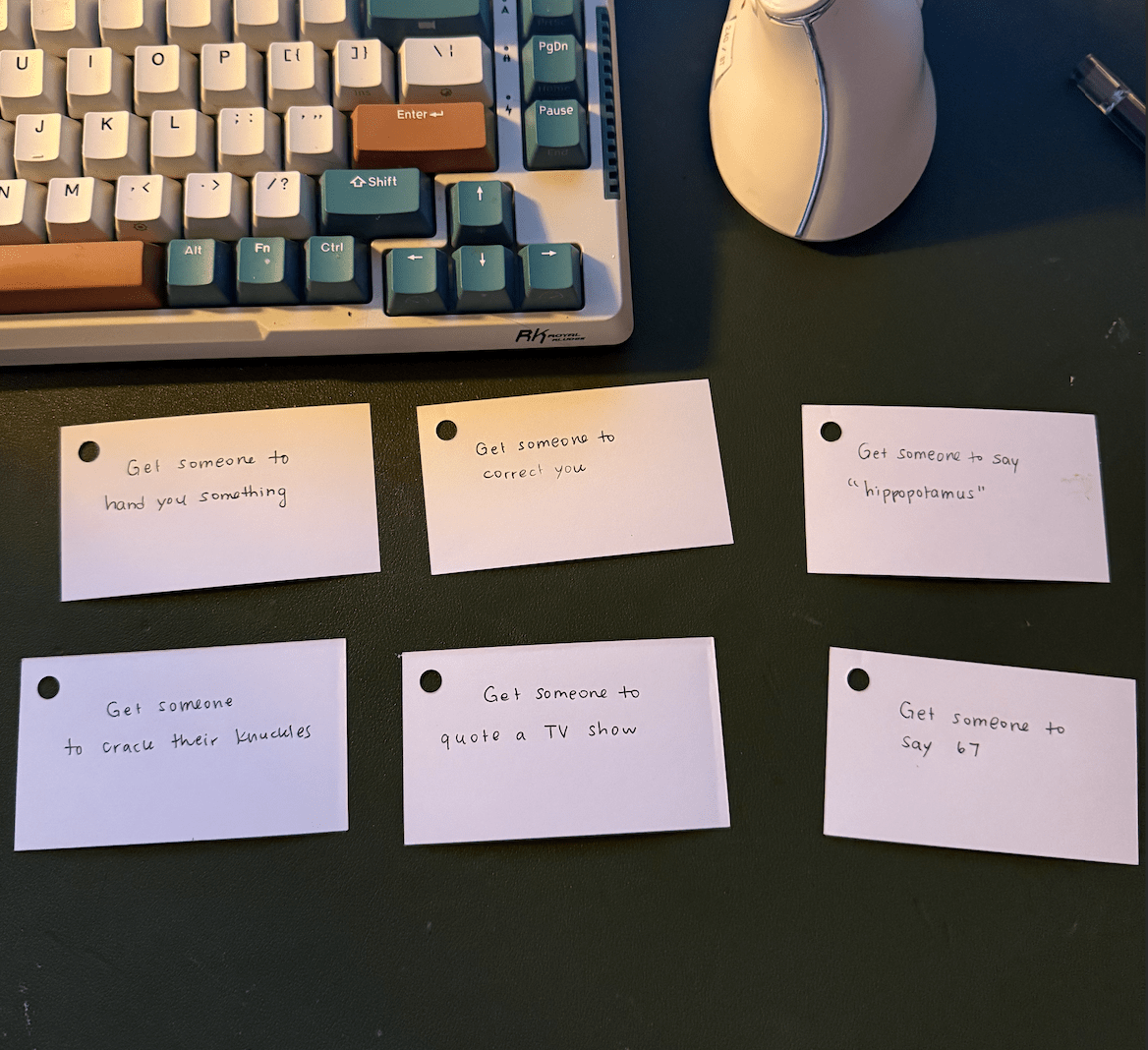
Photo: My six secret missions
In contrast, playtesting our game felt immediate and interactive. During one round, we responded to the prompt “What food would you eat for the rest of your life if you had to?” This sparked a lively discussion while players simultaneously attempted missions like getting someone to “point at something” or say the word “decade.” Unlike Don’t Get Got, multiple objectives were pursued within the same conversation. I tried steering discussion toward time spans (“I’d get bored after a decade of eating hot pot over and over…”) to fish for the word “decade”. Another player pulled up photos of his chosen food on Google to try to get people to point at them. This created overlapping strategy layers within a single moment, keeping everyone engaged.
This difference stems from a key design choice: structured, rotating question prompts that ensure constant interaction. Instead of waiting for opportunities, players actively create them by embedding objectives into conversation. Another evolution is giving players three missions at once, replacing each as completed. Inspired by Don’t Get Got, this prevents stagnation and encourages opportunistic play. Players continuously evaluate which mission fits the current conversational context, increasing agency and decision-making dynamism.
Through the MDA framework, these differences produce distinct experiences. Don’t Get Got creates dynamics of patience, subtlety, and delayed payoff, producing long-con satisfaction. Our game produces rapid improvisation and constant opportunism, resulting in continuous tension and frequent “gotcha” moments.
Another contrast lies in the purpose of social interaction. In Don’t Get Got, interactions are often purely for the purpose of deception. For example, another mission one of my roommates had was “Get another person to repeat what they said.” She initiated a normal conversation with me while I was cooking lunch, and once the stove and fan were on (making the room loud), she asked, “What are you cooking?” I responded “ahi tuna steaks,” and she followed up with “sorry, what was that?” prompting me to repeat myself and complete her mission. This interaction demonstrates how conversation in Don’t Get Got can function purely as a tool for deception.
Our game, by contrast, is intentionally designed to foreground social connection. The question cards prompt discussions about preferences, experiences, and opinions, encouraging players to genuinely engage with one another. This shifts interaction from being purely strategic to both strategic and relational. Players are not just trying to win, they are also learning about each other and reacting authentically. This dual purpose creates a richer social dynamic, where meaningful conversation and gameplay are intertwined.
Compared to other games in the genre, this approach stands out. Headbanz (trying to deduce what word you have on your forehead) rely on hidden information but lack deception, focusing instead on guessing. Verbal Assassins (a game I ran for a summer camp the past summer where you “eliminate” other students by getting them to say a specific word) incorporates word-trigger mechanics but lacks structured conversation. Our game combines these elements but distinguishes itself by making conversation the central system rather than a supporting feature.
That said, Don’t Get Got highlights potential pitfalls. Its strength is subtlety. It’s fun because actions unfold over time. Our game risks losing this if players become too explicit in pursuing objectives.
I also think that the design of question prompts is a critical constraint in our game. Prompts that are too vulnerable or emotionally deep may not fit well, because the game always contains an element of strategic manipulation and “trying to get each other out,” which can feel uncomfortable if players are simultaneously expected to open up in a sincere way. Instead, prompts should encourage social interaction without requiring emotional exposure that can be exploited. For this reason, I want to design prompts that are fun, slightly unhinged, and conversation-driving rather than personal or reflective. They should spark engagement and creativity without relying on generic formats like standard “get-to-know-you.”
Ultimately, both games explore hidden objectives and social manipulation, but they operationalize them differently. Don’t Get Got works as a slow experience rewarding patience. Our game transforms that foundation into a faster, more interactive system emphasizing continuous participation and meaningful social interaction, where every moment is active and strategically meaningful.