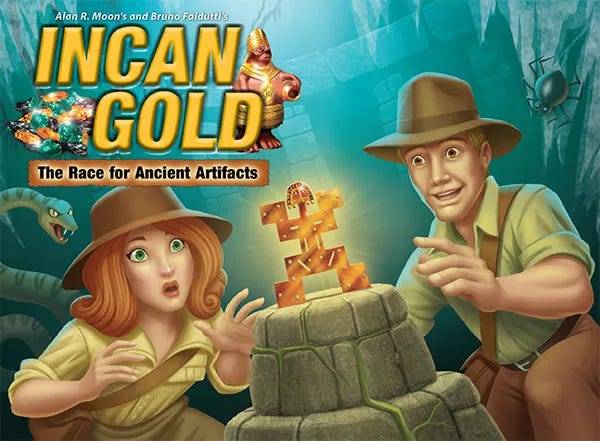
This week I chose to write about Incan Gold, a luck-based multiplayer card game designed by Alan R. Moon and Bruno Faidutti and published by Schmidt Spiele in Germany (originally under the name “Diamant”), before an English-language edition was published in 2006 by Sunriver Games. It has a fairly young target audience of ages 8 and up, and is meant for 3-8 players. I personally played it with 6 players. Its gameplay is adequately described in one sentence by TA Ryan: “This is a gambling game!”
In Incan Gold, you and your competitors are Meeples looking for treasure in the Incan Temple, which has 5 chambers total. Each turn, you choose to either leave or stay in the chamber you’re in: leaving meaning you safety return with the treasure you gathered, staying meaning you could collect even more treasure, but risk losing it all at the same time as your excursion in each chamber is forcibly ended if two of the same “hazard” cards are drawn. Some prisoner’s dilemma flavoring is added to the gameplay as if you leave alone, you collect all of the treasure gathered during the trip, but if you and other players leave in the same turn, you are forced to split the spoils.
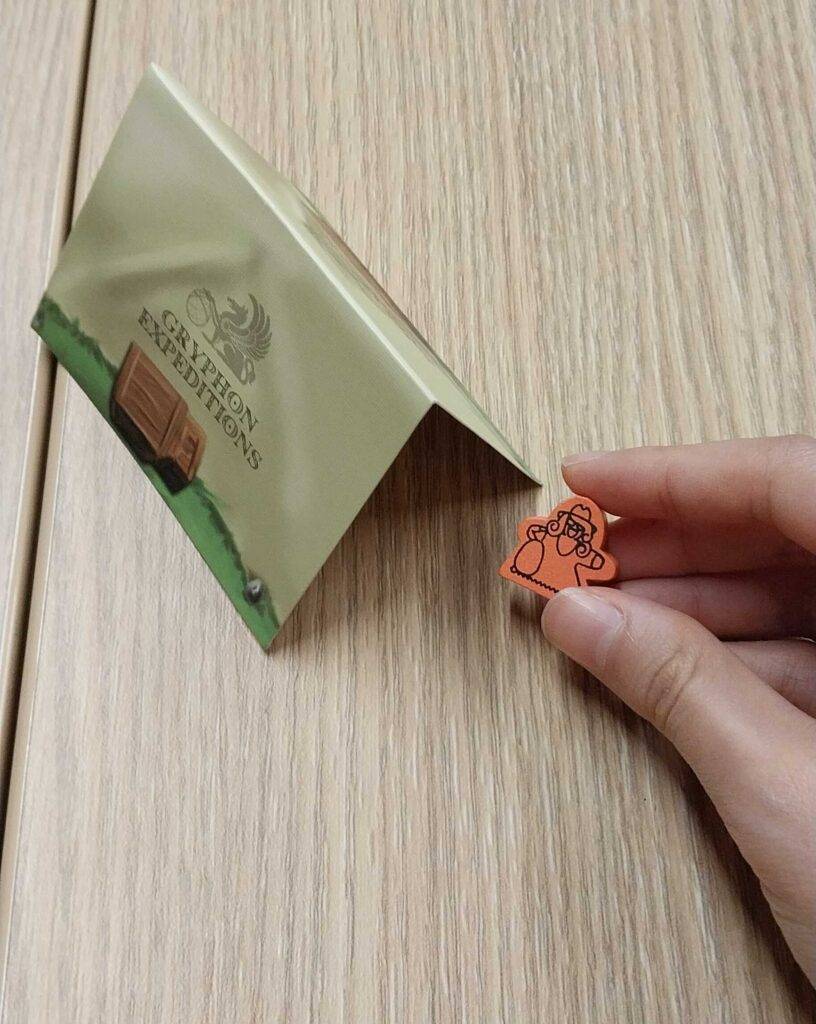
Mechanics-wise, there are some similarities between Incan Gold and The Shrimp Game (my group’s game). Both games are multilateral free-for-all games with currency systems where some currencies are more valuable than others (big/mid/small shrimp vs turquoise/obsidian/gold) and where the win condition for both games is related to the amount of currency each player has at the end of the game. There’s also a fantasy aspect to both games. Though each game’s theme is quite different, with one being exploring an Incan Temple and the other being about silly sea creatures, there’s a certain goofy feeling to both games. This feeling is aided in Incan Gold by the addition of the “Meeples”, which are each player’s character tokens (see Fig. 1). There are also some similarities between the roles of the cards, with the hazard/reward card pile being especially similar to the action card deck of The Shimp Game as each card is important for either improving or worsening your position (in other words, a “risk element”.)

Incan Gold and The Shrimp Game are also different in several ways: you can’t exchange currency with one another in Incan Gold in contrast to The Shrimp Game, there’s much less of a “gambling” aspect in The Shrimp Game, and there are no asymmetrical roles in Incan Gold. However, those are just mechanical differences. The real differences lie within the dynamics and aesthetics of each game.
The two most important differences of the two games are: the rhetorical “main opponent” of the players, and how the type of fun fellowship is evoked. In Incan Gold, while the players are technically competing against one another to get the most money, one component rises in hostility above all: the fictional environment of the game. The prime determining factor of if you’ll win or lose is literally luck: will you by chance get two hazard cards in a row, or will you strike treasure time after time after time? The fact that you are mainly interacting with the game’s environment also fundamentally affects the how fellowship shows up throughout the game. The sense of fellowship created is not necessarily a result of in-game discussion between you and the other players, but is instead created through reaction, especially in response to each other’s choices.
For example, as our group was playing, a great sense of comedic absurdity connected us as we saw Ryan continually choose to stay in the chamber rather than leave. This meant that after two full playthroughs of the game, he had accrued no money at all (see Fig. 2). Another example of when this connection comes through is group reactions to collective events, like if an absurd number of hazard cards come out or the whole group is exterminated at once. In the Shrimp Game on the other hand, a player’s definitive competitors are the other players. While there are still some frustrations that may come out of the game’s fictional environment (like maybe drawing a card that makes you give some of your shrimp away), the primary goal is to outsmart the other players while talking and trading with them. This also affects the mode of fellowship, which as a result is a much more straightforward talk-to-each-other kind of fellowship.
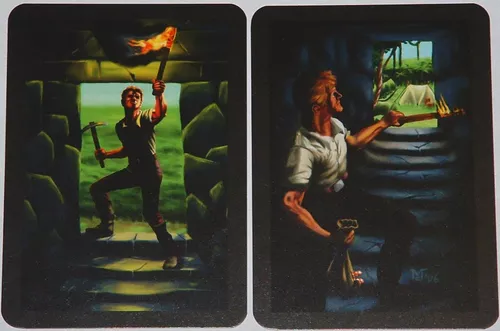
Overall, I found Incan Gold very enjoyable. It’s fast-paced and entertaining enough for my Instagram Reel dehydrated brain, and the hit of adrenaline before the card flips over to be a hazard or reward evokes the great standard of good old fashioned gambling. It also feels very unique from other games similar to its genre, like Uno where luck is a big factor. The only notable critique I have of the game are of the stay and leave card designs, which lack any labels and being fairly similar in content/color scheme (see Fig. 3), leading to some false votes and confusion during my playthrough. Playing the game has taught me that even if superficial elements of two games may seem similar (like The Shrimp Game and its currency system), the dynamics and systems of play may turn out to be very different!