Game / Platform: One Night Ultimate Werewolf (ONUW) / Tabletop Analog
Game Creator: Though there’s an official game developed at Bézier Games by Tes Alspach and Akihisa Okui we played an improvised version with playing cards, set up by Sabrina.
Target Audience: We played with 8 players but I believe it can be 3-10 players. Fast-paced social deduction game with no player elimination.
Both ONUW and my team’s concept (Accomplices & Alibis / Séance) both eliminate player death and rely on hidden roles, but they diverge on, as of now, one critical axis—ONUW uses collective memory as its only truth-tracking mechanism while our concept introduces a physical Shared Notebook—creating externalization of memory. Playing ONUW made me more confident in our notebook mechanic’s potential to be tweaked and actually solve a real problem: in pure memory-based deduction, confident liars can overwhelm the group before anyone fact-checks them.
ONUW targets casual game night groups who love Werewolf/Mafia but hate sitting out after death. By compressing the game into a single night phase and eliminating player elimination, it solves the boredom problem. My concept targets a similar audience but solves a different problem: how do you make social deduction work for players who struggle with pure bluffing? The Shared Notebook gives them a concrete artifact to anchor their reasoning—a training wheel for the memory-impaired (like me)—and ensures that even timid/new players always have something to contribute. This addresses a core flaw in the formal elements of traditional social deduction games. In Mafia, the primary resources are speech and memory; if you’re quiet or forgetful, you have no other tools to fall back on. Our concept adds a new resource—Evidence Cards borrowed from Clue—which allows players to leverage logical deduction alongside social deduction. This shifts the aesthetic from pure Fellowship (who can you trust?) to a hybrid of Fellowship and Challenge (whose trust is warranted by what you can prove?)
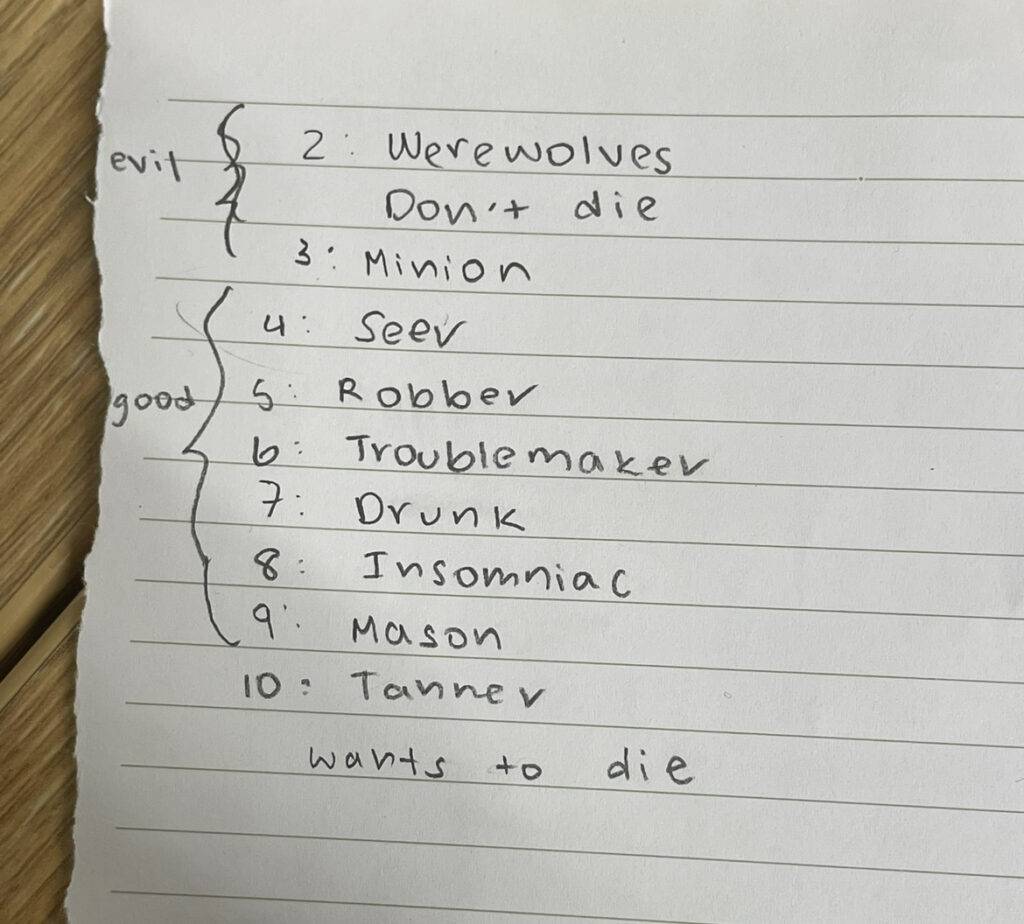
ONUW has nine roles in the base game, but you rarely use all at once. The modular design means the roles can be mixed and matched. This taught me something about my own concept. I had worried that five roles (Suspect, Spoliator, Sheriff, Scapegoat, Samaritan) were too many. But ONUW packs nine roles (all with individual actions) into a ten-minute game. The difference is that ONUW’s roles can operate as optional. My concept could borrow this modularity: a core set for beginners, and advanced roles for wanting groups. I see this as further addressing replayability issues.
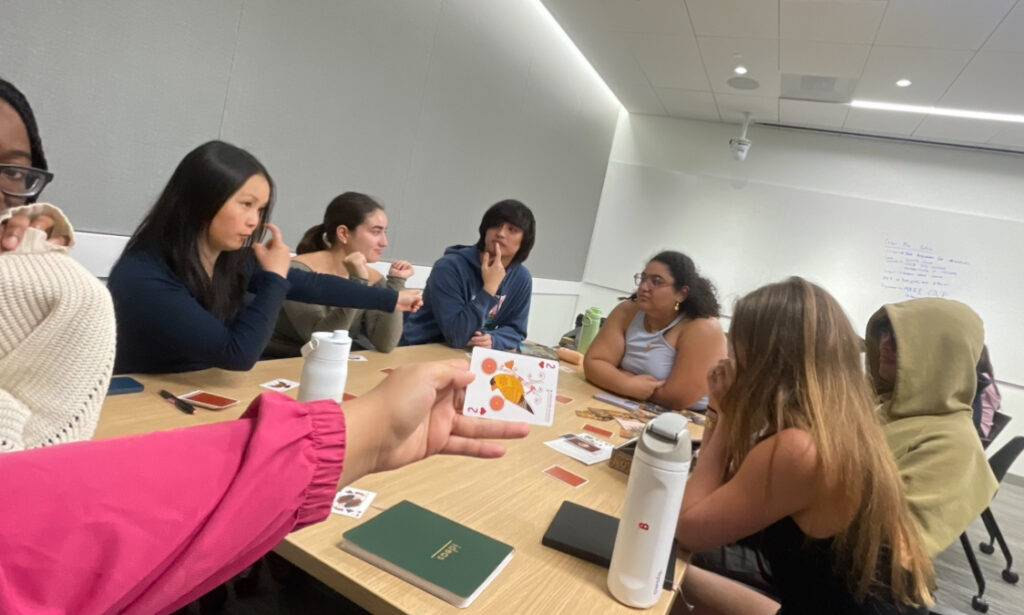
The most revealing moment in my playthrough came when I won as the sole Werewolf by lying about being the Troublemaker. I claimed I had “switched the cards back” of two players, a flat lie that contradicted the would have contradicted the truth. But because everyone was wrapped up in tracking their own roles, no one caught my inconsistency in real time. The discussion moved on, I pushed harder for the minion I was blaming. I won.
This would not have happened in our team’s game. Our shared notebook creates a physical record of clues. If I claimed something that contradicted the notebook, someone could point to it. The dynamic shifts from “who can talk the fastest” to “who can build the most coherent case.” The aesthetic becomes Challenge (logical deduction) layered on top of Fellowship (social trust). ONUW prioritizes Fellowship and Expression—the fun of performing a lie and getting away with it. Our concept adds Challenge, which may appeal to players who find pure bluffing anxiety-inducing. So far the comparison game makes me feel stronger about keeping our slower pacing mechanics even if they add some difficulty to the game. Difficult can still be good!
ONUW’s reliance on collective memory is a feature, not a bug—it keeps the game fast and low-overhead. But it also means confident liars dominate, or at least in my case, very lucky liars surrounded by many first time players. Maybe we could consider if a optional “Clue Token” that players could spend to force a fact-check—”I want to confirm what the Seer actually saw”—would be an improvement. This would give quieter players a tool without slowing the game.
Compared to The Resistance, ONUW is faster and more chaotic. Compared to my concept, it’s more accessible but less strategic. Our concept’s notebook adds bookkeeping, but that tradeoff may be worth it for groups who want a meatier deduction experience. The modular role system from ONUW—where the sort of “river” of extra cards creates asymmetric knowledge. A concept I’ve already isolated as something to push for and one we can see through with adapting. Having one extra Weapon and Room evidence card that no one holds, known only to the Sheriff, would create a quiet verification mechanic without solely needing and overly relying on the success of the Journalist Chip being maximally used—which we shouldn’t expect for any player to immediately know how best to utilize game mechanics.