The audience of Priorities is young adults, and is recommended for ages 14+. I played the game with two of my friends (for a total of 3 players) online on a platform called Orderly (https://orderly.games/play). Players and Dynamics share mechanics like guessing another player’s ranking. However, Dealbreakers add mechanics like relationship cards, cutoff lines, and individual scoring, creating very different experiences. Priorities is cooperative and playful, while Dealbreakers is competitive and revealing, showing how small mechanical changes can change a game’s dynamics, aesthetics, and magic circle.
Both games encouraged players to think from another person’s perspective. When my friend and I were unsure about two rankings, we asked the ranker questions like “What do you do on Fridays?” and “How often do you sing in the car?” but they refused and said “think about the way I would think about it,” similar to Dealbreakers. Players also relied on what they knew about each other’s personalities. For example, my friends guessed my rankings by saying “Siya loves to organize her desk” and “Siya is a slow walker, so if someone is slower than her that is a real problem.” Even with close friends, both games could be challenging. After seeing a ranking, I said, “I literally don’t know how I would rank this for you,” and my friend replied, “You have been living with me for 21 years.”
This evidence shows that Priorities and Dealbreakers are similar because they rely on similar formal elements. Specifically, in both games, people predict rankings, share the same procedures and materials like cards, and are rewarded for matching the ranker’s thinking. These mechanisms create the dynamics of social deduction. As a result, the challenge becomes knowing the other player through clues and what you know about their personality. The hidden ranking and guessing mechanics also create suspense and strategy as guessers try to make decisions with incomplete information. The revealing card mechanic may also lead to surprise which makes the game fun as people may discover new things about the person and feel challenged. Both games also create a strong magic circle where players might make guesses about each other’s values which they might not bring up otherwise.

We switched 2 and 3 even if we tried to ask questions about the person and get extra clues

Thinking like me helped my friends and they got a perfect score
One major difference between Priorities and Dealbreakers is cooperation versus competition. In Priorities, it was often hard to reach a consensus. For example, when deciding whether “Fridays” or “An Empty Gym” should be number 1, my friend said, “I will go with what you say because you know the ranker more.” As a result, some players participated less, and the game felt less like understanding the ranker’s perspective and more like a negotiation in which some opinions mattered more than others. Dealbreakers changes the formal elements of rules, players, and outcomes as each guesser has their own ranking and score. As a result, everyone sticks with their interpretation and participates equally. This creates different dynamics as players remain more engaged and defend their ideas. The competitive structure also creates stronger suspense and surprise as the guessers want to see who was closest.

My “number 1” guess ended up dominating because I knew having an empty gym was important to my friend
Although both games are collaborative, Priorities leaves less room for in-depth discussion. When explaining a ranking, players gave short comments like “I think you don’t like skinny jeans because you never wear them,” then ended with “that’s just the way I thought about the ranking.” As a result, rounds were much faster (2–3 minutes) than in Dealbreakers (5–6 minutes). My friends told each other, “it was really fun playing with you even if I don’t know you really well,” while Dealbreakers felt better suited to people who know each other closely. This may be because of differences in mechanics as Priorities use simple preference cards whereas Dealbreakers adds a Relationship Card and a “draw the line” mechanic, making the game more complex and leading to deeper discussions. Additionally, the themes and magic circles of the two games are very different. Priorities consist of broad tastes and everyday opinions, making the game feel playful and humorous. On the other hand, Dealbreakers is more personal and about relationships and values, shifting the game towards learning about peoples values which may insight deeper conversations.

Even though there was a huge difference with rankings, not a lot of insightful discussion emerged
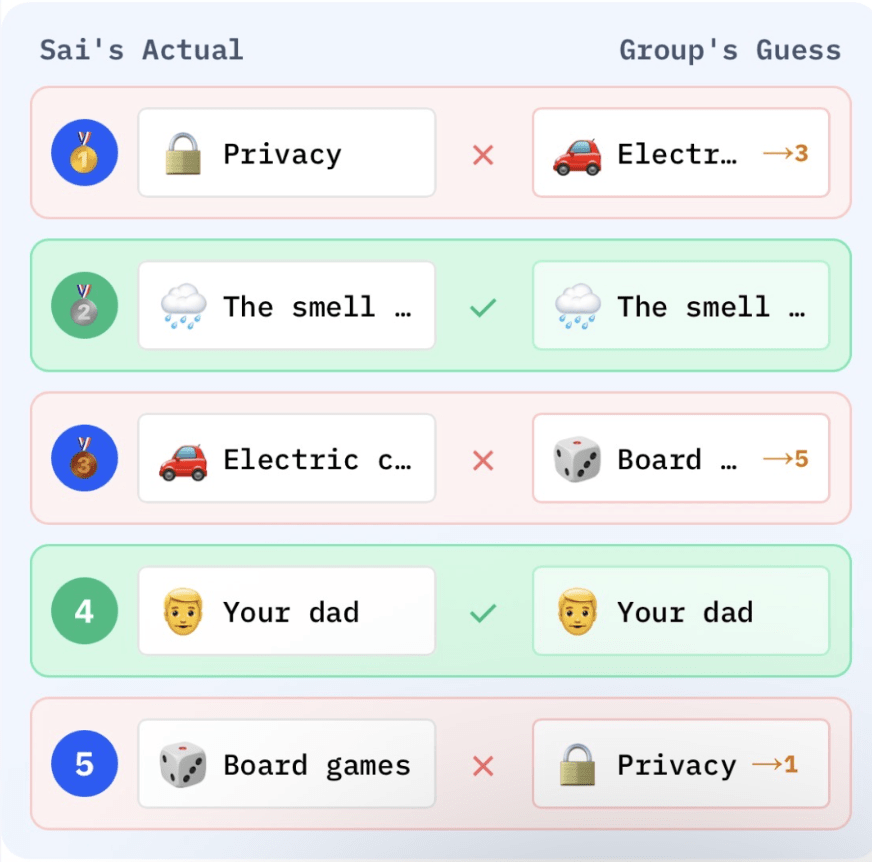
Priorities stands out because the challenge is guessing another player’s preferences, unlike games such as Wavelength, which focuses on communication, or Scattergories, which rewards creativity and quick thinking. However, this mechanic also creates ambiguity. For example, I interpreted “your dad” as the ranker’s dad, while another player thought it meant my dad. We also disagreed about whether “privacy” meant digital or physical privacy. One way to solve this is by making cards more specific like “your own dad” or “digital privacy”. There could also be a clarification rule where the ranker defines ambiguous cards in a sentence like “I’m thinking of privacy as digital privacy.” This is a problem that may come up in Dealbreakers as well and we have tried to solve it by making the cards more specific.

Guesses were not correct due to ambiguity
These differences show that even though Priorities and Dealbreakers have the same idea of predicting other people’s preferences, small changes to mechanic can change the game into a very different experience. Priorities becomes playful and cooperative whereas Dealbreakers is more revealing and competitive, showing how even a small change can alter a game’s dynamics and aesthetics.