Understanding the Mechanics of The Murder Game through Online Town of Salem
Town of Salem, originally created and published by BlankMediaGames and now owned and operated by Digital Bandidos, is an online social-deduction game targeted towards teens and young adults, though accessible for players aged 12 and above. The game hosts up to 15 players across 48 unique roles divided among three alignments: Town, Mafia, and Neutral. I played through several rounds in a browser-based session: the anonymity of the digital interface, timed discussion phases, and a reliance on a running chat log created an atmosphere defined entirely by language and inference. That atmosphere stood in sharp contrast to everything my team is building with The Murder Game, our in-person bluffing and whodunnit concept for 4–8 players ages 10 and up, and the gap between the two experiences is exactly where the most useful design insights live.
My central argument is this: both Town of Salem and The Murder Game use information asymmetry as their core mechanical engine, but where Town of Salem distributes that asymmetry across a large cast of competing roles mediated entirely through text, The Murder Game concentrates it into a single theatrical act- the Victim’s clues. Thus, making deception not just a social negotiation but a narrative performance. That difference is both The Murder Game’s greatest strength and its most important unresolved design challenge.
The Game Exposed My Assumptions About How Deception Works
I think of myself as someone who can hold multiple competing ideas/theories at once and stay flexible under pressure. Town of Salem tested that almost immediately. Playing as an Investigator in classic mode, I built what I thought was an airtight case against a Mafioso based on visit logs and behavioral patterns in chat. The Town ignored me, lynched a confirmed Town member, and I was killed that same night. The problem wasn’t my logic- it was that in a game mediated entirely by text, logic without social capital is invisible. Nobody knew me. Nobody trusted me. And I had no way to make them.
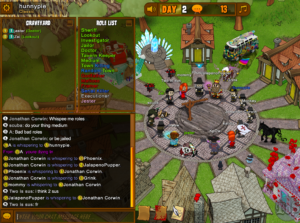 Gameplay mechanisms – chat, village backdrop (location), role list, graveyard

Me getting executed by the townspeople as the Investigator
That experience clarified something essential about The Murder Game. Because our game is physical and in-person, trust and social capital already exist before a single card is drawn. Players know each other’s faces, voices, and nervous habits. The Killer cannot hide behind a username. In Town of Salem, the challenge is manufacturing credibility from nothing in a crowded text thread; in The Murder Game, it’s maintaining a performance in front of people who already know you. One demands rhetorical skill, the other demands theatrical nerve- fundamentally different experiences that satisfy the same underlying psychological needs through entirely different means.
Town of Salem satisfies Power through vote control, Achievement through reaching your faction’s win condition, Affiliation through covert coordination between aligned players, and Information through the accumulation of night results and behavioral reads. The Murder Game maps onto those same four needs differently. Affiliation isn’t sustained through a private chat channel; it’s created in the charged, silent moment when the Killer taps the Victim on the shoulder while everyone’s eyes are closed. Information isn’t gathered from a log of night visits; it’s embedded in the clues the Victim leaves behind. A one-time, irreversible communication the Killer cannot intercept. The need is the same. The experience of satisfying it is nothing alike.
Visual Design: Object, Placement, and Territory
Town of Salem uses a muted colonial New England aesthetic- dark palettes and gothic atmosphere to evoke paranoia. Its role cards are text-heavy, and territory is primarily informational: a town grid where players occupy named houses but only physically move to and from their residences.
The Murder Game operates differently on every axis. Its object design communicates role hierarchy through color before a word is read- the Killer cards’ red signals danger, the Witness cards’ blue signals duty, and the black Victim card signals sacrifice. Placement is where the physical separation from Town of Salem is most substantial: players line up, the Victim steps forward alone, and the Killer moves through shared space with everyone’s eyes closed- choreography that feels ceremonial, echoing the formal accusations of medieval justice. Territory is the resulting crime scene, an active puzzle authored by the Victim, rather than Town of Salem’s graveyard, which is simply a record of who lost.
What Does Town of Salem Reveal About The Murder Game?
In Town of Salem, death is final, and eliminated players spectate from the graveyard. With 15 players, that’s manageable. In The Murder Game’s 4–8 player format, it’s a real problem. The most emotionally rich role in the game cannot also be its most passive one.
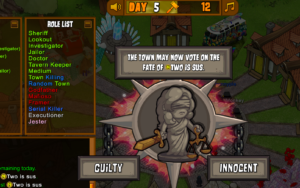
Voting process in Town of Salem (web version)
Our team’s solution is the iterative accusation- if Witnesses vote wrong, the accused reveals their innocence and becomes the next Victim. Elimination stops being a dead end and becomes the next dramatic beat. The wrongly accused doesn’t leave the story, they become its next chapter. This also raises an ethical dimension the game earns through its design- the wrong person condemned, the real killer still free, justice perpetually deferred. That’s not just a compelling loop, it’s a structure that asks players to sit with the discomfort of collective failure, something Town of Salem, with its final graveyard and passive spectatorship, never demands.
I believe that Town of Salem’s greatest strength is also its most revealing limitation. It distributes information asymmetry across 48 roles and nights of accumulated evidence- a sprawling architecture that ultimately keeps players at arm’s length. The Murder Game collapses all of that into a single moment. One Victim. One crime scene. One set of clues that has to say everything. That concentration is not a design constraint, it is the design. And it is precisely what makes these two games, despite sharing the same mechanical DNA, feel like entirely different arguments about what deception between people can look like.