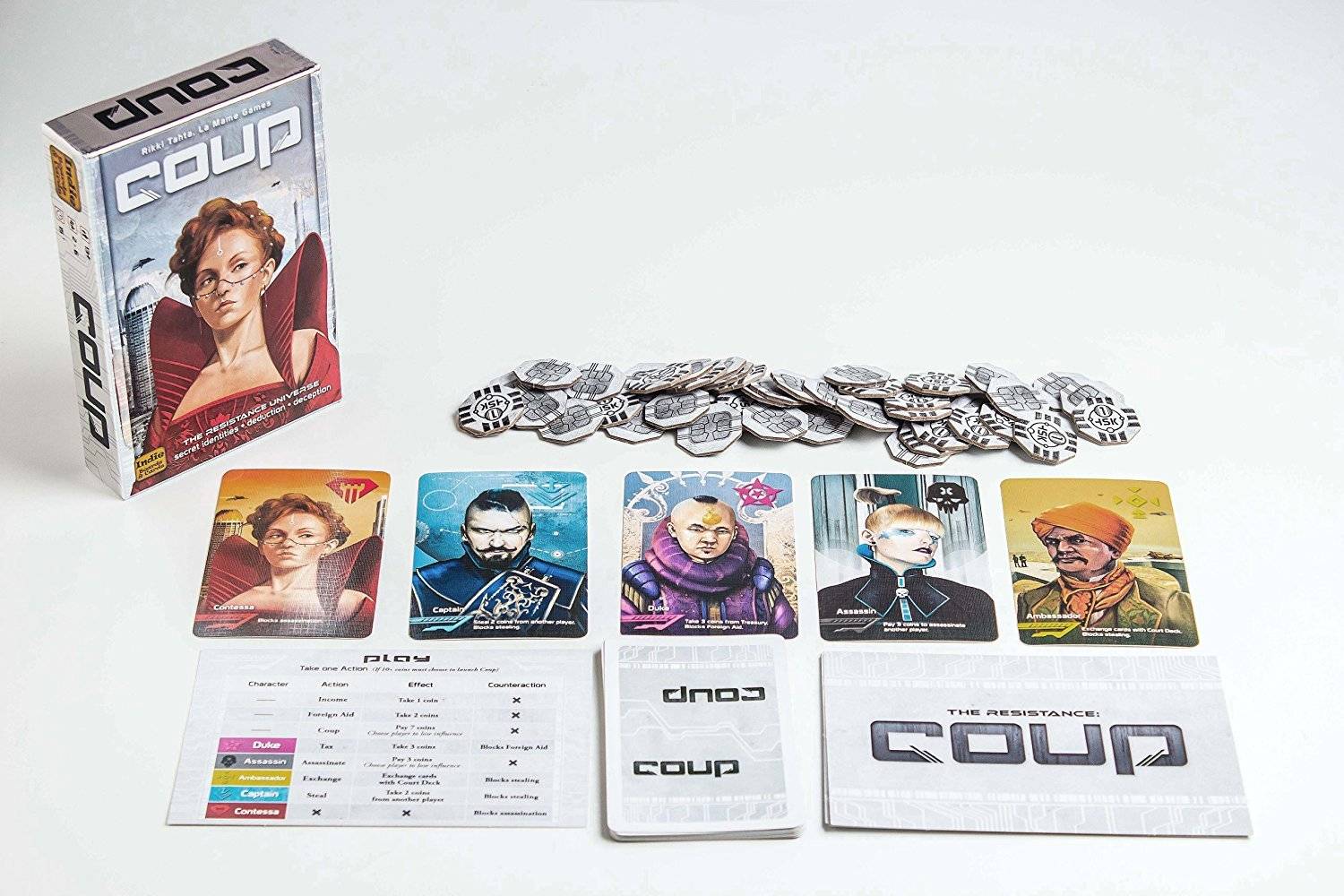
Coup is a 2–6 player social deduction game of deception and political power. The target audience is anyone who is 10 and older. The board and digital game was created by Rikki Tahta. Players are secretly dealt two character cards from five possible roles: Duke, Assassin, Captain, Ambassador, and Contessa, each with unique abilities. A player wins by eliminating every other player’s influence through bluffing, challenging, and spending coins on actions. The last player with at least one remaining influence card wins.
Coup and our team’s game, Collective, share the same ideas in hidden roles, a coin economy, and the threat of elimination, but they are fundamentally different in purpose. Coup is a game about individual survival dressed in political clothing. Collective is a place where wealth and actions determine your identity. Playing Coup made those differences hard to ignore, and understanding them clarified exactly what Collective is trying to do that Coup doesn’t.
The game overlaps in the coin mechanic. Coup’s formal elements include hidden role cards, a shared coin pool, actions, 7 coins to launch a Coup, and 3 to assassinate. In Collective, the same logic applies but with a slight twist. A player is allowed to audit a player’s hidden stack with 8 coins, and eliminate someone with costs 16. Both games treat coins not just as a resource but as social information. Spending big tells the table something about your intentions, even when exact totals stay hidden.
Hidden information is the other major similarity. In Coup, your two role cards stay hidden from the other players. During one of my sessions on Board Game Arena, Cardinal8 declared mid-game: “I literally have a Contessa.” I called bluffed almost immediately, “I have a Contessa and seeeeeeeel had one earlier, you do not have one.”
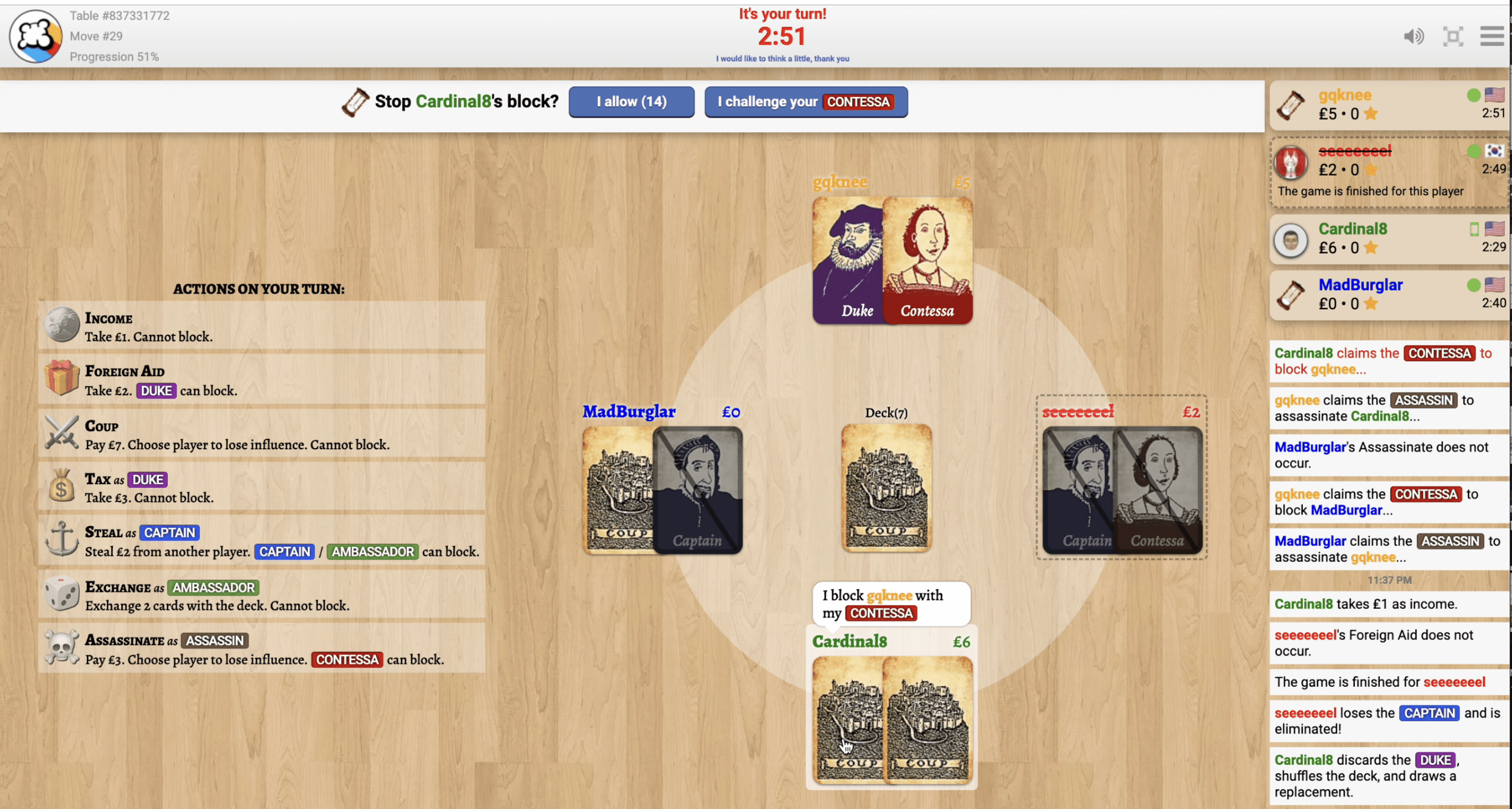
This moment showed the core deduction in Coup. It is not about what cards you have, but what people believe you hold. Collective replicates this through hidden coin stacks, nobody knows how wealthy anyone is unless they spend 8 coins to audit, mirroring the way Coup players must risk influence just to extract information. However, collecting coins can cause suspicion for the player in Collective.
From an MDA perspective: these mechanics, hidden information, coin gating, and the threat of being challenged, creates a dynamic of suspicion and risk-taking in both games. The aesthetic that emerges is fairly the same such as, paranoia, uncertainty, and the satisfaction of reading someone correctly before they read you.
At the beginning of the game (round one, first turn), seeeeeeeel said that “not gonna lie imma challenge all of yall.”
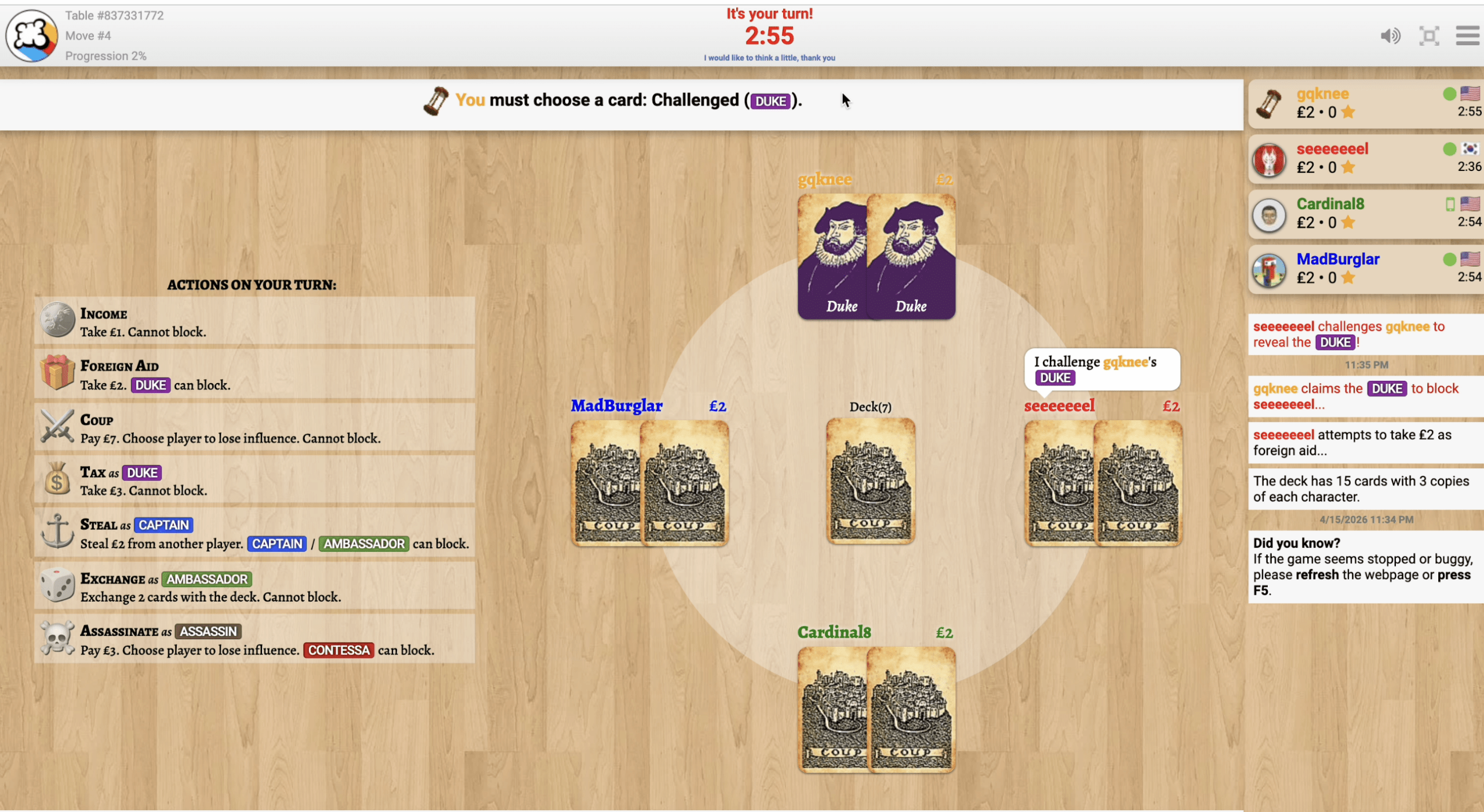
The picture depicts me blocking his tax with my Duke card. Usually players wait to gather information before challenging. Seeeeeeeel challenged my block in the first round, which caught me off guard. That aggression works in Coup because challenges are completely free, but at the cost of your role card. Both Coup and Collective reward social reading, not just mechanical play.
The game differs in that Coup’s win condition is to be the last person standing. Collective has four possible endings, Capitalists win by passing 4 policies or by one player privately holding 15 or more coins. Socialists win by passing 4 policies or ensuring no player holds more than 4 coins. These dual win conditions make Collective a little more complex, but also significantly harder to balance for us designers.
The policy system is another contrast that does not live in Coup at all. In Collective, a rotating chairman draws 3 policy cards and selects 2 for the table to vote on. Players then secretly bid coins on the policy they want to pass. The policy with the higher total bid passes, and spent coins flow into a central bank redistributed through future policy effects. That auction mechanic makes every vote an economic commitment versus in Coup, you either take an action or you don’t. In Collective, how much you spend communicates what your role is. This fundamentally different dynamic gives other players more behavior to read and misread.
Team structure is another major difference. In Coup, everyone is an enemy. Collective assigns Capitalists and Socialists as hidden roles, but with an asymmetry: Capitalists secretly know each other, while Socialists have to deduce who the other socialist are. The deception in Collective is slightly more complex because it operates inside a team structure, not just between individuals.
One area where Coup outperforms Collective’s current design is stakes. Elimination in Coup is permanent. Collective’s bail-out mechanic, where another player can donate coins to save someone eliminated, keeps players engaged. However, this could potentially lead to elimination action in Collective to not be as useful. As a team we would have to discuss the cost of reviving an eliminated player. Collective is the intersection of Secret Hitler and Coup’s economic tension. Coup showed me what a tight coin economy looks like and for us, we need to draw inspiration from them for Collective.