

Wavelength is a getting-to-know-you game that was published by CMYK games and can be played either online or using the real-life game set, which includes the specialized game board and wheel and a deck of spectrum cards. The game is similar to my team’s game, Dealbreaker, in that a key mechanic in both games involves asking players to guess how one of their teammates interprets different concepts relative to one another. In both games, this creates a dynamic in which players try to understand how their teammates think and learn more about them with each reveal, creating fun through challenge, discovery, and fellowship. At the same time, the games’ intended audiences differ, as Wavelength can be played successfully with players who know each other well or who are more casually acquainted, whereas Dealbreaker is designed for people who know each other well and have a higher degree of existing intimacy.
Procedurally, Wavelength is similar to charades, in that players are divided into teams and score points as a team. During each team’s turn, one player from that team will draw a card, on which is printed two extremes, such as “Clean ↔ Dirty.” This player then provides a hint, naming something that falls on a particular place along the spectrum, before adjusting the game’s built-in wheel so that the point-scoring slices of the wheel are centered around where the player thinks their hint falls on the spectrum. The wheel is then covered, and it is the objective of the player’s team to place the game’s built-in needle where they think their teammate would put their hint; points are then awarded based on how close their guess was. One of the main challenges of the game, as well as one of its most clever components, is the inherent subjectivity of the prompts. For instance, during one of my turns, my teammate drew a card, shown in the first image, with the continuum “Bad person ↔ Good person” and gave the hint “Judas Iscariot,” an answer that proved more challenging than it first seemed due to my teammate’s religious beliefs. Cards like this are especially clever in that they utilize the differences in players’ perspectives; how I would interpret the prompt is irrelevant, and the only thing that matters is how this player thinks. This mechanic forces players to suppress their own egos and examine the hints from their teammates’ perspective, creating fun through the challenge of guessing, as well as through fellowship and discovery as players learn more about their teammates.

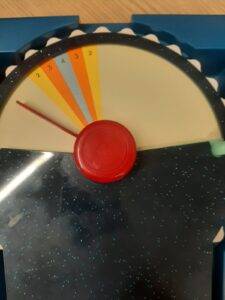
This is the main pleasure of the game, and is similar to the intended dynamic of my team’s game, Dealbreaker, although in our game, our guessing mechanic is different in that players must discretely rank several prompts relative to one another, rather than placing a single hint of their choosing on a continuous and abstract spectrum. This continuous spectrum was one of my issues with Wavelength’s mechanics, in that the hint and guessing systems are very “vibes-based.” As shown in the second image, the game’s wheel is largely unmarked except for the slices that award points. This led to a number of ambiguous situations in which the needle was right on the boundary between point values, something that I think could have been fixed if the developers had discretized the wheel in some way, such as by giving it pegs or other physical barriers that make these ambiguities physically impossible.
The other key difference between Wavelength and Dealbreaker is in the content of the cards and how this reflects each game’s target audience. The cards in Wavelength are intentionally vague, which is clever, because it allows players to make their responses as personal or impersonal as they choose, making the game a more casual experience that works with a broader range of group dynamics. Dealbreaker, on the other hand, contains cards that are meant to reveal a person’s deepest held values and how they distinguish the tolerable from the intolerable. This can increase the sense of fun through fellowship, as it can enhance feelings of intimacy and trust between friends, creating an emotionally deeper experience than that provided by Wavelength, but it also makes the game less accessible to casual players. Thus, while the games are mechanically similar, our game is intended for a narrower audience with deeper interpersonal ties.
Wavelength is, overall, a fun, broadly appealing game with a novel mechanics and assets. Similarly to last week’s game, We’re Not Really Strangers, this game can help increase familiarity among players, although Wavelength also has the advantage of still mostly feeling like a guessing game, making it more accessible while still helping players grow closer as they play.