*recreated gameplay screenshots using G rated cards
For this critical play, I chose to play Cards Against Humanity, a fill-in-the-blank card game created by Max Temkin and Ben Hantoot, with some old friends from high school (albeit, we used this website instead due to distance constraints). I chose Cards Against Humanity due to it having similar game mechanics to our P1 Project ‘On Display,’ a drawing game in which players must draw a masterpiece (with constraints and limited time) in response to a prompt. They then pitch their artwork to a player known as the curator, convincing them why their art best reflects the prompt. The curator then chooses a winner, the role switches, and the cycle repeats!
Cards Against Humanity’s primary prompt/response card mechanic incentivizes players to learn about their group in order to have a winning advantage. Each round, one player is chosen to be a ‘Card Czar,’ who both reads the prompt and chooses the winner for the round. This type of multilateral competition creates a dynamic where players are encouraged to decode the personality of the Card Czar in hopes of getting an edge against other players. This results in players becoming socially and emotionally invested into the game, trying to tailor the ‘funniest’ response for a particular player/group. I definitely experienced this within my own friend group, as I’d begin to save responses that I know would get greater reactions from one Czar rather than another. Much of the fun in Cards Against Humanity comes from this expression and fellowship, along with the spontaneity and randomness of possible cards. This is a mechanic we want to keep in our P1 project: having 1 prompt card per round that everyone responds to, competing against one another to respond in the ‘funniest’ way.
Cards Against Humanity’s mechanic of choosing only one winner, however, can become demotivating as player counts get larger. Since the game supports groups up to 20 people, it can be difficult for all players to feel as though they are succeeding in the game. Even in smaller groups, it can be disheartening if one player hasn’t won a round and can see others’ amass more points. And as each round only has 1 winner (and 1 point given), these players can be convinced to believe they have no chance of winning if their opponents are much farther ahead, lowering their overall satisfaction.
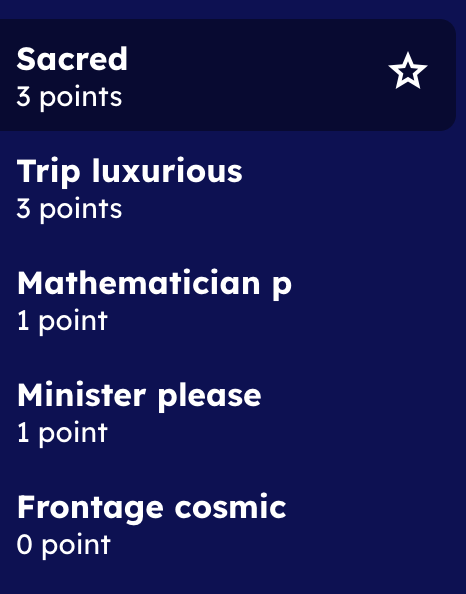
Frontage cosmic would need to win three rounds in a row to catch up to the top players.
While having a winner is important to add stakes and purpose to a game, we also think that there should be additional ways for other players to earn points so as to still have a fighting chance at winning. Thus, we are experimenting with having 1st and 2nd place winners that our curator will choose, allowing for multiple players to feel a sense of accomplishment for their efforts.
I found that Cards Against Humanity doesn’t actively encourage NEW relationship building through its major premise and mechanic. The game provides very vulgar, oftentimes offensive cards for players to use. This, alongside the Card Czar mechanic and following dynamic, means that players will often be placing very outrageous and questionable cards to elicit the strongest reaction from the Card Czar. This plays into the player’s sensual needs to laugh and joke, which produces the engagement and entertainment for the players. There is nothing inherently wrong with this: the game is rated 17+ after all. However, a major part of friendship making is to NOT engage in such risky trust building too early. Cards Against Humanity challenges social desires for reciprocity by creating an environment where learning other’s moral characters can be unpredictable. Players lack a ‘magic circle’ to enter: they seemingly play as themselves, unlike other social games like Mafia where you play as a ‘villager’ or the ‘mafia.’ These two aspects of the game combined result in a game where building NEW friendships can be difficult: it can be difficult to separate a player’s responses from that player’s character if you are meeting them for the first time through the game. As such, our P1 project tries to avoid including prompts that are especially vulgar and/or surround sensitive topics so as to produce an engaging experience that does not entirely rely on shock value to be enjoyable. On the other hand, the risky trust building present in Cards Against Humanity is also crucial in DEEPENING pre-existing friendships. We hope that by keeping drawing prompts especially vague that we can still leave an avenue for close social groups to engage in this trust building if they so desire.
I also found that having predetermined responses for players could also limit player expression, lowering player satisfaction. Players are only allowed to have 10 response cards at all time, which creates a dynamic where players consider which cards they think is best to play in one round or to save for another. As such, part of the fun that arises is from the challenge of working with what you are handed to create something memorable. However, my group often reached a point where we all had no cards that were particularly interesting to us, which awkwardly interrupts the player experience. The website had some built-in mechanics to address this issue that I found very helpful (see below).
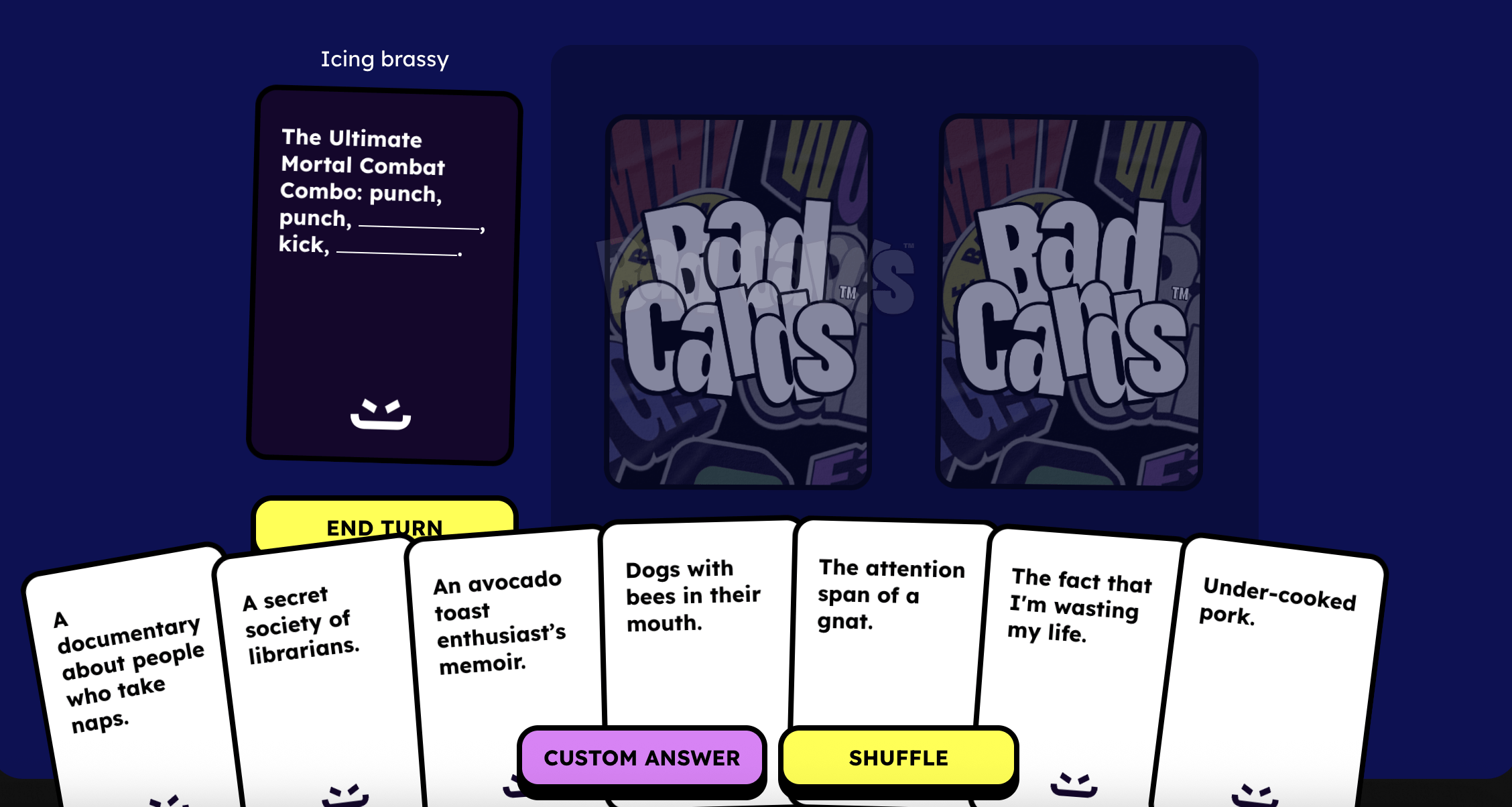
In our P1 project, by replacing response cards with player-made drawings, we hope that players can have more freedom in exactly what they want to articulate. In order to keep the challenge aspect that contributed to player engagement, we added ‘Challenge’ cards to constrain player drawings in unique ways while also giving artists and non-artists alike a more equal opportunity to win.