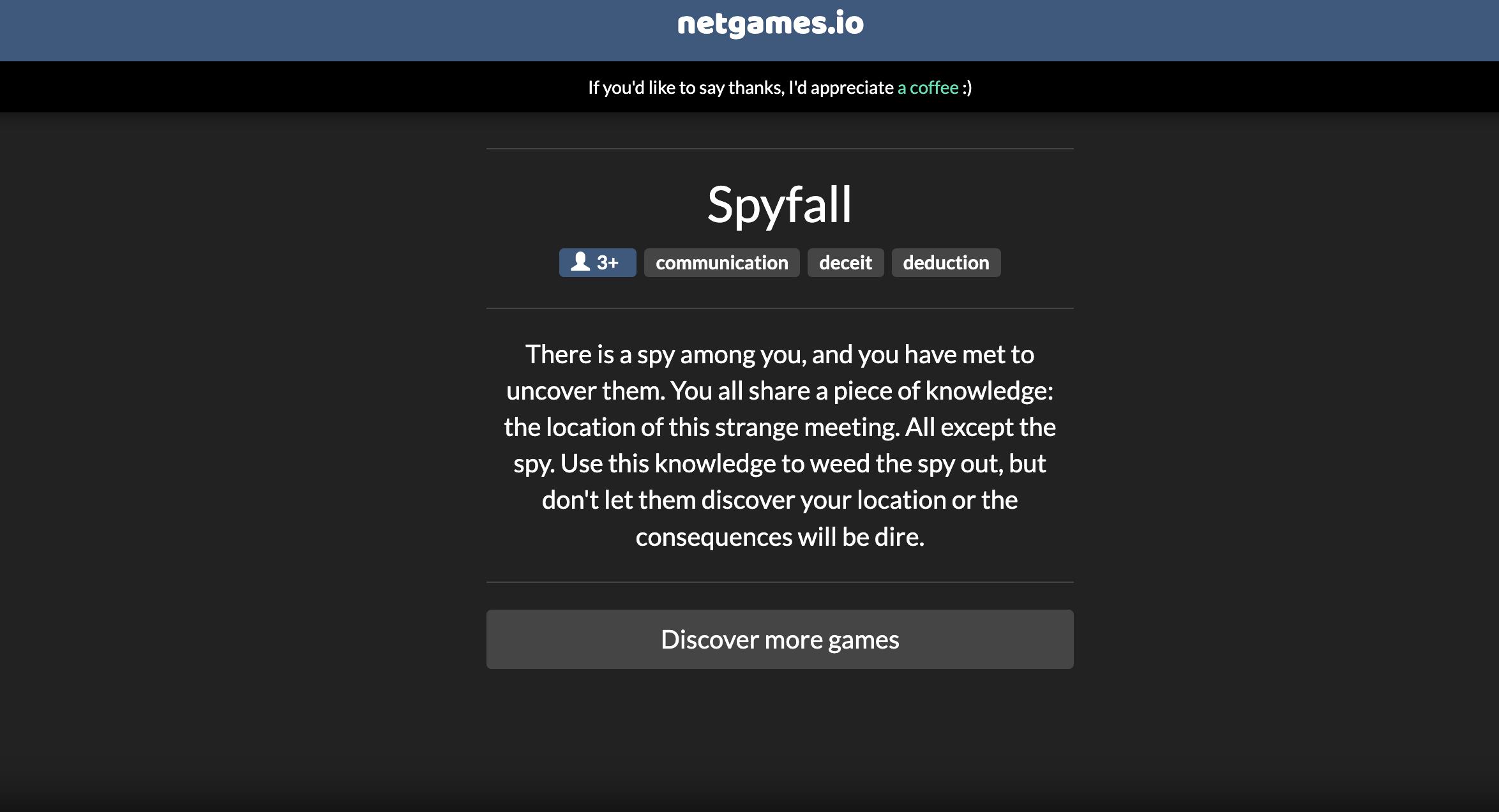
When our team began developing Blind Spot, Spyfall was the first comparison that came to mind. Designed by Alexandr Ushan and published by Hobby World in 2014, Spyfall is a social deduction party game for 3 to 8 players. I played it on netgames.io, a browser-based version of the game. At first glance, Spyfall seems very close to our concept: both games are built around conversation, hidden information, and the tension of saying the wrong thing at the wrong time. But after actually playing it, I realized that Spyfall concentrates pressure on one person, while Blind Spot distributes that pressure across the entire table.
That difference matters because it changes the emotional shape of play. In Spyfall, all players except one receive a location card. The remaining player, the Spy, does not know the location and must bluff through a round of questioning without being identified. Other players try to confirm shared knowledge without making the location too obvious. The formal elements are simple and effective: one hidden role, one shared information set, clear objectives for each side, and short rounds that create immediate tension. The mechanics are easy to learn.
But the dynamics are uneven. Only one person is truly under pressure. The Spy has to improvise, decode the conversation, and project confidence. Everyone else may feel cautious, but they are not equally vulnerable. Non-Spy players can often stay safe by speaking vaguely and waiting for someone else to take the risk. The game is tense, but the tension is concentrated rather than shared.
That is where Blind Spot diverges. In our game, every player wears a Forehead Card they cannot see and holds a Mission Card that tells them to make someone else perform a specific forbidden action. Each round also begins with a Topic Card that forces the group to discuss something and reach consensus under time pressure. The result is a very different structure of uncertainty. In Spyfall, the central question is, “Can the Spy hide long enough?” In Blind Spot, the question becomes, “Am I doing the thing that will get me caught?” Instead of one outsider bluffing against a group, every player is simultaneously a target and a threat.
The MDA framework helps make that difference clearer. The mechanics of Spyfall create a dynamic of asymmetrical suspicion: one player lacks information while the others share it. The dominant aesthetic is social tension mixed with performance. Blind Spot, by contrast, creates distributed uncertainty. Because players do not know their own forbidden behavior, they begin monitoring themselves in real time while also trying to manipulate others. The resulting aesthetic is not just deduction, but self-doubt, which is something Spyfall does not produce.
One playtest made this especially clear. A player with the Forehead Card “No Nodding” became so focused on suppressing the behavior that they turned stiff and unnatural halfway through the round. That odd behavior made the person next to them laugh, which immediately caused a second violation because that player’s own forbidden behavior was “No Laughing.” In a few seconds, one player’s attempt at self-control triggered another player’s failure. This kind of chain reaction shows one of the most promising features of Blind Spot: tension does not stay isolated. It spreads. In Spyfall, only the Spy is fighting their own behavior. In Blind Spot, any slip can destabilize the whole table.
Compared with other games in the genre, Spyfall sits near games like Werewolf and Secret Hitler, which also rely on a hidden minority facing an informed majority. What makes Spyfall stand out is speed. It removes the moderator, reduces the rule overhead, and turns social deduction into a compact conversation game. That simplicity makes it a useful reference point for Blind Spot. Our game also aims for short rounds, accessible rules, and strong table talk. However, Blind Spot differentiates itself by rejecting the hidden-minority structure entirely. There is no safe majority and no single suspicious outsider. In a sense, everyone is the Spy.
Playing Spyfall also revealed a weakness in our own design: replayability. Spyfall benefits from a large set of locations that continually reshape the conversation. Our Topic Cards serve an important structural role because they force players to engage rather than stay silent, but the current set is still limited. Over repeated sessions, the conversations could start to feel familiar. Expanding the Topic Card pool is the clearest improvement because it would make each round feel less predictable and keep the social tension fresh.
There is also an ethical dimension to this comparison. Games like Spyfall and Blind Spot depend on social pressure, deception, and the possibility of embarrassment. That can be funny and exciting, but it can also exclude quieter players or make some people uncomfortable. In that sense, Blind Spot both improves on and intensifies the genre. It improves on the usual “everyone gangs up on one liar” structure by distributing vulnerability more evenly, but it also places every player under scrutiny. That means the design has to be careful: penalties should stay playful, prompts should encourage engagement, and the mood should feel chaotic in a fun way rather than socially punishing.
What Spyfall ultimately showed me is that Blind Spot should not imitate classic social deduction too closely. Its strongest idea is not hidden roles alone, but hidden behavior. Spyfall puts one player under a spotlight and asks the rest of the table to expose them. Blind Spot turns that spotlight outward and inward at the same time. Everyone is watching everyone else, but everyone is also suddenly unsure of themselves. That is the part of the design worth keeping.